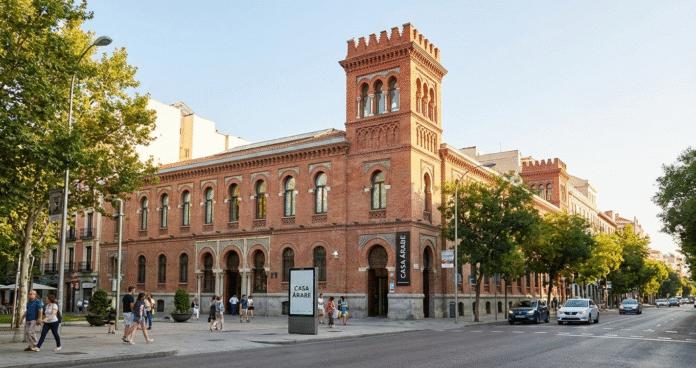
Walk along Calle Alcalá near Retiro Park, and you’ll spot a striking Neo-Mudéjar building that looks like it stepped straight out of the 19th century. The red brick tower rises 37 meters high with intricate details, catching your eye among the more modern buildings around it. This is Casa Árabe, and it’s one of Madrid’s most fascinating – yet surprisingly overlooked – cultural institutions.
I’ll be honest: most travelers rush past this beautiful building on their way to Retiro Park without giving it a second glance. Big mistake. Inside this historic gem, there’s a world of Arab culture waiting to be discovered, from cutting-edge contemporary art exhibitions to language courses, film screenings, and one of the most charming gardens in central Madrid.
Whether you’re into art, history, architecture, or just looking for a peaceful escape with excellent cultural programming, Casa Árabe deserves a spot on your Madrid itinerary.
The Building: A Neo-Mudéjar Masterpiece
Let’s start with the building itself, because it’s absolutely stunning. Originally constructed in 1886 as the Escuelas Aguirre (Aguirre Schools), this architectural gem was the vision of philanthropist Lucas Aguirre y Juárez, who wanted to create an innovative educational space for Madrid’s children.
The architect Emilio Rodríguez Ayuso (who also co-designed Madrid’s old bullring) created something truly special. The Neo-Mudéjar style – which blends Spanish and Islamic architectural traditions – feels perfectly appropriate for what the building has become. The design incorporated cutting-edge features for its time: a gymnasium, library, school museum, playground, music hall, and even a meteorological observatory in that iconic tower.
Walking around the exterior, you’ll notice the intricate brickwork, decorative tiles, and horseshoe arches that give the building its distinctive character. The tower, with its clock faces and glass-enclosed mirador at the top, is particularly striking. It’s one of the few Neo-Mudéjar buildings left in Madrid, making it architecturally significant beyond its cultural importance.
The building has recently received official recognition as a Bien de Interés Cultural (Asset of Cultural Interest), Spain’s highest level of heritage protection. It’s about time – this place is a treasure.
What Is Casa Árabe?
Casa Árabe was established in 2006 as an institutional consortium to strengthen relations between Spain and the Arab world. Think of it as a cultural bridge – a place where Spanish and Arab cultures meet, interact, and learn from each other.
The institution operates two headquarters, one here in Madrid and another in Córdoba (another Spanish city with deep Arab heritage). It’s supported by Spain’s Ministry of Foreign Affairs, the Spanish International Development Cooperation Agency (AECID), and various regional and municipal governments.
But here’s what makes Casa Árabe special: it’s not a dusty, academic institution or a tourist-trap cultural center. It’s a living, breathing space where contemporary Arab culture is showcased, debated, and celebrated. The programming is current, relevant, and genuinely interesting – whether you’re an expert on the Arab world or just curious to learn more.
What You Can Experience at Casa Árabe
Art Exhibitions
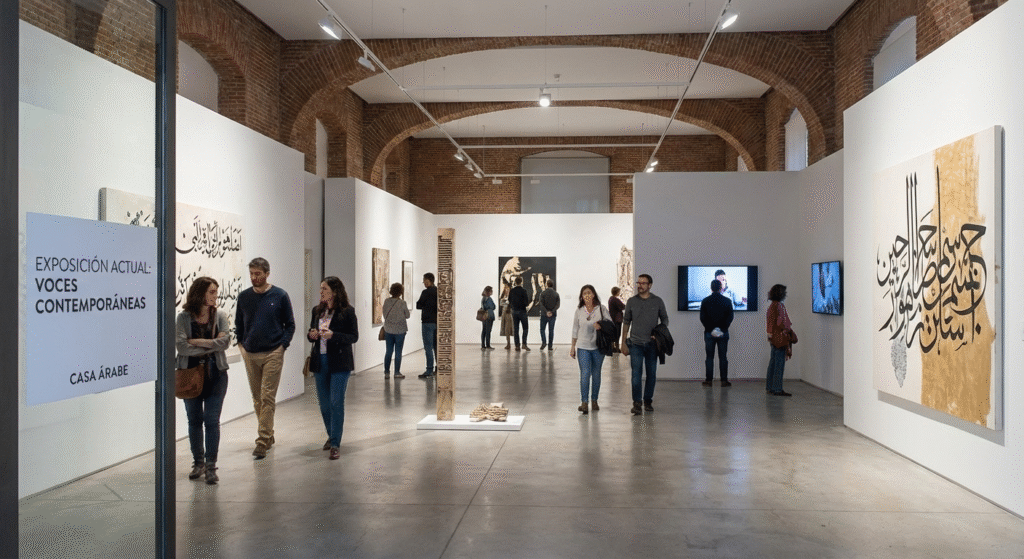
The exhibition spaces at Casa Árabe host some of Madrid’s most interesting contemporary art shows, and they’re all free to visit. The focus is on Arab artists – both established names and emerging talents – working in photography, video art, installations, calligraphy, and mixed media.
Recent and current exhibitions include shows on avant-garde Arabic calligraphy, Palestinian embroidery traditions, and Iraqi artists exploring themes of cultural heritage and tragedy. The exhibitions change regularly, usually every few months, so there’s always something new to see.
What I appreciate about the curation here is that it goes beyond stereotypical representations of Arab culture. You’ll see contemporary artists grappling with modern issues, experimenting with forms, and pushing boundaries. The work is thought-provoking without being preachy, beautiful without being merely decorative.
The main exhibition hall is spacious and well-lit, and there’s usually a smaller exhibition space featuring photography or more intimate works. Plan to spend at least 30-45 minutes if you want to properly engage with what’s on display.
The Arabic Language Center
Want to learn Arabic? Casa Árabe’s Language Center offers courses for adults and young people from age 13, plus special programs for children aged 3-12. They offer everything from beginners’ courses to advanced levels, and during summer months (June and July), they run intensive immersion courses in Madrid, Toledo, and Córdoba.
Even if you’re not ready to commit to a full course, they occasionally offer cultural workshops and taster sessions that give you a glimpse into Arabic language and culture. It’s a great way to go beyond tourist-level engagement with the culture.
Conferences, Films, and Cultural Events
The auditorium hosts a packed calendar of events throughout the year. We’re talking film screenings (documentaries and features from Arab countries), academic lectures, panel discussions, book presentations, and musical performances.
The “Aula Árabe Universitaria” lecture series collaborates with universities in Madrid, Córdoba, Granada, Segovia, Seville, and Toledo, bringing expert speakers to discuss everything from geopolitics to art history to social issues.
Most events are free, though some require advance registration. The programming is in Spanish (occasionally with English translation), so brush up on your language skills or be prepared to challenge yourself.
The Bookshop (Librería Balqis)
The ground-floor bookshop specializes in books about Arab culture, history, politics, and literature – many in Spanish translation, but also some in Arabic, English, and French. It’s small but thoughtfully curated, with everything from academic texts to contemporary novels to children’s books.
Even if you’re not buying, it’s worth browsing. The staff are knowledgeable and happy to recommend books based on your interests.
The Garden and Summer Terrace
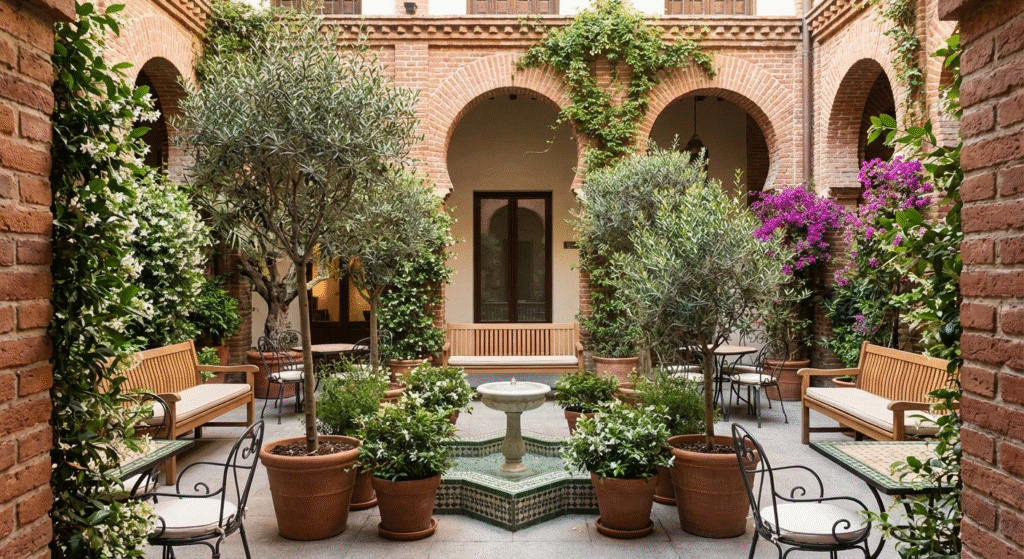
Here’s one of Casa Árabe’s best-kept secrets: the interior garden. This nearly 600-square-meter oasis is tucked away from the bustle of Calle Alcalá, offering a peaceful retreat with trees, plants, and seating areas.
During the summer months (typically June through September), the garden transforms into a terrace restaurant. You can enjoy summer cocktails, tapas inspired by Arab recipes, and live music in this beautiful setting. The restaurant has changed operators over the years, but the emphasis is always on quality Arab and Mediterranean cuisine.
The terrace project has a social mission too – recent iterations have employed refugees and migrants as part of integration programs, so your visit directly supports a good cause.
Even when the restaurant isn’t operating, the garden is accessible during opening hours and provides a lovely spot to relax between activities.
Practical Information for Visitors
Location and How to Get There
Casa Árabe is at Calle Alcalá 62, right next to the north entrance of Retiro Park in the Salamanca neighborhood.
Metro:
- Retiro station (Line 2) – 5-minute walk
- Príncipe de Vergara (Lines 2 and 9) – 8-minute walk
- Banco de España (Line 2) – 10-minute walk
Walking distance from:
- Retiro Park – literally next door
- Puerta de Alcalá – 5 minutes
- Prado Museum – 10 minutes
- Puerta del Sol – 15 minutes
Opening Hours
Exhibitions: Monday-Sunday, 10:00-20:00 (extended to 21:00 in summer) Closed: December 24, 25, 31, January 1, and throughout August
The rest of the building (library, offices, auditorium) has different hours depending on scheduled events. Check their website for specific program times.
Admission
Exhibitions: FREE Most cultural events: FREE (some may require registration) Language courses: Paid (check their website for current fees)
Yes, you read that right – the exhibitions and most events are completely free. There’s no catch, no pressure to buy anything. Just quality cultural programming accessible to everyone.
Accessibility
The building has been modernized inside and should be accessible for visitors with reduced mobility, though the historic nature of the building means some areas may be challenging. If you have specific accessibility needs, it’s worth calling ahead to confirm.
Time to Spend Here
- Quick visit (just exhibitions): 30-45 minutes
- Thorough visit (exhibitions + garden + bookshop): 1-1.5 hours
- With an event or film: 2-3 hours
It’s easy to combine with a visit to Retiro Park, the Prado, or the nearby Salamanca neighborhood for shopping and dining.
Why You Should Visit Casa Árabe
For art lovers: The contemporary Arab art exhibitions offer perspectives you won’t find in Madrid’s major museums. The work is challenging, beautiful, and often underrepresented in mainstream art institutions.
For culture enthusiasts: If you’re interested in understanding the connections between Spain and the Arab world (which run deep in Spanish history), this is the place to start. The programming goes far beyond tourist-level “coexistence” narratives to engage with real, current cultural exchanges.
For architecture buffs: The Neo-Mudéjar building is gorgeous and represents an important period in Madrid’s architectural history. The contrast between the historic exterior and modernized interior is fascinating.
For garden seekers: That hidden garden is a genuine oasis in central Madrid. If you’re tired of crowded museums and bustling streets, duck in here for a peaceful moment.
For families: The children’s language programs and occasional family-friendly events make this more accessible than you might expect. Plus, being next to Retiro Park makes it easy to combine educational activities with outdoor play.
For foodies (in summer): When the terrace is operating, it’s one of Madrid’s most pleasant spots for a meal or drink, with better food and more interesting surroundings than most touristy restaurants.
Beyond the Tourist Trail
Casa Árabe represents something increasingly rare in major European capitals: a serious cultural institution that’s not dumbed down for tourists but also isn’t intimidatingly academic. It’s sophisticated without being pretentious, educational without being boring, and welcoming without being cheesy.
The building’s history adds another layer of meaning. These walls have seen Madrid transform from a 19th-century city to a 21st-century capital, from Franco’s dictatorship to modern democracy, from a relatively homogeneous society to a multicultural European hub. The fact that a building originally designed to educate Spanish children now serves as a bridge to Arab culture feels symbolically perfect.
Current Exhibitions and Events
The programming changes regularly, so I won’t give you specific exhibition titles that will be outdated by the time you visit. Instead, check their website (casaarabe.es) before you go. They maintain an excellent online calendar with details about current and upcoming exhibitions, films, lectures, and events.
The website is in Spanish, but there’s an English version too. You can also follow them on social media for updates and photos of current exhibitions.
Tips for Your Visit
Check what’s on before you go: The exhibitions change every few months, so make sure there’s something currently showing that interests you.
Combine with Retiro Park: The proximity to Retiro makes this an easy add-on. Do Casa Árabe first (especially on hot days – it’s air-conditioned), then head to the park.
Visit during an event: Check if there’s a film screening, book presentation, or lecture during your visit. Even if your Spanish isn’t perfect, the experience of attending a cultural event here adds depth to the visit.
Don’t rush: Unlike some of Madrid’s blockbuster museums where you’re fighting crowds and sensory overload, Casa Árabe rewards slow, contemplative engagement. Take your time.
Explore the neighborhood: The Salamanca neighborhood around Casa Árabe is worth exploring – elegant streets, high-end shopping, excellent restaurants, and beautiful architecture.
Summer terrace: If you’re visiting June-September, check if the garden terrace is operating. It’s a magical spot for an evening drink.
Photography: Check the exhibition rules, but generally photography is allowed in the galleries (without flash). The building itself is definitely photo-worthy.
A Few Final Thoughts
In a city packed with world-class museums and cultural attractions, Casa Árabe might not make the typical “Top 10” lists. And honestly? That’s part of its charm. This is a place for curious travelers who want to dig a little deeper, who appreciate that Spanish culture has been profoundly shaped by its Arab heritage, and who enjoy discovering spaces that feel authentic rather than packaged for tourists.
The building alone is worth the visit – that Neo-Mudéjar architecture is simply beautiful. But it’s the programming that makes Casa Árabe special. Where else in Madrid can you see cutting-edge contemporary art from Iraqi or Palestinian artists, attend a lecture on Arabic calligraphy, browse books about Maghrebi literature, and sip mint tea in a hidden garden, all in one place?
If you’re spending more than a couple of days in Madrid, I’d strongly encourage you to add Casa Árabe to your itinerary. Check what exhibitions are on, maybe catch an event if the timing works, and definitely peek into that garden. You’ll leave with a richer understanding of Madrid’s cultural landscape and probably a new appreciation for the depth of connections between Spanish and Arab cultures.
Plus, you’ll have found one of those “I discovered this amazing place” spots that make travel memorable. The kind of place you’ll enthusiastically recommend to friends, preferably with that slightly smug satisfaction that comes from knowing about somewhere genuinely special that most tourists walk right past.
Frequently asked question:
Q: What is Casa Árabe in Madrid? A: Casa Árabe is a cultural center promoting relations between Spain and the Arab world. It’s housed in a beautiful 1886 Neo-Mudéjar building and offers free art exhibitions, Arabic language courses, cultural events, and a peaceful garden.
Q: Is Casa Árabe free to visit? A: Yes! The art exhibitions and most cultural events at Casa Árabe are completely free. Only the language courses and occasional special events have admission fees.
Q: What are Casa Árabe’s opening hours? A: Exhibitions are open Monday-Sunday, 10:00-20:00 (extended to 21:00 in summer). The center is closed December 24, 25, 31, January 1, and throughout August. Event times vary – check their website.
Q: How do I get to Casa Árabe? A: Casa Árabe is at Calle Alcalá 62, next to Retiro Park. Take Metro to Retiro station (Line 2) for a 5-minute walk, or it’s 10 minutes walking from Banco de España.
Q: What can I see at Casa Árabe? A: You can visit contemporary Arab art exhibitions, attend film screenings and lectures, browse the specialized bookshop, take Arabic language courses, and relax in the beautiful interior garden. In summer, there’s also a terrace restaurant.
Q: How long should I spend at Casa Árabe? A: Plan 30-45 minutes for a quick visit to see the exhibitions, or 1-1.5 hours to also explore the garden and bookshop. If you attend an event or film, allow 2-3 hours.
Q: Is Casa Árabe worth visiting? A: Absolutely, especially if you’re interested in art, architecture, or culture. The Neo-Mudéjar building is stunning, the contemporary art exhibitions are excellent, and it offers perspectives you won’t find in Madrid’s major museums – all for free!

 15°C
15°C - Temperature
- Precipitation
- Rain Chance
- Wind
- Humidity
- Pressure