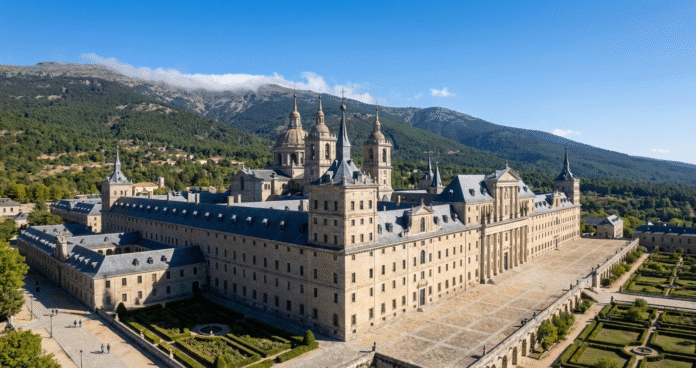
About 50 kilometers northwest of Madrid, built into the foothills of the Sierra de Guadarrama mountains, sits one of Spain’s most impressive monuments: the Royal Monastery of San Lorenzo de El Escorial. It’s massive, it’s severe, and it’s absolutely stunning.
If you’re spending more than a few days in Madrid, El Escorial should be on your day trip shortlist. This UNESCO World Heritage Site is one of Spain’s most important historical monuments, and it’s surprisingly easy to reach from the city. But it’s also complex, huge, and can be overwhelming if you don’t know what you’re getting into.
Having visited multiple times and talked to countless travelers about their experiences, I’ve learned what works and what doesn’t. So let me help you plan the perfect El Escorial day trip – the highlights to prioritize, how much time you really need, how to get there, and whether you should combine it with the controversial Valley of Cuelgamuros (formerly Valley of the Fallen).
Why Visit El Escorial?
El Escorial isn’t just another palace or monastery. It’s a statement of power, faith, and ambition frozen in stone.
King Philip II commissioned it in 1563 after Spain’s victory at the Battle of Saint-Quentin. He wanted a building that would serve multiple purposes: a royal palace, a monastery, a basilica, a library, and a mausoleum for his father, Emperor Charles V, and future Spanish monarchs.
The result is this extraordinary complex – austere yet magnificent, covering 33,000 square meters with more than 2,600 windows, 1,200 doors, and 16 courtyards. The architectural style, known as Herreran (after the architect Juan de Herrera), became a defining aesthetic of Spanish Renaissance architecture.
What makes El Escorial fascinating is the tension between its grandeur and its severity. There’s no excessive decoration, no frivolous ornament. Every element serves a purpose. It’s power expressed through restraint, which somehow makes it even more impressive.
Inside, you’ll find one of the most beautiful libraries in the world, a basilica with incredible acoustics, royal apartments that feel surprisingly intimate despite their setting, and the Pantheon of the Kings – one of the most unusual burial chambers you’ll ever see.
What You’ll See at El Escorial
The complex is huge, but the visitor route is well-marked and takes you through the most important areas:
The Royal Library (Biblioteca)
Start here if you can – it’s genuinely spectacular and often less crowded early in the visit.
The library hall stretches 54 meters long with a beautifully frescoed barrel-vaulted ceiling depicting the seven liberal arts. The frescoes, by Italian artist Pellegrino Tibaldi, are vibrant and wonderfully preserved.
But it’s not just beautiful – this was a serious scholarly library. Philip II collected more than 40,000 books and manuscripts, many of which are still here. Look at the wooden shelving holding ancient texts, scientific instruments, globes, and illuminated manuscripts.
The books are shelved spine-inward (the medieval way) to protect them from light damage. The library also pioneered a cataloging system that influenced libraries across Europe.
Photography is allowed here, but respect the space – these are priceless, irreplaceable treasures.
The Basilica
The church is the heart of El Escorial, both literally (it’s in the center of the complex) and spiritually.
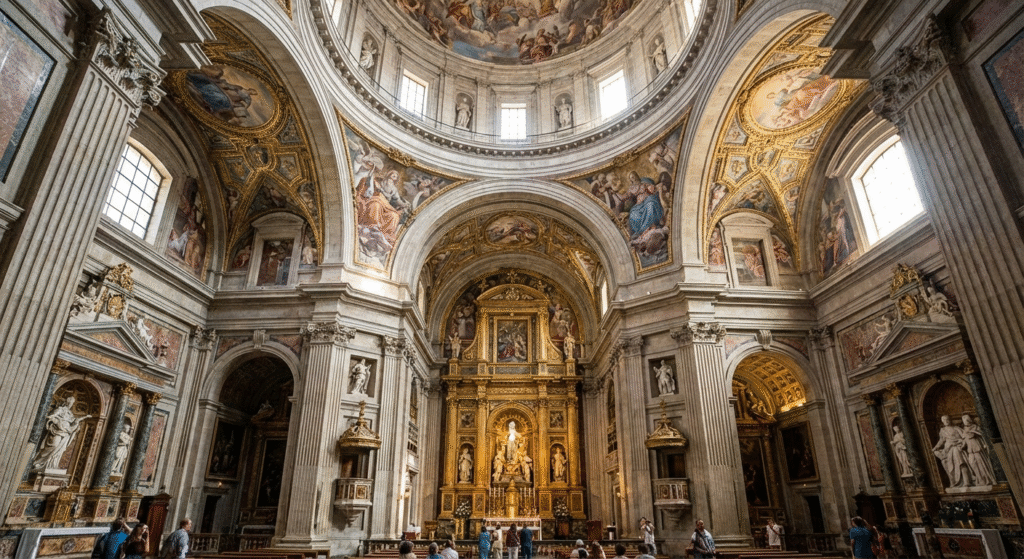
The interior is impressive: a soaring 92-meter dome, a massive altarpiece with jasper and gilt bronze, beautiful frescoes, and incredible acoustics. If you’re lucky enough to be here during a service or concert, the sound is extraordinary.
Look up at the dome and the frescoes depicting heaven – the attention to detail is remarkable. The basilica contains 45 altars, each with its own artwork and significance.
The royal family still uses this basilica occasionally for special masses and ceremonies.
Note: Sunday mornings, the basilica is used for services, which may affect visit access. Plan accordingly.
The Pantheon of the Kings (Panteón de los Reyes)
This is one of the most unusual spaces you’ll see anywhere.
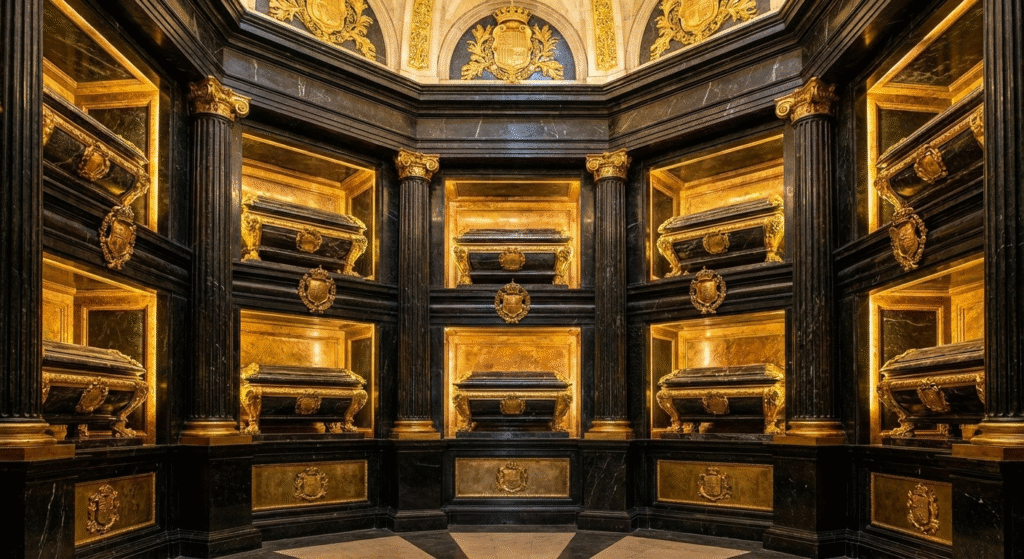
You descend stairs into an octagonal chamber beneath the basilica’s main altar. The walls are lined with gilded bronze and black marble sarcophagi containing the remains of Spanish monarchs and queens who were mothers of kings.
It’s simultaneously grand and claustrophobic, beautiful and morbid. The golden decoration against black marble creates an almost surreal atmosphere.
Nearly all Spanish monarchs from Charles V onward are buried here (with a few exceptions based on dynastic rules). When a monarch dies, their body spends 25-50 years in a waiting chamber (the Pudridero – literally “rotting room”) before being moved to their final sarcophagus.
It’s fascinating, but also quite sobering. This is a real burial chamber, not a museum display. Be respectful.
The Palace of the Habsburgs (Palacio de los Austrias)
Philip II’s royal apartments are surprisingly austere compared to what you’d expect for a king ruling one of the world’s most powerful empires.
The rooms are relatively small and simply decorated. Philip II’s bedroom is particularly striking – he could see the basilica’s altar from his bed, allowing him to attend mass even when ill.
The contrast between the simplicity of his personal quarters and the grandeur of the surrounding complex tells you a lot about Philip II’s character and beliefs.
The Hall of Battles (Sala de Batallas)
A 55-meter-long gallery with frescoes depicting key Spanish military victories. It’s impressive more for scale than artistic merit, but historically fascinating.
The paintings show battles from Philip II’s reign and earlier, serving as both art and propaganda – a visual reminder of Spanish military power.
The Museums
El Escorial has several small museums displaying paintings, tapestries, and other treasures from the royal collections. The art collection includes works by Titian, El Greco, Velázquez, and other masters.
These are worth seeing if you have time and interest, but if you’re short on time, prioritize the library, basilica, and pantheon.
The Gardens and Grounds
Don’t miss the exterior. The formal gardens aren’t elaborate, but walking around the complex gives you a sense of its massive scale. The views of the surrounding Guadarrama mountains are beautiful.
The west facade, with its austere symmetry, is particularly striking. This is where you’ll get your best photos of the building’s exterior.
How Much Time Do You Need?
Minimum: 2-3 hours just for the monastery complex itself
Recommended: 4-5 hours including the monastery, time to walk around outside, and lunch
Full day: 6-7 hours if you’re also visiting the town of San Lorenzo de El Escorial and surrounding area
Most people underestimate how much time they need. The complex is enormous, and if you rush through, you’ll miss a lot. The library alone deserves 30-45 minutes if you appreciate books and art.
If you’re combining with the Valley of Cuelgamuros (more on this later), add another 2-3 hours.
Getting to El Escorial from Madrid
You have three main options:
Option 1: Train (Recommended)
Take Cercanías line C-8a or C-8b from Madrid Atocha or Chamartín stations to El Escorial.
Journey time: About 1 hour
Frequency: Several trains per hour during the day
Cost: Around €4-5 each way
Advantages: Reliable, comfortable, scenic ride through the mountains
The train station is about a 15-20 minute walk uphill to the monastery. It’s a pleasant walk through the town, though the hill can be tiring in summer heat. Taxis are usually available at the station if you prefer.
Pro tip: Get seats on the right side of the train heading out from Madrid for better mountain views.
Option 2: Bus
Buses run from Madrid’s Moncloa station (Line 661 or 664).
Journey time: About 1 hour (can be longer with traffic)
Frequency: Every 15-30 minutes
Cost: Around €4-5 each way
Advantages: Drops you closer to the monastery entrance than the train
The bus is fine, but I prefer the train for comfort and views. Choose bus if you’re staying closer to Moncloa than to Atocha.
Option 3: Organized Tour
Many companies offer half-day or full-day tours from Madrid, often combined with the Valley of Cuelgamuros.
Cost: €50-80+ per person
Advantages: No navigation hassles, includes guide, often includes skip-the-line tickets
Disadvantages: Less flexibility, set schedule, group pace
Tours make sense if you want historical context and don’t want to worry about logistics. But El Escorial is easy enough to visit independently, and you’ll have more flexibility with timing.
Tickets, Hours & Practical Information
Tickets
Adult: €14
Reduced (ages 5-16, students under 25, seniors 65+): €7
Children under 5: Free
EU citizens: Free on Wednesdays and Sundays from 3-6 PM (October-March) or 5-7 PM (April-September)
Guided tours (in Spanish): Add €6 per person
Buy tickets online in advance through the official Patrimonio Nacional website to skip the ticket line. During peak season (April-September, especially weekends), lines can be long.
Hours
April-September: Tuesday-Sunday, 10:00 AM – 7:00 PM
October-March: Tuesday-Sunday, 10:00 AM – 6:00 PM
Closed: Mondays, and certain holidays (January 1 & 6, May 1, September 14, December 24, 25 & 31)
Important: Ticket office and access close 75 minutes before closing time. Don’t arrive too late!
Current Access Note
As of February 2026, due to facility improvements, visitor access is via the West Façade/Patio de Reyes. The Visitor Reception Center is at Avenida de Don Juan de Borbón y Battenberg 4. Check the official website before visiting for any updates.
What to Bring
- Comfortable walking shoes: Lots of walking, stairs, and some uneven surfaces
- Layers: Can be cool inside even in summer
- Water: There’s a café, but having water is smart
- Camera: Photography is allowed in most areas (no flash, no tripods)
- Respect: This is a functioning monastery and royal site – dress and behave appropriately
Accessibility
Limited accessibility for people with reduced mobility due to the historic nature of the building (many stairs, uneven surfaces). Contact the site in advance if you have specific accessibility needs.
When to Visit
Best times:
- Weekday mornings (Tuesday-Thursday): Fewest crowds, especially outside peak season
- April-May or September-October: Pleasant weather, manageable crowds
Avoid if possible:
- Sunday mornings: Basilica may have limited access due to services
- Weekends in summer: Crowded with both tourists and local day-trippers
- August: Very hot, and crowded with Spanish summer tourists
Weather considerations: The location at the foot of the mountains means it’s often cooler than Madrid (5-10°C/10-15°F difference), especially in shoulder seasons. Bring a light jacket even if Madrid is warm.
Should You Visit the Valley of Cuelgamuros?
This is the complicated question.
The Valley of Cuelgamuros (officially renamed from “Valley of the Fallen” in 2023) is a massive monument about 10km from El Escorial. It was built by dictator Francisco Franco in the 1940s-50s, ostensibly to honor all Spanish Civil War dead, but in practice it glorified his regime.
The facts:
- Built partly by forced labor from political prisoners
- Contains remains of 33,000+ people from both sides of the Civil War, many moved without family consent
- Franco was buried here from 1975-2019; his body was exhumed as part of Spain’s reckoning with its fascist past
- Currently undergoing “resignification” as Spain debates how to handle this controversial legacy
- Site has been renamed and is being transformed into a place of historical memory
Should you visit?
This depends on your interests and comfort level with difficult history.
Arguments for visiting:
- The monument is architecturally impressive (though controversial)
- It’s part of understanding Spain’s 20th-century history
- The location and mountain setting are dramatic
- It helps contextualize Spain’s ongoing debates about historical memory
Arguments against:
- You may not want to visit a site associated with Franco’s regime
- It can feel uncomfortable given its history
- The “resignification” is ongoing, so the narrative may be in flux
- Your visit could be seen as supporting or legitimizing a problematic monument
My take: If you’re interested in complex, difficult history and Spain’s ongoing reckoning with its past, it’s worth visiting – but go informed. Understand what you’re seeing and why it’s controversial. If you prefer to focus on less contentious historical sites, skip it and spend more time in El Escorial or the surrounding area.
Practical note: As of 2026, the site is undergoing significant changes. Check current access status before planning to visit.
Combining El Escorial with Other Activities
If you want to make a longer day of it:
The Town of San Lorenzo de El Escorial
The town itself is pleasant. There are good restaurants, cafés, and some nice shops. The main square (Plaza de la Constitución) is lively, especially on weekends.
Good lunch spots:
- Horizontal (modern Spanish cuisine, excellent quality)
- Charolés (traditional Castilian food, famous for their meat)
- Montia (casual, good tapas and raciones)
Mount Abantos
If you’re into hiking, there are trails up Mount Abantos with excellent views over El Escorial and the surrounding area. The Silla de Felipe II (Philip’s Chair) is a popular viewpoint about 30 minutes hike from town.
La Granjilla de La Fresneda
A smaller royal retreat about 5km from El Escorial. Much less visited, more peaceful. Only worth it if you have extra time and enjoy quieter historical sites.
Tips for Making the Most of Your Visit
Audio guide or human guide? The audio guide (available at entrance) is solid and covers all the main areas. A human guide (book in advance) provides more context and can answer questions. If you’re not too interested in deep historical detail, the audio guide is fine.
Highlights if you’re short on time: Library → Basilica → Pantheon of the Kings. These are the most impressive and distinctive spaces.
Photography: Allowed in most areas without flash. The library is particularly photogenic. Be respectful in the basilica and pantheon.
Crowd strategy: Visit Tuesday-Thursday if possible. Within your visit, start with the library (less crowded early), then move through the palace rooms. The basilica and pantheon get crowded midday.
Lunch planning: The on-site cafeteria is mediocre and overpriced. Either bring snacks or plan to eat in the town (15-20 minute walk).
Combined with other day trips? Don’t try to combine El Escorial with Segovia or Toledo – that’s too much. If you want to combine it with something, the Valley of Cuelgamuros is close by, or spend the afternoon exploring the town and maybe hiking.
What to Expect
El Escorial is impressive but serious. This isn’t a playful, ornate palace like Versailles. It’s austere, powerful, and sometimes overwhelming in its scale and severity.
Some people find it cold or oppressive. Others find it fascinating and moving. Your experience will partly depend on your interest in history, architecture, and religion.
Give yourself time to absorb it. Don’t rush through just to check it off a list. Sit in the library for a while. Stand quietly in the basilica and listen to the acoustics. Let the place reveal itself.
Also be prepared for a lot of walking and stairs. The complex is enormous, and you’ll cover several kilometers moving through the various sections.
Is El Escorial Worth Visiting?
Absolutely, if you have 3+ days in Madrid and an interest in history, architecture, or Spanish culture.
Skip it if:
- You only have 2 days in Madrid (stick to the city)
- You’re not into historical sites or architecture
- You have mobility issues (many stairs, limited accessibility)
Definitely go if:
- You love UNESCO sites and historical monuments
- You’re interested in Spanish history and the Habsburg dynasty
- You appreciate libraries, architecture, or religious art
- You want to see something impressive outside central Madrid
- You’re traveling in spring or fall and want a scenic day trip
Final Thoughts
El Escorial is one of those places that’s hard to fully appreciate until you’re there. Photos don’t capture the scale. Descriptions don’t convey the atmosphere. You need to experience it.
It’s not warm or welcoming in the conventional sense. It’s severe, powerful, and unapologetically grand. But that austerity is part of what makes it remarkable. This is what happens when enormous power and deep faith converge in stone and marble.
Go on a weekday if you can. Buy tickets in advance. Give yourself at least 3-4 hours. Start with the library. Take your time in the basilica. Stand in the Pantheon and consider the weight of history surrounding you.
And when you step back outside into the Spanish sunshine with the Guadarrama mountains rising behind you, take a moment to appreciate that you’ve just walked through one of the most singular monuments in Europe – severe, strange, and utterly unforgettable.
FAQs:
Q: How do I get to El Escorial from Madrid? A: Take Cercanías train C-8a or C-8b from Madrid Atocha or Chamartín to El Escorial (about 1 hour, €4-5). Alternatively, take bus 661 or 664 from Moncloa station. Train is recommended for comfort and mountain views.
Q: How much does El Escorial cost? A: Adult tickets are €14, reduced tickets (ages 5-16, students under 25, seniors 65+) are €7, children under 5 free. EU citizens get free entry on Wednesdays and Sundays during specific afternoon hours. Buy tickets online in advance to skip lines.
Q: How long does it take to see El Escorial? A: Minimum 2-3 hours for the monastery complex itself. We recommend 4-5 hours total including the monastery, walking around outside, and lunch. If combining with Valley of Cuelgamuros, add another 2-3 hours.
Q: Is El Escorial worth visiting? A: Yes, especially if you have 3+ days in Madrid and interest in history or architecture. It’s one of Spain’s most impressive monuments – the Royal Library alone is spectacular. However, if you only have 2 days in Madrid, prioritize the city center.
Q: What are the opening hours for El Escorial? A: April-September: Tuesday-Sunday, 10:00 AM – 7:00 PM. October-March: Tuesday-Sunday, 10:00 AM – 6:00 PM. Closed Mondays and major holidays. Ticket office closes 75 minutes before closing time.
Q: Should I visit the Valley of Cuelgamuros (Valley of the Fallen)? A: This is personal. The site is historically significant but controversial – built by Franco’s regime partly with forced labor. It’s currently being “resignified” as a place of historical memory. Visit if you’re interested in complex history and Spain’s ongoing reckoning with its past. Skip if you prefer less controversial sites.
Q: Can I visit El Escorial on a guided tour? A: Yes, many companies offer half-day or full-day tours from Madrid (€50-80+) often including Valley of Cuelgamuros. Tours include transport, guide, and often skip-the-line tickets. However, El Escorial is easy to visit independently with more flexibility.
Q: What should I prioritize if I have limited time at El Escorial? A: Focus on these three highlights: The Royal Library (spectacular frescoed hall with ancient books), the Basilica (impressive dome and acoustics), and the Pantheon of the Kings (unique royal burial chamber). These are the most distinctive and impressive spaces.
Q: When is the best time to visit El Escorial? A: Weekday mornings (Tuesday-Thursday) outside peak summer have the fewest crowds. April-May or September-October offer pleasant weather. Avoid Sunday mornings (basilica services limit access) and summer weekends (very crowded).
Q: Is El Escorial better than Toledo or Segovia? A: They’re different experiences. El Escorial is a single massive monument (monastery-palace complex). Toledo is an entire medieval city with cathedral, synagogues, and El Greco art. Segovia has the Roman aqueduct and fairy-tale castle. All three are excellent – choose based on whether you prefer concentrated architecture (El Escorial) or full city exploration (Toledo/Segovia).

 17°C
17°C - Temperature
- Precipitation
- Rain Chance
- Wind
- Humidity
- Pressure