Last Updated on June 3, 2026 by Jaime
By Jaime · April 28, 2026 · 14 min read

Everything US citizens need to know before arriving in Madrid — sorted, verified and explained clearly
🛂 Visa: Not required for US citizens (stays up to 90 days) · Passport must be valid 3+ months after departure
⚠️ ETIAS: Online pre-authorization launching late 2026 · ~€20 · 3-year validity · Not yet operational — monitor travel.state.gov
✈️ Best direct routes: NYC (JFK) — 8h · Miami (MIA) — 9.5h · LA (LAX) — 11.5h (Iberia only)
💳 Cards: Visa & Mastercard widely accepted · Always pay in euros (never dollars) · Avoid airport exchange
💶 Cash: Use bank ATMs after landing · Charles Schwab / Wise debit for zero-fee withdrawals
🚇 Metro: 13 lines, €1.50–€2/ride · Tourist Pass from €10/day (includes airport) · Buy at station machines
📱 SIM: eSIM from Airalo/Holafly recommended · Physical SIM requires passport at store
👗 Dress: Smart casual for restaurants · No shorts in churches · Layers for spring/autumn
🆘 Emergencies: 112 (all emergencies) · US Embassy Madrid: Calle Serrano, 75
You have decided to go to Madrid. Good decision. Now comes the part that nobody makes easy enough: the logistics. What exactly do you need at the border? Which airline actually flies nonstop from your city? What happens when you tap your US credit card and the Spanish card reader asks if you want to pay in dollars? Why does everyone say to avoid airport ATMs?
This guide answers all of it — by a local who has watched thousands of American visitors navigate (or misnavigate) these exact questions. Everything here is verified against official sources as of 2026. I will tell you what actually matters and what you can stop worrying about.
| Requirement | Status for US Citizens (2026) |
| Visa | Not required for stays under 90 days (Tourism) |
| ETIAS Authorization | Mandatory for 2026. Apply online before travel |
| Passport Validity | Must be valid for at least 3 months beyond departure |
| Currency | Euro (€). Note: 1 USD is approx. 0.90 – 0.95 EUR |
| Power Adapter | Type C / Type F (European 2-pin, 230V) |
| Driving License | US License + International Driving Permit (IDP) |
1 ETIAS for US Citizens: What you need to know for 2026

US citizens do not need a visa for Spain — but your passport needs to meet specific requirements, and ETIAS is coming
The short answer
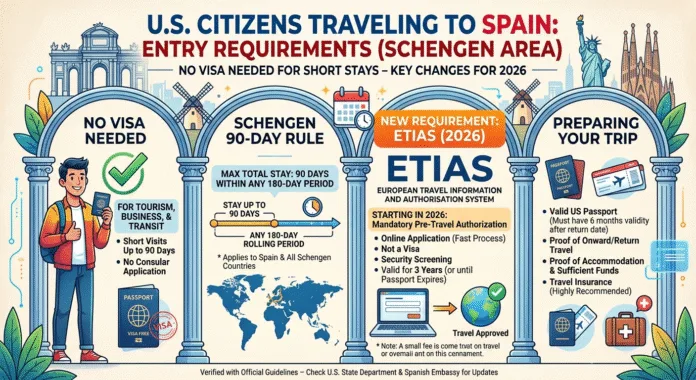
No visa required. US citizens can visit Spain for up to 90 days in any 180-day period without a visa. Spain is part of the Schengen Area, a zone of 29 European countries with shared border controls. Your US passport is sufficient for entry.
Passport requirements — check these now
- Validity: Your passport must be valid for at least 3 months beyond your planned departure date from the Schengen Zone. If you are staying in Madrid until June 30, your passport must be valid until at least September 30. Check this before you book.
- Issuance date: Your passport must have been issued within the last 10 years. An old but technically valid passport that was issued 11 years ago will be rejected at the border.
- Blank pages: You need at least one blank page for entry stamps (though the new EES digital system is replacing physical stamps — more below).
The 90-day rule — how it actually works
The 90-day limit is not a calendar-year reset. It is a rolling 180-day window. At any given moment, you can have stayed a maximum of 90 days in the Schengen Zone during the previous 180 days. Days in any Schengen country count — France, Germany, Italy, Portugal, all of them contribute to the same 90-day limit. Many Americans make the mistake of thinking that leaving Spain for France “resets” their allowance. It does not.
ETIAS — what you need to know for 2026
The EU is introducing the ETIAS (European Travel Information and Authorization System) — the European equivalent of the US ESTA for visitors entering without a visa. As of the time of writing, ETIAS is expected to become operational in the last quarter of 2026, but no specific launch date has been confirmed.
- ETIAS is not a visa — no embassy visit, no interview, no stamps
- Application is fully online, takes about 10 minutes
- Fee: approximately €20 per person (free for under-18s and over-70s)
- Valid for 3 years or until your passport expires, whichever is sooner
- Allows multiple visits within the 90-day limit during its validity
- Linked electronically to your passport — no physical document to carry
⚠️ ETIAS status as of May 2026: ETIAS is not yet operational. No action is required before it launches. When it does launch, the EU will announce the date several months in advance. Monitor travel.state.gov for official US government guidance. Beware of unofficial third-party “ETIAS application” websites charging fees — the official application portal has not launched yet.
EES — Entry/Exit System (already active)
As of October 2025, the EU’s Entry/Exit System (EES) is active. When you arrive in Spain, your fingerprints, facial image and passport details are collected and stored digitally. This replaces passport stamping — your entry and exit are recorded automatically. No advance action required from you.
Financial means requirement
Spanish border officials may ask you to demonstrate you have sufficient funds for your stay. The official 2026 requirement is a minimum of €122 (~$135) per person per day, or at least €1,099 for stays of 9 days or more. In practice, showing a return ticket and a credit card is almost always sufficient for US tourists and this check is rarely applied.
💡 Official sources only: For entry requirements, always cross-reference the US State Department Spain page and the Spanish Consulate in Washington before travel. Requirements can change. This guide is current as of April 2026.
2 Flights to Madrid from the US — Best Routes & Airlines

Madrid-Barajas (MAD) is Spain’s main hub — well served by direct flights from multiple US cities, with the best connections from New York and Miami
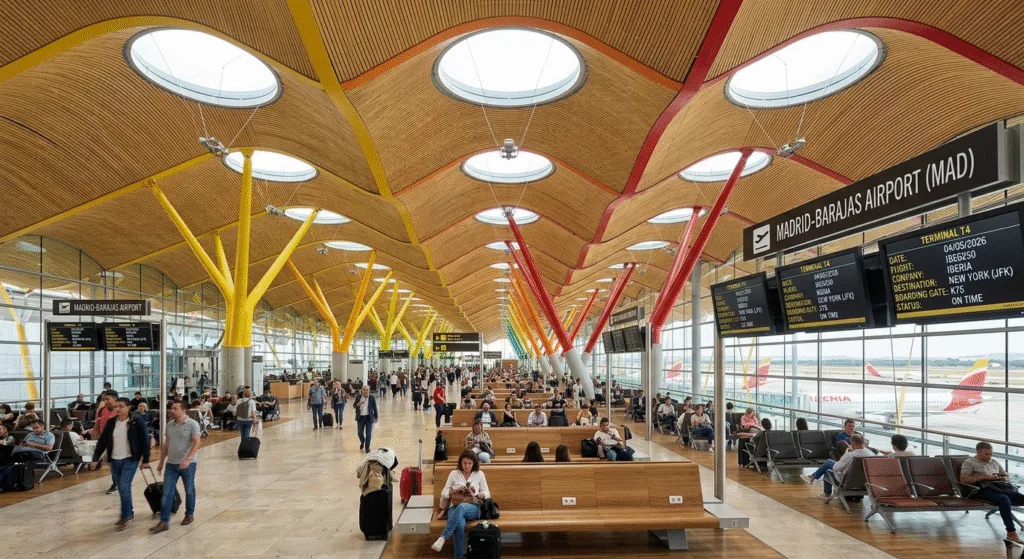
Madrid-Barajas Airport (IATA: MAD) — officially Adolfo Suárez Madrid-Barajas — is Spain’s largest airport and a major European hub. It has four passenger terminals, with Terminal 4 (T4) being the most modern and handling most transatlantic flights.
| From | Direct airlines 2026 | Flight time | Typical economy roundtrip | Best months to book |
|---|---|---|---|---|
| New York (JFK) | Iberia · American · Delta · Air Europa | ~8h | $550–$900 | Jan, Feb, Nov |
| Miami (MIA) | Iberia (14/wk) · American (9/wk) · Air Europa (7/wk) | ~9.5h | $525–$850 | Jan, Feb, Nov |
| Los Angeles (LAX) | Iberia (nonstop, 3x/week) | ~11.5h | $700–$1,100 | Jan, Feb, Oct |
| Boston (BOS) | Iberia · via connection | ~8.5h (1-stop) | $550–$850 | Jan–Mar |
| Chicago (ORD) | Via connection (usually NYC or Heathrow) | ~11h total | $580–$900 | Jan, Feb |
| Washington DC (IAD) | Iberia · via connection | ~9h (1-stop) | $550–$900 | Jan–Mar |
Best booking strategies
- Book Sunday: Data consistently shows Sunday bookings are 6–13% cheaper than Friday for international routes to Spain.
- International flights: book 2 months ahead — you can save around 10% vs last-minute for transatlantic routes.
- Cheapest months: January, February and November are the lowest-demand months for Madrid and consistently offer the best fares. Peak is June–August (summer) and late December (Christmas).
- Google Flights price tracking: Set a price alert on Google Flights for your route — it will email you when prices drop. Most effective 3–5 months before travel.
- Iberia for LAX: Only Iberia flies nonstop LAX–MAD (3 flights/week on an Airbus A350-900). All other West Coast routes connect via European hubs.
💡 Alliance tip: Iberia is a member of the oneworld alliance (with American Airlines). If you have American AAdvantage miles, you can book Iberia flights using those miles — often better value than paying cash, particularly in business class. Air Europa is a member of the SkyTeam alliance (with Delta). Check award availability 6–11 months out.
Arriving at Madrid airport
Most US flights arrive at Terminal 4 (T4) or T4S satellite. T1, T2 and T3 are connected by walkways; to get from T4 to T1–T3 or vice versa, take the free inter-terminal shuttle bus or the metro (Line 8 — one stop). Getting from the airport into Madrid: take Metro Line 8 (pink) from Aeropuerto T4 or T1-T2-T3 to Nuevos Ministerios (15–20 min, ~€5 with airport supplement). See the full Madrid transport guide for all airport options.
3 Money — Credit Cards, Euros & Avoiding Costly Mistakes

The right card setup saves you hundreds of dollars on a Madrid trip — here is exactly what to use and what to avoid
Using US credit cards in Spain
Visa and Mastercard are accepted almost universally in Madrid — restaurants, hotels, shops, museums, taxis and the metro all take cards. American Express is accepted at hotels and upscale restaurants but not everywhere. Cash remains important for small tapas bars, local markets, church donations and tips — always carry €20–30 in cash.
The critical issue with US cards in Spain is foreign transaction fees — typically 3% charged by your bank on every purchase made in a foreign currency. On a $3,000 Madrid trip that is $90 straight to your bank for nothing. The solution is simple: use a card with no foreign transaction fees.
Best US cards for Spain (no foreign transaction fees)
- Chase Sapphire Preferred / Reserve — No foreign transaction fees, travel rewards, trip protection. The gold standard travel card for most Americans.
- Capital One Venture Rewards — No foreign transaction fees, 2x miles on everything. Simpler rewards structure.
- Citi Premier / Strata Premier — No foreign transaction fees, strong points on restaurants and hotels.
- Charles Schwab Investor Debit Card — No foreign transaction fees AND reimburses all ATM fees worldwide. Exceptional for cash withdrawals from Spanish ATMs.
- Wise Multi-Currency Card / Wise Debit — Transfers at mid-market rate, very low fees. Load euros before travel or convert when withdrawing.
Getting euros — the right way
- ✅ Best option: Withdraw from Spanish bank ATMs (Caixabank, Bankinter, BBVA, Santander) using your fee-free debit card after landing. You get the Visa/Mastercard network rate, very close to the mid-market rate.
- ✅ Good alternative: Wise or Revolut — exchange dollars to euros at close to mid-market rate before or during your trip, withdraw locally.
- ❌ Avoid: Airport currency exchange booths — terrible rates, often 7–10% worse than the actual exchange rate.
- ❌ Avoid: Private ATM companies (Euronet, Travelex-branded machines) — they charge high fees and use poor exchange rates. Use ATMs affiliated with Spanish banks instead.
- ❌ Avoid: Ordering euros from your US bank before departure — the rates are poor and fees add up.
🚨 Dynamic Currency Conversion (DCC) — the biggest tourist money trap in Spain
When you pay at a Spanish restaurant, shop or ATM, you may see a prompt: “Would you like to pay in USD ($43.21) or EUR (€39.80)?” This is Dynamic Currency Conversion. Always — always — choose euros. The “convenience” of seeing a dollar amount costs you an extra 3–8% because the merchant’s conversion rate is heavily marked up. If a card machine or ATM defaults to dollars without asking you, reject the transaction and try again paying in euros.
Tipping Etiquette (La Propina)
Tipping in Spain is not mandatory and definitely not the 20-25% standard you find in the US.
- Cafés & Bars: Leaving the small change or rounding up to the next Euro is plenty.
- Restaurants: If the service was excellent, a 5% to 10% tip is considered very generous. Check your bill for “Servicio incluido”, though it’s rare in Spain to have a forced service charge.
- Taxis: Rounding up to the nearest Euro is sufficient.
4 Getting Around Madrid — Metro, Bus & Taxi

The Madrid metro — 13 colour-coded lines, 300+ stations, air-conditioned and one of the best urban transit systems in Europe
Madrid’s public transport is excellent — fast, air-conditioned and cheap. The system includes the metro (underground), EMT city buses, Cercanías suburban trains, and a light rail (Metro Ligero). For most tourists, the metro covers everything.
The Tarjeta Multi — your transport card
To travel on the Madrid metro, you need a Tarjeta Multi — a red contactless smartcard. It costs €2.50 to buy (one-time, valid 10 years) and is purchased at any metro station ticket machine, including at the airport. You load it with whichever ticket type you need.
Ticket types — which one to buy
| Ticket | Price | Trips | Airport | Shareable | Best for |
|---|---|---|---|---|---|
| Single (Sencillo) | €1.50–€2.00 | 1 | ❌ +€3 supplement | No | Occasional riders |
| 10-trip Metrobús | €12.20 (€1.22/trip) | 10 | ❌ +€3 supplement | ✅ Yes | Most visitors 3–5 days |
| Tourist Pass 1 day | €10 | Unlimited | ✅ Included | No (personal) | Day of arrival/departure with airport |
| Tourist Pass 3 days | €22.50 | Unlimited | ✅ Included | No (personal) | 3-day trips flying in/out |
| Tourist Pass 5 days | €32.50 | Unlimited | ✅ Included | No (personal) | Week trips with heavy transport use |
| Tourist Pass 7 days | €42.00 | Unlimited | ✅ Included | No (personal) | Full-week stays |
The 10-trip Metrobús card is shareable — multiple people in your group can tap the same card, one at a time. The Tourist Pass is personal and non-transferable. The Tourist Pass includes the airport metro supplement (€3 saved per airport trip). See the full breakdown in our Madrid tourist card guide.
Key metro lines for tourists
- Line 8 (Pink): Airport (T1-T2-T3 and T4) → Nuevos Ministerios. Your airport connection.
- Line 1 (Blue): North–south spine. Connects Atocha (main train station) → Sol → Gran Vía → Chamberí.
- Line 2 (Red): Opera → Sol → Retiro → Goya. Essential for the historic centre and Salamanca.
- Line 5 (Green): Callao → Chueca → Alonso Martínez → La Latina end. Connects major tourist areas.
- Line 10 (Dark Blue): Chamartín (Renfe/AVE) → Nuevos Ministerios → Tribunal → Tribunal. Airport connect via change to L8.
💡 Metro essentials: Runs daily 06:00–01:30. Trains every 2–4 minutes peak hours. All stations have English signage. Download the “Metro de Madrid” app (iOS/Android) for live maps and journey planning. Keep your card out of magnetic contact with credit cards — it can demagnetise. Never use your credit card at ticket machines as a cash advance — it triggers high interest immediately.
Taxis and rideshare in Madrid
- Official taxis are white with a red stripe. Flag them on the street, call RadioTaxi 915 474 100, or book via the MyTaxi app. Meters are mandatory. Airport to city centre: flat rate €33 anywhere within the M-30 ring road.
- Uber and Cabify both operate in Madrid — download before arrival and link your card. Useful after 1:30 AM when the metro closes. Expect €12–25 for most central rides.
- Avoid: unlicensed taxis approaching you at the airport. Always use official white taxis or a pre-booked rideshare app.
5 Connectivity — SIM Cards, eSIMs & Wi-Fi

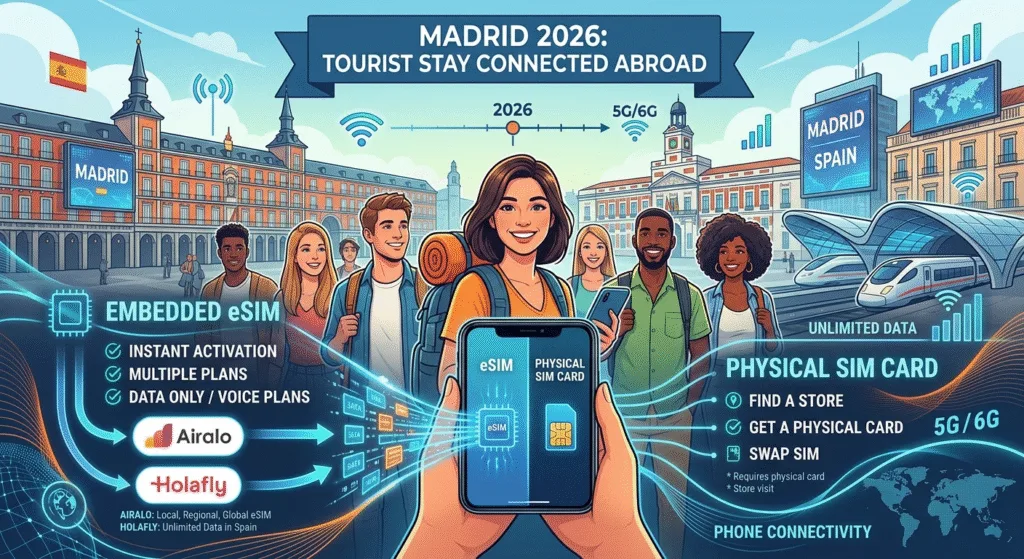
An eSIM purchased before departure is the easiest and cheapest way to stay connected in Madrid — no store queues, no passport presentation, instant activation
Your US plan in Spain
Check your US carrier’s international options before departure. T-Mobile Magenta and higher plans include unlimited data in Spain at 2G/3G speeds with texting at no extra cost — useful but slow. Most Verizon and AT&T plans offer international day passes ($10–15/day) for full-speed data. For longer trips, a dedicated eSIM or local SIM is almost always better value.
eSIM — the recommended option for most American visitors
An eSIM is a digital SIM card installed on your phone without removing your physical SIM. It requires an eSIM-compatible phone (iPhone XS 2018 or newer, most Android flagships from 2019). You purchase online, receive a QR code by email, scan it to install, and activate before boarding. Your US phone number and SIM remain active simultaneously.
| Provider | Best plan for Spain | Price | Data | Best for |
|---|---|---|---|---|
| Airalo | Spain 10GB / 30 days | ~$15 | 4G, data only | Budget-conscious, short to medium trips |
| Holafly | Unlimited / 15 days | ~$51 | 4G/5G, unlimited | Heavy users, digital nomads, families |
| Nomad | 20GB / 30 days | ~$20 | 4G, data only | Best value for medium-heavy users |
| Saily | 3GB / 7 days | ~$8 | 4G/5G, data only | Short trips, light use |
Physical SIM card in Spain
If you prefer a physical SIM, the main Spanish carriers are Movistar (best coverage), Orange and Vodafone España. Buy at carrier stores in central Madrid (widely available on Calle Gran Vía and major shopping streets). You will need to present your physical passport — Spanish law requires identity registration for all SIM cards. Digital copies or phone photos are generally rejected. Prepaid tourist SIMs with 10–15GB typically cost €15–25.
Wi-Fi in Madrid
Free Wi-Fi is widely available in Madrid — cafés, hotels, the metro (stations, though not on trains), many public plazas and the Retiro Park. However, public Wi-Fi is not always reliable and carries security risks for banking or sensitive logins. Use a VPN on public networks or keep banking for your mobile data connection.
6 Cultural Translation: Navigating Madrid like a Local
To enjoy Madrid to the fullest, you need to adjust your “internal clock” and social expectations. Here is how to navigate the most common cultural differences:
Mealtimes: The 9 PM Rule
Forget about 6:00 PM dinners. In Madrid, restaurants usually open for lunch at 1:30 PM and for dinner at 8:30 PM.
- Pro Tip: Most Madrileños don’t sit down for dinner until 9:00 PM or 10:00 PM. If you are hungry early, head to a Tapas bar; they stay open all day, but formal dining rooms have strict schedules.
Coffee & Water: Tap is Top
The Coffee Script: If you want something similar to a Latte, ask for a “Café con Leche”. If you want a strong, small shot like an Espresso, ask for a “Café Solo”. Note: There are no “free refills” in Spain!
Tap Water: You’ll be happy to know that Madrid has some of the best tap water in Europe. It is perfectly safe and delicious. Don’t waste money on bottled water; just ask for “Agua del grifo” (tap water) at restaurants—it’s free!
7 What to Pack for Madrid

Madrid is a stylish city — smart casual is the baseline. Here is what to actually pack by season.
Spring (March–May) — the best packing season
- Layering is essential: Mornings can be 10–14°C; afternoons reach 18–24°C; evenings drop again. A mid-layer (light jacket, smart cardigan) is not optional.
- Light rain layer: April especially has afternoon showers. A packable waterproof jacket takes no space and saves your day.
- Comfortable walking shoes: Non-negotiable. Madrid’s historic centre is cobblestone. Most tourists underestimate how much they will walk (10–15km/day is normal). Break in your shoes before arriving. Trainers/sneakers in neutral colours are fine — Madrileños wear them.
- Smart casual for evenings: Madrid dresses up slightly for dinner, particularly if going to a nicer restaurant. Men: chinos/dark jeans + a collared shirt or light blazer. Women: dress, smart trousers or jeans with a blouse. Shorts at dinner at a proper restaurant is generally frowned upon.
Summer (June–August) — the heat season
- Lightweight breathable fabrics only: Linen, cotton, moisture-wicking. Synthetics are suffocating at 38°C.
- Sun protection: High-SPF sunscreen (SPF 50+), a hat with a brim, UV sunglasses. The Madrid sun is intense and the altitude (650m/2,130ft above sea level) makes UV radiation stronger than at sea level.
- A light layer for evenings and interiors: Spanish air conditioning in restaurants and museums is aggressive — bring a light cardigan even in August.
- Comfortable sandals AND walking shoes: Sandals for leisurely days, proper walking shoes for museum days and long sightseeing walks.
Dress code for churches and cultural sites
- Shoulders and knees must be covered to enter active churches (Almudena Cathedral, any parish church). Carry a light scarf or sarong that can be wrapped around as needed.
- Museums have no formal dress code but smart casual is the norm — beachwear is inappropriate.
- Very few restaurants in Madrid enforce a formal dress code. The exceptions are fine dining establishments — check specific restaurant policies when booking.
Essential items to pack
- ✅ European Type C plug adaptor — Spain uses 220V / 50Hz with Type C/E/F plugs. US plugs do not fit. Buy a universal travel adaptor.
- ✅ Portable power bank — Your phone’s GPS and data will be working hard all day. A 10,000mAh power bank keeps you going.
- ✅ Small day bag / crossbody bag — Madrid is safe but metro stations and tourist areas attract pickpockets. Wear bags across your body with the clasp facing forward. Avoid back pockets for phones and wallets.
- ✅ Reusable water bottle — Tap water in Madrid is safe and excellent. Public water fountains exist throughout Retiro Park and the city. Fill up and save money.
- ✅ Copy of your passport — Keep a digital copy in your email and a paper copy separate from the original. Some venues and pharmacies may ask for ID.
- ✅ Downloadable offline maps — Download Madrid in Google Maps or Maps.me before arrival. Useful when you have weak signal or want to save data.
💡 What NOT to bring: Hairdryer (hotels always have one), heavy guidebooks (your phone is better), more than 3 pairs of shoes (you will wear two), formal evening wear unless you have a specific dinner booked. Madrid is stylish but not formal. Smart casual almost always works.
Quick Reference — Everything at a Glance
| Topic | Key fact | Action needed |
|---|---|---|
| Visa | Not required for US citizens (up to 90 days) | Check passport validity (3+ months beyond departure) |
| ETIAS | Expected late 2026, ~€20, 3-year validity | Monitor travel.state.gov — not yet operational |
| EES | Active since Oct 2025 — digital biometric entry system | No action required |
| Best direct route | NYC or MIA — most flights, lowest fares | Set Google Flights alert 3–5 months out |
| Credit card | No-foreign-transaction-fee card (Chase Sapphire, Capital One Venture) | Apply 4+ weeks before travel |
| Cash/ATM | Withdraw from Spanish bank ATMs on arrival | Use Charles Schwab or Wise debit for zero-fee withdrawals |
| DCC | Always pay in euros — never accept “pay in USD” | Know how to say “en euros, por favor” |
| Metro card | Tarjeta Multi (€2.50) + 10-trip ticket (€12.20) or Tourist Pass | Buy at airport metro machine on arrival |
| eSIM | Airalo (budget) or Holafly (unlimited) recommended | Purchase and install before boarding |
| Plug adaptor | Type C (European) required — 220V | Buy before departure |
| Emergency number | 112 (all emergencies in Spain) | Save in phone |
| US Embassy | Calle de Serrano, 75, Madrid · (+34) 91 587 2200 | Save number, register trip at travel.state.gov (STEP) |
FAQs — US Citizens Travelling to Madrid 2026
No. US citizens do not need a visa to visit Spain for stays up to 90 days in any 180-day period. Your US passport is sufficient. However: your passport must be valid for at least 3 months beyond your departure date from the Schengen Zone, and must have been issued within the last 10 years. Starting in late 2026, ETIAS (European Travel Information and Authorization System) will become mandatory — this is a quick online pre-authorization (~€20, takes 10 minutes), not a visa. As of May 2026 it is not yet operational. Monitor travel.state.gov for the latest updates. Also note: all Schengen countries (France, Italy, Germany, etc.) count toward the same 90-day limit as Spain — leaving Spain for France does not reset your allowance.
Best way to get euros for Spain 2026: Use a debit card with no foreign transaction fees at Spanish bank ATMs (Caixabank, Bankinter, BBVA, Santander) after you land. Best cards: Charles Schwab Investor Debit (reimburses all ATM fees worldwide) or Wise Multi-Currency card. You get the Visa/Mastercard network exchange rate — very close to the mid-market rate. AVOID: airport currency exchange booths (7–10% worse rates), private/independent ATMs from Euronet/Travelex (high fixed fees + bad rates), ordering euros from your US bank before departure (poor rates). Always choose to pay in euros (never dollars) when offered a choice at payment terminals or ATMs — this avoids Dynamic Currency Conversion, which typically costs an extra 3–8%.
Direct nonstop US to Madrid (MAD) 2026: From New York JFK: Iberia, American Airlines, Delta, Air Europa (multiple daily, ~8h flight). From Miami MIA: Iberia ~14x/week, American Airlines ~9x/week, Air Europa ~7x/week (nonstop, ~9.5h). From Los Angeles LAX: Iberia only (nonstop, 3x/week, Airbus A350, ~11.5h) — all other West Coast routes connect via European hubs. Other US cities: Boston, Chicago, Washington DC connect via NYC, London (Heathrow/Gatwick) or Frankfurt. Best fares: book Sundays, 2 months in advance for international routes, target January/February/November travel. Use Google Flights price tracking for your specific route. Iberia is part of oneworld (AA miles). Air Europa is SkyTeam (Delta miles).
For most US visitors to Spain in 2026, an eSIM purchased before departure is the best option. Top providers: Airalo (5–20GB data-only plans from ~$5–20 for 30 days, 4G, reliable), Holafly (unlimited data from $29.90/7 days, 4G/5G, 24/7 support, best for heavy users), Nomad (20GB for ~$20, good value). eSIM requires: iPhone XS (2018) or newer, or recent Android flagship. Alternatively, buy a physical prepaid SIM in Spain from Orange, Vodafone or Movistar stores — requires presenting your physical passport (Spanish law). Your US carrier day passes ($10–15/day for T-Mobile, Verizon, AT&T) work but are expensive for trips over 3–4 days. T-Mobile Magenta/Go5G includes slow data in Spain at no extra cost — adequate for navigation and messaging if you are on a tight budget.
Madrid is one of the safest capitals in Europe. The main concern for US tourists is petty theft (pickpockets) in crowded areas like Sol or the Metro. Violent crime is extremely rare.
Yes, Visa, Mastercard, and American Express are widely accepted. However, ensure your card has “Chip and PIN” technology, as it is the standard in Spain.

 19°C
19°C - Temperature
- Precipitation
- Rain Chance
- Wind
- Humidity
- Pressure