Last Updated on June 3, 2026 by Jaime
By Jaime · April 25, 2026 · 8 min read

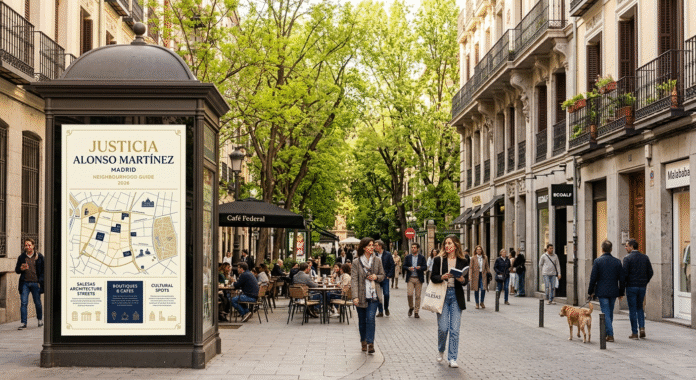
The Salesas streets of Justicia — the Madrid neighbourhood that looks like Paris and feels like home
📍 Location: Between Chueca (west), Chamberí (north), Salamanca (east) and Gran Vía (south)
🚇 Metro: Alonso Martínez (Lines 4, 5, 10) · Chueca (Line 5) · Colón (Line 4) · Tribunal (Lines 1, 10)
🏛️ Must-see: Iglesia Santa Bárbara · Palacio de Longoria · Museo del Romanticismo · Plaza de Santa Bárbara
🍷 Best street: Calle Santa Teresa · Calle Fernando VI · Calle Argensola
🎨 Culture: Gallery strip along Calle Almirante · Max Estrella Gallery · Salesas Village market (1st Saturday/month)
🛒 Shopping: Malababa (Santa Teresa 5) · Taschen (Barquillo 30) · independent boutiques on Calle Almirante
⭐ Why locals love it: Beautiful architecture, quiet streets, excellent restaurants, three metro lines — and none of the tourist chaos of Sol
| Feature | Justicia & Alonso Martínez |
| Vibe | Chic, Bohemian, High-end, Literary |
| Best For | Boutique shopping, Art galleries, Late-night cocktails |
| Crowd | Fashionistas, Locals, Creative professionals |
| Top Landmark | Palacio de Longoria & San Antón Market |
Ask a Madrileño where they would actually choose to live in this city — not where they can afford, where they would choose — and a disproportionate number will say the same thing: Alonso Martínez. Or Salesas. Or Justicia. Three names for the same stretch of territory that sits between the buzzing energy of Chueca to the south, the dignified elegance of Chamberí to the north, and the expensive quietness of Salamanca to the east.
It is the neighbourhood that gets the balance right. Haussmann-style 19th-century buildings with the kind of high ceilings and ornate facades that make you feel you have accidentally wandered into the 7th arrondissement. Cocktail bars where the art crowd meets the legal crowd meets the design crowd on Calle Santa Teresa. A monthly street market that spills through three streets. Galleries that show work that ends up at ARCO. A Baroque church that contains the tombs of a king and queen. And — crucially — a metro station with three lines that makes the rest of the city feel five minutes away.
Most tourists walk straight through here on the way from Chueca to somewhere else. This guide is about why you should stop.
Understanding the Geography — Justicia, Salesas, Alonso Martínez
First, a clarification, because the naming confuses everyone. Justicia is the official administrative neighbourhood — a large zone running from Gran Vía north to Calle Génova, covering both the famous Chueca area in the west and the Salesas/Alonso Martínez area in the east. The neighbourhood takes its name from the Spanish Supreme Court (Tribunal Supremo), which has occupied the old Salesas Reales Convent here since 1870.
Within Justicia, most visitors know Chueca — the LGBTQ+ hub around Plaza de Chueca. What they miss is the eastern section, which locals call Salesas (after the convent) or Alonso Martínez (after the metro station and the plaza). This is the area this guide is about: roughly the streets between Calle Hortaleza (west), Paseo de Recoletos (east), Calle Génova (north) and Calle Almirante (south).
The key streets you will spend your time on: Calle Fernando VI (the main spine, running east-west), Calle Santa Teresa (cocktail bars, restaurants, the Salesas Village market), Calle Argensola (gallery strip, boutiques, terraces), Calle Almirante (design shops, art galleries), and the area around Plaza de Santa Bárbara (the neighbourhood’s historic heart).
💡 Local tip: Madrileños do not really use the name “Justicia” day-to-day. They say “el barrio de las Salesas” or just “Alonso Martínez.” If you ask for directions to Justicia, you may get a blank look. Ask for “Alonso Martínez” — everyone knows it.
The Architecture — Why This Feels Like Paris
The streets of Salesas — late 19th century residential architecture that earns the neighbourhood its “Parisian” nickname
The reason this neighbourhood keeps getting compared to Paris is not laziness — it is accurate. The area was developed primarily in the second half of the 19th century, during the same period as Haussmann was rebuilding Paris, and Madrid’s architects were watching closely. The result is blocks of handsome stone-faced residential buildings with ornate iron balconies, high ceilings, wide pavements shaded by plane trees, and the occasional jaw-dropping exception.
The neighbourhood’s grandest buildings are concentrated on and around Calle Fernando VI and the streets approaching the Salesas Reales Convent. Walk east from Alonso Martínez metro station and you start to understand why rents here are among the highest in central Madrid.
Justicia: Madrid’s “Soho” and the Salesas Spirit
While often grouped with its famous neighbor Chueca, Justicia has a distinct personality. If Chueca is the soul of the party and Pride, Justicia is its sophisticated, artistic, and chic sibling.
The heart of this district is the Salesas area, a cluster of streets (principally Fernando VI and Argensola) where traditional Madrid architecture meets avant-garde design. Here, you won’t find big commercial chains. Instead, Justicia is defined by:
- Niche Fashion: Independent boutiques and concept stores like NAC or Ecoalf.
- Art & Design: Some of the city’s most prestigious contemporary art galleries.
- Slow Living: Historic bakeries like Pan.Delirio sitting next to trendy specialty coffee shops.
Insider Tip: Don’t miss the Palacio de Longoria. Located on the corner of Fernando VI, it is one of the few pure Art Nouveau (Modernista) buildings in Madrid. Its organic, “Gaudi-esque” facade is a photographer’s dream.
Palacio de Longoria — Madrid’s Art Nouveau Masterpiece

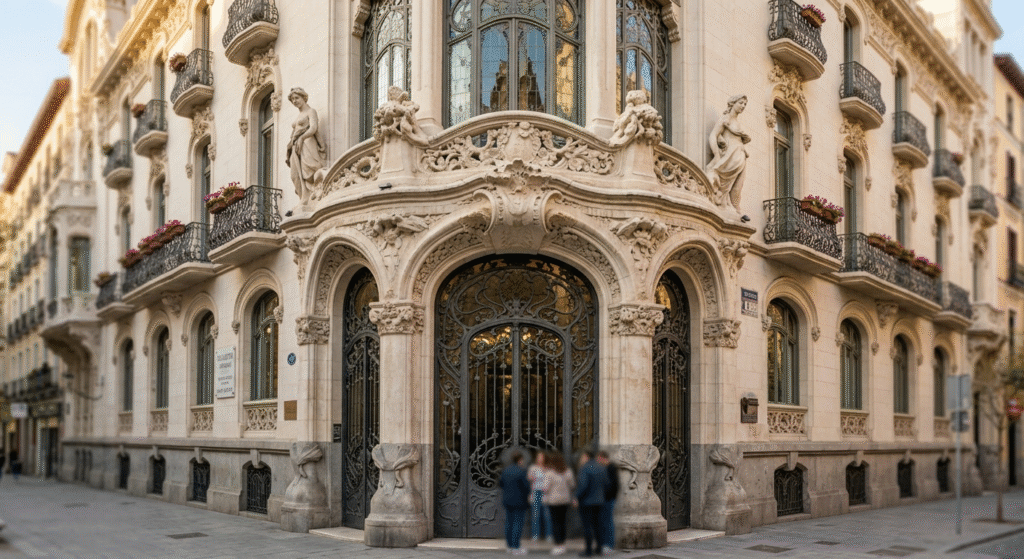
The Palacio de Longoria (1902) on Calle Fernando VI — Madrid’s most extraordinary example of Art Nouveau architecture and current headquarters of the SGAE
Stop everything when you reach the corner of Calle Fernando VI and Calle Pelayo. The building in front of you — the Palacio de Longoria — is the most astonishing piece of architecture in this neighbourhood and one of the most beautiful buildings in all of Madrid. It was commissioned in 1902 by politician and financier Francisco Javier González Longoria, built in an extravagant Art Nouveau style with an intricate facade of carved stone flowers, sinuous female figures with long flowing hair, intertwined leaves and baroque scrollwork that cascades across every surface.
It currently serves as the headquarters of the SGAE (the Spanish Society of Authors and Publishers) and is not generally open to the public. It does not matter. Stand on the pavement across the street and stare at the facade for five minutes — the detail at every level is extraordinary. This is what happens when a very rich man falls in love with Art Nouveau and has no one to tell him to stop.
📍 Palacio de Longoria · Calle de Fernando VI, 4 (corner with Calle Pelayo) · Exterior viewing: always · Interior: not open to public
1 Iglesia Santa Bárbara — A Royal Church Most Tourists Miss

The Iglesia de Santa Bárbara (1757) — built by a queen for herself and her husband, now one of Madrid’s most beautiful and most overlooked churches
Most visitors who come to Madrid see the Royal Palace, the Prado and perhaps the Reina Sofia. Very few find their way to the Iglesia de Santa Bárbara, which is a genuine shame, because the story behind this church is extraordinary and the building itself is one of the finest pieces of Baroque-Rococo architecture in the city.
The church was built between 1750 and 1757 as part of the Convent of the Salesas Reales, founded by Queen Bárbara de Braganza, the Portuguese wife of King Ferdinand VI. The Queen had two practical motivations: she wanted a school and residence for young noble women, and she wanted somewhere to retire if her husband died before her. (He did not — she died first, in 1758, just months after the church was completed.) Both the Queen and the King are buried here, in magnificent marble and porphyry tombs designed by Francisco Sabatini.
The complex was designed by the French architect François Carlier, though it was largely built by the Madrid architect Francisco Moradillo, who made significant modifications including the two bell towers and the dome. The facade is adorned with sculpted reliefs by the Italian craftsman Juan Domingo Olivieri. Inside, the church is sumptuously decorated in the Rococo style — coloured marbles, gilt bronzes, painted ceilings by the González Velázquez brothers, and works by Italian masters including Francesco de Mura and Corrado Giaquinto. It is officially classified as a Bien de Interés Cultural (protected national heritage monument).
💡 Local story: The Convent was so lavish that it inspired a famous contemporary critique: “Bárbara Reina, bárbara obra, bárbaro gusto, bárbaro gasto” — Barbara the Queen, barbarous work, barbarous taste, barbarous expense. The building was considered absurdly extravagant at the time. Now it houses Spain’s Supreme Court. The church beside it contains the buried remains of a king and queen. Barbarous, perhaps. But still standing 270 years later.
In 1870, when the convent was converted into the Palacio de Justicia (the Supreme Court building that gives the neighbourhood its name), the church was kept open for worship. It became a full parish church in 1891, dedicated to Saint Barbara — and that is what it remains today. The adjacent Supreme Court building, with its grand 19th-century neoclassical facade facing Plaza de la Villa de París, is worth a look from the square, though the interior is not open to visitors.
📍 Iglesia de Santa Bárbara · Calle General Castaños, 2 · Metro: Alonso Martínez · Open: Mon–Fri 09:00–13:00 & 17:00–20:00 · Sat–Sun: 10:00–13:00 & 18:00–21:00 · Free entry
2 Plaza de Santa Bárbara — The Neighbourhood’s Living Room

Plaza de Santa Bárbara — a long, elegant square that serves as the neighbourhood’s social hub from morning coffee to late-night drinks
Walk south from the metro station down Calle Hortaleza and you arrive at Plaza de Santa Bárbara — a wide, elongated square lined with terraces, bars and historic buildings that functions as the neighbourhood’s unofficial living room. On a warm evening, every table is occupied. On a Sunday morning, it is the place where people read the newspaper over a cortado and watch the city ease slowly into the day.
The plaza has been a gathering point for a very specific Madrid crowd since the 1970s: labour lawyers, trade unionists, journalists, artists, academics. The square holds a particular place in post-Franco democratic history — it was here that many of the lawyers who defended political prisoners against the Franco regime came to decompress, and the culture of intelligent, politically engaged late-night conversation never entirely left. You still feel it.
The Cervecería Santa Bárbara is the anchor institution of the square — a bar that traces its origins to a brewery licensed on Calle Hortaleza in 1815, with the current Plaza de Santa Bárbara outpost opening in 1966 and remaining essentially unchanged. It is famous for its draught beer and its prawns. It is honest rather than exceptional. The institution is the thing, not the food.
On the south side of the square, the Palacio de Santa Bárbara — a 19th-century mansion at number 10 — occasionally opens for pop-up markets, design events and seasonal terraces. Check what is on when you visit; it is one of the most atmospheric spaces in the neighbourhood when activated.
📍 Plaza de Santa Bárbara · Exit metro Alonso Martínez, walk south on Calle Hortaleza (2 min) · Cervecería Santa Bárbara: Plaza de Santa Bárbara, 8
3 Calle Santa Teresa — The Cocktail Street

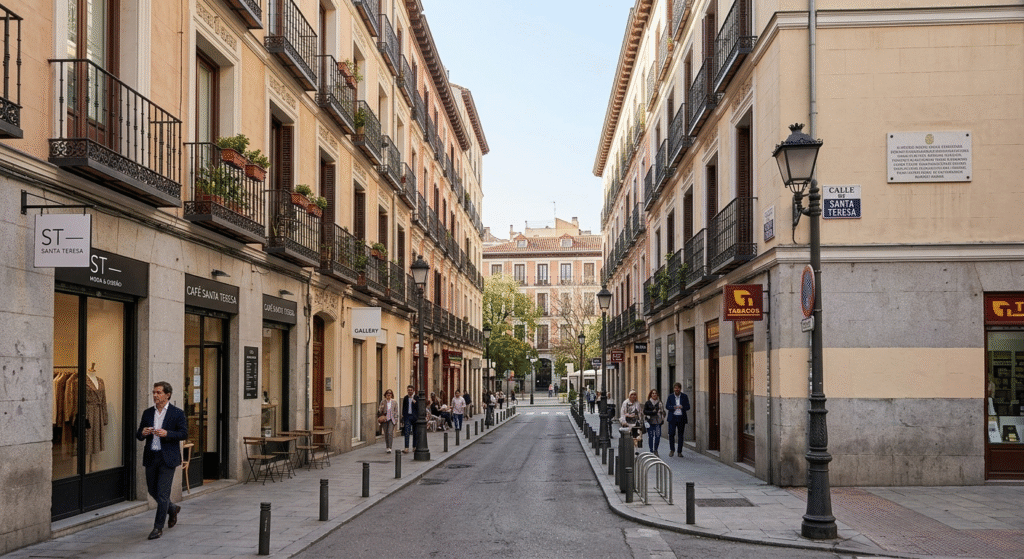
Calle Santa Teresa — a short, dense street of bars and restaurants that punches significantly above its length
Calle Santa Teresa is not a long street. You can walk it end to end in three minutes. But it punches significantly above its length, concentrating some of the neighbourhood’s best bars and restaurants into a stretch that functions as the social core of the Salesas scene — particularly from about 20:00 onwards.
The street hosts the Salesas Village market on its first Saturday each month (shared with Calle Campoamor and Calle Argensola), which transforms the whole area into an outdoor design fair. On regular evenings, the tables spill onto the pavement and the crowd is the neighbourhood in miniature: architects and lawyers from the local offices, gallery staff post-opening, residents who live in the high-ceilinged flats above.
What to eat and drink on Calle Santa Teresa:
- Lado A / Lado B (Calle Santa Teresa, 1) — One of Madrid’s most talked-about spots. By day it operates as a cantina with small plates and natural wines. At 20:00 it switches to a burger joint. No reservations — you queue and wait, and it is worth it. The art and gallery crowd from nearby spaces eats here constantly.
- Taberna at No. 9 (Calle Santa Teresa, 9) — A classic taberna madrileña that has been described by the art community as their unofficial HQ for post-opening dinners and lunches with collectors. Over a century old but without the tired feeling that afflicts older establishments — the truffle Spanish omelette and the peas with Iberian secreto are extraordinary.
- Barbara Ann (Calle Santa Teresa, 8) — Cocktail bar with genuine craft credentials and a local following. Reliable natural wines, good gin selection, unpretentious atmosphere.
- Malababa (Calle Santa Teresa, 5) — Not a bar but worth noting: the flagship store of one of Spain’s best leather accessories brands, with a shop interior that is itself worth seeing.
💡 Timing tip: Calle Santa Teresa really comes to life after 21:00, which by Madrid standards is still early. If you want a table at Lado A or the Taberna at No. 9, go at 20:30 — the full crowd arrives from 21:30. Come hungry and plan to stay.
4 Why Justicia is Madrid’s Soho — Art at Street Level

The gallery streets of Salesas — Calle Almirante, Calle Argensola and the surrounding blocks have the highest concentration of contemporary art spaces in central Madrid
The Justicia/Salesas area has quietly become Madrid’s most significant gallery district over the past two decades. It happened organically — a few spaces opened in the 1990s, attracted the kind of crowd that galleries attract, which drew more galleries, restaurants, boutiques and architects, which raised rents, which made it even more desirable. The area around Calle Almirante, Calle Argensola and the side streets connecting them now has more contemporary art spaces per square block than anywhere else in central Madrid.
The galleries here are not tourist-facing vanity spaces. They show work that goes to ARCO (Spain’s major international art fair) and internationally. The programme changes monthly and openings draw a serious crowd. If you are visiting Madrid and want to understand the contemporary art scene rather than just the historic collections, walk these streets.
Key gallery spaces in the neighbourhood:
- Max Estrella Gallery (Calle Santo Tomé, 6) — One of Madrid’s most respected contemporary spaces, representing both established and emerging international artists. 350 square metres in a distinctive patio setting. Their programme regularly shows work that has appeared at ARCOMadrid.
- Galería Elvira González — Long-established and serious. International roster.
- Calle Almirante — Walk the full length of this street for the highest concentration of gallery windows and design boutiques. The street combines art with fashion in a way that feels natural rather than forced.
- Calle Barquillo — Contains the Taschen bookshop (No. 30) — one of the most beautifully designed bookshops in Madrid, worth entering even if you buy nothing, alongside several design-adjacent spaces.
The Salesas Village Market:
On the first Saturday of each month (except January and August), the streets around Calle Campoamor, Calle Santa Teresa and Calle Argensola transform into the Salesas Village market — 60–80 stalls of independent designers, vintage, jewellery, ceramics, illustration, photography and street food. It runs from 11:30 to 20:00 and is consistently one of the best design markets in Madrid. If your visit coincides with a first Saturday, make the effort to come.
📍 Salesas Village Market · Calle Campoamor / Calle Santa Teresa / Calle Argensola · 1st Saturday of the month (except Jan & Aug) · 11:30–20:00 · Free entry
5 Museo del Romanticismo — The Neighbourhood’s Hidden Gem

The Museo del Romanticismo garden — one of the most peaceful spots in central Madrid, largely unknown to tourists, free to enter during museum hours
Two streets west of the main Salesas area, on Calle San Mateo, sits one of the most underrated museums in Madrid: the Museo del Romanticismo. It occupies a beautifully preserved 18th-century palace (the former Palacio del Marqués de Matallana, built 1776) and immerses you completely in the world of 19th-century bourgeois Spain — not through didactic displays, but through the physical reconstruction of the rooms themselves.
The museum is a house museum in the truest sense: 17,000 objects spread across rooms furnished exactly as they would have been in the Isabeline period (1833–1868), complete with original furniture, pianos, porcelain, portraits of the royal family, fans, miniatures, domestic objects and works by Goya, Federico de Madrazo, Leonardo Alenza and others. You are not looking at art behind glass — you are standing in a room that has been restored to feel inhabited.
But here is the thing that most visitors miss entirely: the garden. Hidden at the back of the palace is a small, shaded patio garden with a decorative fountain, planted beds, and a café that is one of the most peaceful spots in central Madrid. The garden is technically free — you do not need a museum ticket to access it during opening hours. On a warm afternoon in spring or autumn, this garden café is one of the best places in the neighbourhood to sit and do nothing. Almost nobody knows it exists.
📍 Museo del Romanticismo · Calle de San Mateo, 13 · Metro: Tribunal or Alonso Martínez · Tue–Sat: 09:30–20:30 (summer) / 09:30–18:00 (winter) · Sun & public holidays: 10:00–15:00 · Closed Mondays · Entry: €3 (standard) / Free Sat after 14:00 · Garden: free during opening hours
6 Best Restaurants and Cafes in Justicia — Beyond Santa Teresa

The dining scene along Calle Fernando VI and the surrounding Salesas streets — where the neighbourhood’s residents actually eat
Calle Santa Teresa is the headline act, but the wider neighbourhood has an extraordinary density of good restaurants and cafés for its size. This is where lawyers, architects, gallery directors and designers eat — which means the standard is high and the tourist-trap ratio is low.
Restaurants worth your evening:
- Krachai (Calle Fernando VI, 11) — Elegant Thai restaurant that has been a neighbourhood institution for years. Exceptional quality, beautifully designed space. Book ahead.
- Grosso Napoletano (Calle Fernando VI) — Madrid’s best Neapolitan pizza, wood-fired oven, reliable and unpretentious.
- Fismuler (Calle de Sagunto, 2, just north in Chamberí — a 5-minute walk) — One of Madrid’s most acclaimed restaurants by chefs Nino Redruello and Patxi Zumárraga. Market-driven, seasonal, extraordinary. Book well ahead.
- Media Ración (Calle Mejía Lequerica, 8) — Smart cooking in raciones, excellent wine list, very much a local restaurant.
Coffee and pastries:
- La Duquesita (Calle Fernando VI, 2) — One of Madrid’s most beautiful old pastry shops, dating to 1914. The facade alone is worth the trip. Inside: extraordinary traditional pastries, cakes and chocolates. This is where Madrileños go when someone needs cheering up.
- Cripeka (Calle Santa Teresa, 2) — German pastries and excellent freshly ground coffee in a charming neighbourhood café with a loyal daily following.
Evening drinks:
- Only You Hotel terrace (Calle Barquillo, 21) — The hotel terrace is one of the neighbourhood’s better-kept secrets for an aperitivo. The bar inside is reliably good.
- The neighbourhood’s rooftop terraces — Several buildings around Alonso Martínez have private residents’ terraces and occasional pop-up bar events during summer. Keep an eye on neighbourhood social media for what opens seasonally.
The Neighbourhood Walk — A 2-Hour Loop
Start at Alonso Martínez metro station and follow this route to see the best of the neighbourhood in about two hours at a relaxed pace.
- Exit the metro south onto Plaza de Alonso Martínez — take in the handsome square (rebuilt 2011) with the Palacio de Santa Bárbara at the southern end.
- Walk south on Calle Hortaleza to Plaza de Santa Bárbara — have a coffee or beer at one of the terrace tables.
- Walk east on Calle Bárbara de Braganza to reach the Iglesia de Santa Bárbara and the Supreme Court complex — enter the church if open.
- Continue east to Plaza de la Villa de París — the peaceful square behind the Supreme Court with its neoclassical facade and shaded benches.
- Walk west on Calle Fernando VI — past La Duquesita, independent boutiques, Krachai, and arrive at the corner of Calle Pelayo for the Palacio de Longoria. Stop and stare.
- Turn south on Calle Pelayo, then west on Calle Almirante — the gallery and design boutique strip. Browse at your pace.
- North on Calle Barquillo to the Taschen bookshop (No. 30) — a visit, even without buying.
- East on Calle Santa Teresa — plan your dinner or drinks for later in the evening.
- North on Calle Argensola back toward the metro — this street has some of the best-preserved residential architecture in the neighbourhood.
✅ Best time to visit: Spring and early autumn — the terraces are open, the light is extraordinary on the 19th-century facades, and the neighbourhood is at its most alive. Come on a first Saturday for the Salesas Village market. Come on any evening from 21:00 for dinner. The neighbourhood is beautiful year-round but at its finest when the weather lets it live outside.
Getting There & Practical Information
- Metro: Alonso Martínez (Lines 4, 5 and 10) is the main hub — three lines from one station, which connects you to almost everywhere in Madrid quickly. From Sol: 6 minutes on Line 5. From Nuevos Ministerios: 3 minutes on Line 10.
- On foot: 15 minutes from the Prado (walking north up Paseo del Prado and Paseo de Recoletos). 10 minutes from Gran Vía. 5 minutes from Chueca.
- Transport: See the full Madrid transport guide for metro card options and prices.
- Bike: BiciMAD electric bike stations throughout the neighbourhood — see the BiciMAD guide for how it works.
- Nearby: Retiro Park is 15 minutes east on foot. Prado Museum 20 minutes south. La Latina 25 minutes south-west by metro.
FAQs — Justicia & Alonso Martínez, Madrid
Justicia is the official administrative neighbourhood covering the area between Gran Vía (south), Calle Génova (north), Calle Fuencarral (west) and Paseo de Recoletos (east) in central Madrid. It contains two distinct sub-areas: Chueca (the famous LGBTQ+ quarter in the west) and Salesas/Alonso Martínez (the more residential, gallery-focused eastern section). The neighbourhood takes its name from the Spanish Supreme Court (Tribunal Supremo), which occupies the former Salesas Reales Convent on Calle Bárbara de Braganza since 1870. Locals typically say “Alonso Martínez” or “Salesas” rather than Justicia in daily conversation. Key landmarks: Iglesia Santa Bárbara, Palacio de Longoria, Museo del Romanticismo, Plaza de Santa Bárbara.
Alonso Martínez and the Salesas sub-area combine the best of multiple worlds simultaneously: exceptional 19th-century Haussmann-style architecture, proximity to Chueca and Malasaña nightlife without the noise, excellent restaurants on Calle Santa Teresa and Fernando VI, a gallery and design-boutique scene, three metro lines at the central square (Lines 4, 5 and 10), and quiet residential streets that attract architects, lawyers, writers and artists. It sits in the exact centre of Madrid’s most desirable triangle — close enough to everything, insulated enough from everything that makes the tourist-heavy areas exhausting. Rents reflect this — it is among the most expensive residential areas in central Madrid — but for Madrileños who can afford it, this is consistently the first choice.
The Iglesia de Santa Bárbara (also called Iglesia de las Salesas Reales) is a magnificent Baroque-Rococo church built between 1750 and 1757, classified as Bien de Interés Cultural (national heritage monument). It was commissioned by Queen Bárbara de Braganza, Portuguese wife of King Ferdinand VI, as part of the Convent of the Salesas Reales. Both the Queen and the King are buried here in marble tombs designed by Francisco Sabatini. The interior is sumptuously decorated with coloured marbles, gilt bronzes, ceiling paintings by the González Velázquez brothers and works by Italian masters. YES, absolutely worth visiting — free entry, mostly overlooked by tourists, contains genuine royal tombs and one of the finest Rococo church interiors in Madrid. Address: Calle General Castaños, 2. Metro: Alonso Martínez. Open Mon–Fri 09:00–13:00 and 17:00–20:00.
Alonso Martínez metro station is served by three lines: Line 4 (brown/Argüelles–Pinar de Chamartín), Line 5 (green/Alameda de Osuna–Casa de Campo), and Line 10 (dark blue/Puerta del Sur–Las Tablas). This makes it one of the best-connected hubs in central Madrid. Journey times: Sol = 6 minutes (Line 5); Nuevos Ministerios = 3 minutes (Line 10); Gran Vía = 4 minutes (Line 5); Colón = 2 minutes (Line 4). Additional nearby stations: Chueca (Line 5), Colón (Line 4), Tribunal (Lines 1 and 10), Recoletos (Cercanías C1, C2, C7, C10).
Salesas Village is a monthly street market held on the first Saturday of each month (except January and August) on Calle Campoamor, Calle Santa Teresa and Calle Argensola in the Justicia neighbourhood. It runs from 11:30 to 20:00. The market brings together 60–80 stalls of independent designers, vintage clothing, jewellery, ceramics, illustration, photography and street food from across Madrid and Spain. It is one of the best design markets in the city and a major reason to visit the neighbourhood on a Saturday morning. Metro: Alonso Martínez. Free entry. No reservation needed.
Yes, Justicia is considered one of the safest and most desirable neighborhoods in Madrid. It is a residential and upscale commercial area with a constant flow of locals and tourists. Like any popular city area, you should stay aware of your surroundings at night, but it is a very peaceful district where you can comfortably walk at any hour. Its streets are well-lit and home to many luxury boutiques and high-end residences.
Justicia is incredibly central, located just a 15-minute walk from Puerta del Sol. If you prefer public transport, you can take the Metro Line 1 (Light Blue) from Sol to Tribunal or Line 2 (Red) to Sevilla/Banco de España, which will leave you at the edge of the neighborhood in less than 5 minutes. Its proximity to the center makes it the perfect base for travelers who want to be close to the action but stay in a more “local” and stylish environment.

 13°C
13°C - Temperature
- Precipitation
- Rain Chance
- Wind
- Humidity
- Pressure