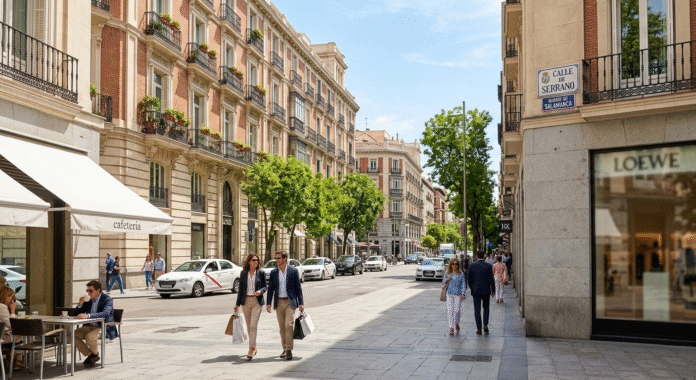
Let me tell you about the neighborhood where Madrid keeps its money, its Michelin stars, and some of its best shopping in Europe.
Salamanca – often called Madrid’s “Beverly Hills” or the “Golden Mile” – is where the city puts on its most polished face. This is where diplomats live in grand 19th-century mansions, where Louis Vuitton and Hermès feel at home, and where you’re more likely to see a Bentley than a bicycle.
But here’s what surprised me about Salamanca: it’s not snooty or exclusionary. Yes, it’s elegant. Yes, it’s expensive. But unlike some luxury neighborhoods that feel like gated compounds, Salamanca welcomes anyone who wants to window shop on Calle Serrano, sip coffee at a sidewalk café, or wander through world-class museums that most tourists somehow miss.
You don’t need to drop thousands at Chanel to enjoy Salamanca. You just need to appreciate beautiful architecture, tree-lined boulevards, excellent food, and that particular kind of Madrid elegance that’s sophisticated without being stuffy.
Let me show you why Salamanca deserves a place on your Madrid itinerary, even if luxury shopping isn’t your thing.
What Makes Salamanca Special?
Salamanca is Madrid’s planned neighborhood – and you can tell. Unlike the organic, medieval chaos of La Latina or the bohemian improvisation of Malasaña, Salamanca was designed from scratch in the mid-1800s by José de Salamanca y Mayol, the Marquis of Salamanca (yes, the neighborhood is named after him).
The Marquis had a vision: create an exclusive residential area for Madrid’s aristocracy and emerging bourgeoisie, with wide boulevards, elegant architecture, and a grid pattern borrowed from Paris. He succeeded spectacularly.
Today, Salamanca remains one of Madrid’s wealthiest neighborhoods. Government officials, diplomats, business elite, and old-money families still live here. The architecture is consistently beautiful – neoclassical and modernist buildings with ornate balconies, ironwork details, and that honey-colored stone that glows in afternoon light.
But what makes Salamanca interesting for visitors isn’t wealth or exclusivity – it’s the concentration of excellent things: world-class shopping, Michelin-starred restaurants, under-visited museums, beautiful streets perfect for strolling, and proximity to Retiro Park.
Think of it as Madrid’s most polished neighborhood, where everything works, everything’s clean, and everything’s been designed to please.
The Golden Mile: Shopping on Calle Serrano & Ortega y Gasset
Let’s start with what Salamanca is famous for: shopping. Specifically, the “Golden Mile” – Madrid’s answer to Fifth Avenue, Bond Street, or the Champs-Élysées.
Calle Serrano: The Main Event
Calle Serrano runs from Plaza de la Independencia (by Puerta de Alcalá) up to Plaza de la República Argentina. This is Madrid’s luxury shopping headquarters.
What you’ll find:
- International luxury brands: Louis Vuitton, Gucci, Chanel, Hermès, Prada, Versace, Dior
- Spanish luxury: Loewe (Spain’s premier leather goods brand, flagship at #34)
- High-end jewelers: Chopard, Suárez, Cartier
- El Corte Inglés (#47): Spain’s department store with luxury sections
- ABC Serrano (#61): Beautiful shopping center in a historic building
The street is immaculate – wide sidewalks, new trees, elegant storefronts. Even if you’re not buying, window shopping here is entertainment. The displays are artful, the architecture is beautiful, and people-watching is prime.
Pro tip: The Loewe flagship store at Serrano 34 is worth visiting even if you’re not buying. It’s a beautiful space showcasing Spain’s finest leather craftsmanship.
Calle Ortega y Gasset: The Other Golden Street
Runs parallel to Serrano and equally luxurious. This street is sometimes called the true “Golden Mile” because of its density of ultra-high-end brands.
Notable stops:
- More Hermès, Chanel, luxury boutiques
- Callejón de Jorge Juan (perpendicular street with trendy restaurants and bars)
- Less touristy than Serrano, more local shoppers
Other Shopping Streets
Calle Velázquez: Mix of luxury and mid-range brands, plus galleries and auction houses
Calle Goya: More accessible shopping, department stores, closer to “normal” Madrid retail
Calle Claudio Coello: Designer boutiques and home décor stores
Reality check: You don’t need to buy anything to enjoy Salamanca’s shopping streets. But if you DO want to shop:
- Mid-range brands: Mango (Serrano 60, huge flagship), Zara, El Corte Inglés
- Spanish luxury you can maybe afford: Loewe accessories, Aristocrazy jewelry, Tous
- Actually affordable: There’s a Primark on Calle Conde de Peñalver (irony!)
Museums: Salamanca’s Hidden Cultural Treasures
Here’s what most tourists miss: Salamanca has several excellent museums that see a fraction of the Prado‘s crowds.
Museo Lázaro Galdiano
Location: Calle Serrano 122
Entry: €7 (free last hour before closing)
Time needed: 1.5-2 hours
This is my favorite of Salamanca’s museums. José Lázaro Galdiano was an art collector who donated his mansion and 13,000-piece collection to the state. The result is a house museum stuffed with treasures:
- Paintings: Goya, El Bosco (Hieronymus Bosch), Constable, Gainsborough
- Decorative arts: Clocks, jewelry, enamelwork, armor
- The building itself: An Italian-style palazzo with gorgeous rooms
It’s intimate, manageable, never crowded, and you get to see masterworks without fighting tour groups. The Goya room alone is worth the visit.
Pro tip: The summer terrace is lovely when open.
Museo Arqueológico Nacional (National Archaeological Museum)
Location: Calle Serrano 13
Entry: €3 (free Saturdays from 2 PM, Sundays all day)
Time needed: 2-3 hours
This is Spain’s national archaeology museum, and it’s spectacular. After a complete renovation, it’s modern, well-curated, and tells Spain’s story from prehistory through the 19th century.
Highlights:
- Lady of Elche: The famous Iberian sculpture (5th-4th century BC)
- Roman mosaics and sculptures
- Visigothic crowns: Gold crowns from medieval Spain
- Ancient Egypt section
- Greek ceramics
It’s 100% accessible, has good English labeling, and never feels overwhelming despite its size.
Skip if: You’re not into archaeology/ancient history. Otherwise, this is one of Madrid’s best museums that tourists inexplicably ignore.
Museo de la Fundación Juan March
Location: Calle Castelló 77
Entry: FREE
Time needed: 1 hour
Contemporary art museum with rotating exhibitions. The Juan March Foundation is wealthy and brings in excellent shows. Check what’s on – if it interests you, it’s quality and it’s free.
Museo Sorolla
Location: Paseo del General Martínez Campos 37 (northern edge of Salamanca)
Entry: €3 (free Saturdays from 2 PM, Sundays all day)
Time needed: 1 hour
Joaquín Sorolla’s house and studio, now a charming museum. His luminous beach paintings are gorgeous, and the Andalusian garden is a peaceful oasis.
Note: Currently closed for renovations through mid-2026. Check before visiting.
Where to Eat in Salamanca
Salamanca has more Michelin stars per square kilometer than any other Madrid neighborhood. But it also has excellent options at every price point.
Michelin-Starred Excellence
Ramón Freixa Madrid (2 Michelin stars)
Modern creative cuisine. Tasting menus €145-195. Reserve well ahead. This is serious, sophisticated dining.
Kabuki Wellington (1 Michelin star)
Japanese-Mediterranean fusion. Excellent sushi and innovative dishes. €80-120 per person.
StreetXO (1 Michelin star)
David Muñoz’s more casual concept. Asian-inspired street food elevated to art. Third floor of El Corte Inglés at Serrano 47. €50-80. Fun, creative, loud.
Coque (3 Michelin stars, recently relocated to Madrid)
One of Spain’s best restaurants. Tasting menus €185+. Experience, not just a meal.
Excellent Without the Stars
Platea Madrid
Not a restaurant but a beautiful food hall in a converted theater. Multiple vendors, elegant atmosphere, good for groups with different tastes.
La Castela
Traditional Spanish food done exceptionally well. The croquetas are famous. €30-40 per person. Local favorite.
Bibo Madrid (Dani García)
Andalusian cuisine, creative tapas. More affordable than Michelin spots but still high quality. €40-60.
Lakasa
Modern Spanish cuisine. Good value for Salamanca. €35-50.
Estimar
Seafood specialist by chef Rafa Zafra. Fresh fish, Mediterranean flavors. €50-70.
Cafés & Casual
Café Gijón
Historic literary café (since 1888). Not in Salamanca proper but nearby. Go for the history and atmosphere, not culinary excellence.
Café Saigon
Vietnamese restaurant that’s been here forever. Good pho, spring rolls. €15-25. Refreshing break from Spanish food.
Verdoy
Neighborhood spot beloved by locals. Excellent coffee, breakfast, lunch menu. €12-20.
La Pecera del Círculo de Bellas Artes
Not in Salamanca but nearby. Café-restaurant with terrace overlooking Madrid. Go for views and ambiance.
The Reality of Salamanca Dining
Everything here costs more than in other neighborhoods. A lunch menu that’s €12 in La Latina might be €18 here. Coffee that’s €1.50 elsewhere is €2.50. You’re paying for location and ambiance.
Is the food better? Sometimes yes (Michelin restaurants are genuinely excellent), sometimes no (tourist traps exist here too). But everything tends to be more polished, more formal, and yes, more expensive.
What to Do in Salamanca (Besides Shop and Eat)
Stroll the Streets
Honestly, just walking through Salamanca is pleasant. The wide, tree-lined boulevards, the consistent architectural elegance, the lack of grit or chaos – it’s a different Madrid.
Best streets for wandering:
- Calle Serrano (the main spine)
- Calle Velázquez (galleries and mansions)
- Calle de José Ortega y Gasset (pure elegance)
- Around Plaza del Marqués de Salamanca (peaceful square)
Architecture Spotting
Look up as you walk. Notice:
- The ornate ironwork on balconies
- Neoclassical and modernist façades
- Grand apartment buildings that were designed as single-family palaces
- The Italian Embassy on Calle de Velázquez (beautiful building)
- ABC Serrano (historic newspaper headquarters turned shopping center)
Visit Retiro Park
Salamanca borders Retiro Park on its western edge. Many Salamanca residents treat Retiro as their backyard. After shopping or museums, walk over to the park for a break.
Close entrances from Salamanca:
- Puerta de Alcalá (iconic monument, great photo spot)
- Puerta de la Independencia
- Easy access to Retiro‘s ponds, gardens, and Crystal Palace
Art Galleries
Salamanca has numerous contemporary art galleries, particularly around Calle Claudio Coello and Calle José Ortega y Gasset. If you’re into art, gallery-hopping here is rewarding and free.
Salamanca vs. Other Madrid Neighborhoods
How does Salamanca compare to Madrid’s other notable neighborhoods?
Salamanca vs. La Latina:
- La Latina: Traditional, tapas-focused, crowded, authentic local life
- Salamanca: Polished, upscale, spacious, international luxury
- Choose La Latina for: Sunday El Rastro, tapas crawls, historic charm
- Choose Salamanca for: Shopping, fine dining, museums, elegant atmosphere
Salamanca vs. Malasaña:
- Malasaña: Alternative, vintage, nightlife, young and artsy
- Salamanca: Establishment, luxury, refined, mature and moneyed
- They’re opposites – visit both to see Madrid’s range
Salamanca vs. Chamberí:
- Chamberí: Locals’ secret, Calle Ponzano food scene, authentic and unpretentious
- Salamanca: Well-known, Golden Mile shopping, elegant and expensive
- Chamberí feels real, Salamanca feels polished
Salamanca vs. Chueca:
- Chueca: LGBTQ+ hub, trendy, energetic, diverse
- Salamanca: Conservative, traditional, homogeneous, quiet
- Different vibes entirely
Practical Tips for Visiting Salamanca
Getting There
Metro: Several stations serve Salamanca
- Serrano (Line 4): Mid-Salamanca, good for shopping streets
- Velázquez (Line 4): Central Salamanca
- Goya (Lines 2, 4): Eastern Salamanca, near Calle Goya
- Retiro (Line 2): Southern edge, near Retiro Park
- Núñez de Balboa (Lines 5, 9): Northern section
Walking: Salamanca is about 10-15 minutes walk from Retiro Park, 20 minutes from city center.
When to Visit
Best times:
- Weekday mornings: Shops open, museums quiet, pleasant strolling
- Late afternoon: Golden light on the buildings, pre-dinner drinks
- Avoid: Shops close 2-5 PM for siesta, Sundays many places closed
Seasons: Salamanca is pleasant year-round. Summer can be hot but tree-lined streets provide shade. Winter is elegant with seasonal window displays.
Time Needed
- Quick visit: 2-3 hours for shopping street stroll
- Half day: 4-5 hours including a museum and lunch
- Full day: 7-8 hours if doing serious museum time and shopping
- Combine with: Retiro Park (right next door), Chueca (nearby)
Who Will Love Salamanca
Fashion enthusiasts: The Golden Mile speaks for itself
Museum lovers: Lázaro Galdiano and Archaeological Museum are excellent
Architecture fans: Consistent 19th-century elegance and beautiful details
Foodies with budget: The Michelin restaurants are genuinely world-class
People who appreciate polish: If you like things elegant and well-maintained
Window shoppers: You don’t need to buy to enjoy luxury displays
Who Might Skip It
Budget travelers: Everything costs more here
Those seeking “authentic” Madrid: This is polished Madrid, not gritty authentic
Party animals: Salamanca nightlife is subdued and expensive
People with 2 days in Madrid: Prioritize La Latina, city center, Retiro first
Money-Saving Tips
- Museums are free certain hours (Lázaro Galdiano last hour, Archaeological Museum Saturday afternoons/Sunday)
- Window shop without buying
- Have coffee or snacks, not full meals
- Visit galleries (free)
- Stroll through as part of walking to/from Retiro Park
The Salamanca Attitude
Here’s the thing about Salamanca: it knows it’s elegant, wealthy, and prestigious. It doesn’t apologize for being expensive or exclusive. But it also doesn’t actively exclude anyone.
You can walk down Calle Serrano in jeans and a t-shirt and no one will stop you (though you’ll feel underdressed). You can window shop without buying and no one will judge you (at least not to your face). You can sit at a café with a single coffee for an hour and no one will rush you.
Salamanca is aspirational rather than actively elitist. It wants you to admire it. It’s designed to impress. And honestly, it succeeds.
The neighborhood has a particular kind of Madrid pride – this is what Madrid looks like when it wants to show off its sophistication. It’s the neighborhood diplomats are driven through. It’s where international luxury brands choose to set up shop. It’s what Madrid considers its “best face forward.”
Is it my favorite Madrid neighborhood? No. I prefer the messier authenticity of La Latina or the creative energy of Lavapiés. But Salamanca is undeniably impressive. The architecture is beautiful. The shopping is world-class if that’s your thing. The museums are genuinely excellent. The restaurants at the high end are spectacular.
And walking down those wide, tree-lined boulevards on a sunny afternoon, with the honey-colored buildings glowing and elegant people taking their time, you understand why Madrid is proud of this neighborhood.
Final Thoughts
Salamanca won’t give you the “real” Madrid that guidebooks romanticize. You won’t find hidden taverns where locals have been drinking vermouth for 80 years. You won’t stumble upon spontaneous flamenco or gritty street art.
What you will find is Madrid at its most polished and prosperous. Beautiful architecture on every block. World-class museums most tourists miss. Shopping that rivals any European capital. Restaurants that deserve their Michelin stars.
Think of Salamanca as one note in Madrid’s symphony. It’s not the whole song, but it’s an important note. It shows you what Madrid aspires to be – elegant, sophisticated, European in the old-world sense.
Visit Salamanca to see beautiful things. To window shop on streets designed to impress. To visit museums without crowds. To eat spectacularly if you have the budget. To understand that Madrid isn’t just tapas bars and medieval streets – it’s also this: polished, wealthy, intentionally glamorous.
You don’t need to spend a fortune here. You don’t even need to buy anything. Just walk the streets, admire the architecture, peek into the beautiful shops, maybe visit a museum that deserves more attention.
And if you can afford it, have lunch at one of those Michelin-starred restaurants. Because the food really is spectacular, and you’ll understand why people pay Madrid prices for that level of excellence.
Salamanca won’t steal your heart the way La Latina might. But it will impress you. And sometimes, that’s exactly what you want from a neighborhood.
FAQs:
Q: What is Salamanca Madrid known for? A: Salamanca is known as Madrid’s “Beverly Hills” and home to the Golden Mile luxury shopping district on Calle Serrano. It features international luxury brands (Louis Vuitton, Gucci, Hermès), Spain’s Loewe flagship, Madrid’s highest concentration of Michelin-starred restaurants, excellent museums like Lázaro Galdiano, and beautiful 19th-century architecture.
Q: Is Salamanca a good neighborhood in Madrid? A: Salamanca is Madrid’s most elegant and upscale neighborhood, ideal for luxury shopping, fine dining, and museum visits. It’s safe, clean, beautifully designed with tree-lined boulevards, and borders Retiro Park. However, it’s more expensive than other areas and less “authentic” than neighborhoods like La Latina or Lavapiés.
Q: Where is the Golden Mile in Madrid? A: Madrid’s Golden Mile is located in the Salamanca neighborhood, primarily on Calle Serrano and Calle Ortega y Gasset. These parallel streets from Puerta de Alcalá to Plaza de la República Argentina feature Madrid’s highest concentration of luxury brands, designer boutiques, and high-end shopping.
Q: What can you buy on Calle Serrano? A: Calle Serrano offers international luxury brands (Louis Vuitton, Gucci, Chanel, Hermès, Prada, Versace, Dior), Spanish luxury house Loewe’s flagship store, high-end jewelers, El Corte Inglés department store, and ABC Serrano shopping center. Prices range from affordable (Mango, Zara) to ultra-luxury.
Q: Is Salamanca expensive? A: Yes, Salamanca is Madrid’s most expensive neighborhood. Restaurant prices run 20-30% higher than other areas, coffee costs €2.50+ (vs €1.50 elsewhere), and hotels command premium rates. However, you can enjoy Salamanca without spending much by window shopping, visiting free/affordable museums, and strolling the beautiful streets.
Q: Should I visit Salamanca Madrid? A: Visit Salamanca if you enjoy luxury shopping, fine dining, excellent museums (Lázaro Galdiano, Archaeological Museum), or beautiful architecture. It’s worth 2-5 hours for most visitors. Skip if you have limited time (only 2 days in Madrid), prefer budget travel, or want “authentic” local experiences over polished elegance.
Q: Where do rich people live in Madrid? A: Wealthy madrileños primarily live in Salamanca neighborhood, particularly around Calle Serrano, Velázquez, and Ortega y Gasset. This area houses diplomats, government officials, business elite, and old-money families in grand 19th-century apartments and mansions. It’s Madrid’s most prestigious residential area.
Q: What museums are in Salamanca Madrid? A: Salamanca has several excellent museums: Museo Lázaro Galdiano (€7, art collection in historic mansion), National Archaeological Museum (€3, free weekends, Spanish ancient treasures), Museo Juan March (free contemporary art), and Museo Sorolla (€3, currently closed for renovation until mid-2026).
Q: How do I get to Salamanca Madrid? A: Multiple metro stations serve Salamanca: Serrano (Line 4) for mid-Salamanca, Velázquez (Line 4) for central area, Goya (Lines 2, 4) for eastern section, Retiro (Line 2) for southern edge near the park, and Núñez de Balboa (Lines 5, 9) for northern section. It’s also 10-15 minutes walk from Retiro Park.
Q: Can you visit Salamanca Madrid on a budget? A: Yes! Window shop luxury stores (free), visit museums during free hours (Archaeological Museum free Saturday afternoons/Sundays, Lázaro Galdiano free last hour), stroll beautiful boulevards (free), explore art galleries (free), have coffee instead of meals, and combine with free Retiro Park visit. You don’t need to spend much to appreciate Salamanca’s elegance.

 18°C
18°C - Temperature
- Precipitation
- Rain Chance
- Wind
- Humidity
- Pressure







, Michelin restaurants, Lázaro Galdiano Museum & Madrid's Beverly Hills. Complete neighborhood guide)