🎁 FREE Download: Semana Santa Madrid 2026 Planning Guide
Get your free PDF guide with:
✅ Printable day-by-day itinerary
✅ Interactive procession schedule
✅ Restaurant & hotel recommendations
✅ Budget calculator spreadsheet
✅ Spanish phrases cheat sheet GET IT FREE
Join 5,000+ travelers getting insider Madrid tips. Unsubscribe anytime.
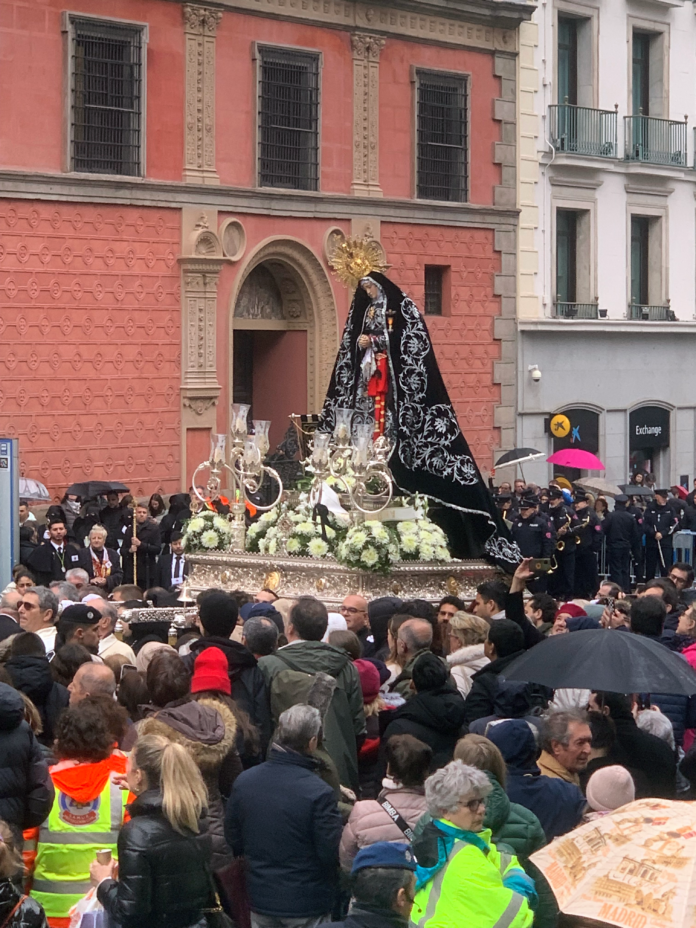
Every year around late March, something magical happens in Madrid. The streets fill with the scent of incense, the sound of drums echoes through narrow alleyways, and centuries-old traditions come alive. This is Semana Santa—Holy Week—and if you’re planning to be in Madrid between March 29 and April 5, 2026, you’re in for an unforgettable cultural experience.
I’ve experienced over 20 Semana Santas in Madrid, and I still get goosebumps when the *Procesión del Silencio* passes in complete silence. Whether you’re religious or not, there’s something profound about witnessing traditions that have been passed down for over 400 years.
But here’s what most travel guides won’t tell you: Madrid’s Semana Santa is completely different from what you’ll find in Seville or other Andalusian cities. It’s more intimate, more authentic, and far less overwhelming. While Seville performs for a million tourists, Madrid simply… lives its traditions.
Let me show you how to experience it like a Madrileño.
📑 Table of Contents
- What is Semana Santa in Madrid?
- Madrid vs Seville: Why Choose Madrid
- Semana Santa 2026: Key Dates & Schedule
- Top 10 Processions You Must See
- Traditional Foods to Try
- Where to Watch: Best Local Spots
- Practical Information & Tips
- 5-Day Semana Santa Itinerary
- Budget Breakdown
- Frequently Asked Questions
Reading time: 45 minutes | Bookmark this page for your trip planning!
What is Semana Santa in Madrid?
Semana Santa (Holy Week) is the week leading up to Easter Sunday, commemorating the Passion, Death, and Resurrection of Jesus Christ. In Madrid, this manifests as a series of solemn religious processions where cofradías (brotherhoods) carry elaborate floats (pasos) depicting scenes from the Passion through the city streets.
But don’t let the religious origins fool you into thinking this is only for Catholics. Even secular Madrileños appreciate Semana Santa as a profound cultural and artistic tradition. The craftsmanship of the floats, some weighing over 2 tons and carried by 40+ men (costaleros), is breathtaking. The music, the silence, the collective reverence—it’s an experience that transcends religious belief.
What Makes Madrid’s Semana Santa Special?
Authenticity Over Tourism: Unlike Seville, where Semana Santa has become an international spectacle with advance hotel bookings required a year out, Madrid’s celebrations remain refreshingly authentic. Yes, tourists come, but you’re watching alongside genuine Madrileños who’ve attended these same processions their entire lives.
Intimate Scale: Madrid has around 30 active cofradías, compared to Seville’s 60+. This means processions feel personal rather than overwhelming. You can actually see the floats, hear the music, and soak in the atmosphere without being crushed by crowds.
UNESCO World Heritage Backdrop: Many processions pass through Madrid’s historic center, a UNESCO World Heritage site. Watching a 400-year-old tradition wind through 300-year-old streets creates a layering of history that’s impossible to replicate.
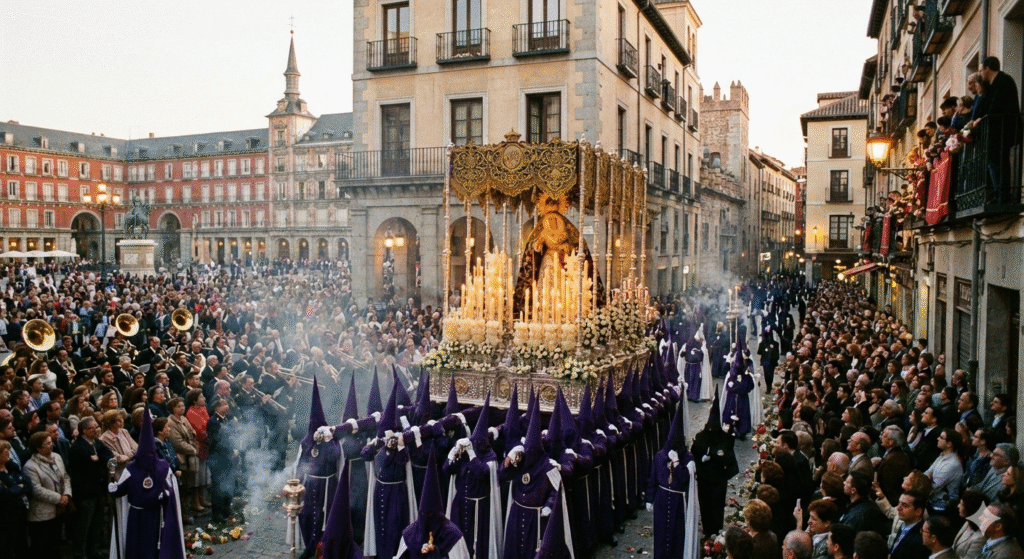
The Procesión del Silencio: Madrid’s most unique tradition. Imagine a procession moving through the city with zero sound except the rhythmic pounding of drums. No one speaks. No music plays. Just drums, footsteps, and the occasional shuffle of the costaleros. It’s haunting, beautiful, and unforgettable.
Madrid vs Seville: Why Choose Madrid for Semana Santa.
I know what you’re thinking. “But isn’t Seville THE place for Semana Santa?” Let me give you the honest comparison:
Seville’s Semana Santa:
- Scale: 60+ cofradías, elaborate productions
- Crowds: 1,000,000+ visitors descend on a city of 700,000
- Hotels: Booked 6-12 months in advance, prices 400% higher
- Atmosphere: Spectacular but can feel like a performance for tourists
- Accessibility: Standing room only, difficult to see
- Experience: Grand, famous, photogenic
Madrid’s Semana Santa:
- Scale: 30+ cofradías, deeply traditional
- Crowds: Manageable mix of locals and visitors
- Hotels: Bookable 1-2 months ahead, 20-30% price increase
- Atmosphere: Authentic neighborhood celebrations
- Accessibility: Easy to find good viewing spots
- Experience: Intimate, real, lived-in
The Verdict
If you want the MOST FAMOUS Semana Santa with international recognition: choose Seville.
If you want an AUTHENTIC Spanish cultural experience without tourist circus chaos: choose Madrid.
Think of it this way: Seville is Broadway. Madrid is an intimate theater where the performance is for the community, not the cameras.
Semana Santa 2026: Key Dates & Schedule.
Mark your calendar. Semana Santa 2026 runs from March 29 (Palm Sunday) through April 5 (Easter Sunday).
Here’s your day-by-day breakdown:
Friday, March 27 – Viernes de Dolores
The preview. While not officially part of Semana Santa, this is when the first processions begin.
What to see: Cristo del Pozo y Nuestra Señora de los Dolores
Vibe: Quiet anticipation, locals starting to gather
Sunday, March 29 – Domingo de Ramos (Palm Sunday) ⭐
The grand opening. This is when Semana Santa officially begins with Madrid’s most colorful and joyful procession.
Main event: Nuestro Padre Jesús del Amor, affectionately called “La Borriquita” (The Little Donkey)
Why it’s special: Depicts Jesus entering Jerusalem on a donkey, surrounded by palm branches
Route: Starts at Almudena Cathedral (3:15 PM) → Gran Vía → Puerta del Sol (around 6:30 PM)
Crowd level: High but manageable
Local tip: Don’t watch from Puerta del Sol. It’s packed with tourists. Instead, position yourself along Calle Mayor between the cathedral and Sol. You’ll get the same procession with half the crowds.
Monday, March 30 – Wednesday, April 1
The calm before the storm. These three days feature smaller, more intimate processions.
Why visit these days:
- See processions without crowds
- Experience neighborhood cofradías
- Explore Madrid with easier access to attractions
- Better restaurant availability
What to do: Use these days for museums (Prado, Reina Sofía), day trips (Toledo has its own beautiful Semana Santa), and exploring neighborhoods.
Thursday, April 2 – Jueves Santo (Maundy Thursday) ⭐⭐
Things get serious. Multiple major processions, including Madrid’s most unique tradition.
Main event: Procesión del Silencio
Time: Starts around 8:00 PM
What makes it special: Absolute silence. No music. Only drums. Spectators are expected to remain completely quiet as the procession passes.
Experience level: Profound, moving, unforgettable
Other processions: Cristo de la Misericordia, Jesús el Pobre, several more throughout the day
Public holiday: Many businesses close early
Friday, April 3 – Viernes Santo (Good Friday) ⭐⭐⭐
THE big day. This is peak Semana Santa. If you can only experience one day, make it this one.
Number of processions: 10+ major processions throughout the day and night
Public holiday: Everything closes except processions, tourist attractions, and some restaurants
Atmosphere: The entire city shifts into a different gear. Solemn, reflective, deeply traditional.
Main processions:
- Cristo de la Fe y del Perdón (morning)
- Cristo de los Alabarderos (afternoon) – Military procession with Royal Guard
- Jesús el Pobre (evening)
- Cristo de la Buena Muerte (night)
Duration: Some processions take 4-5 hours to complete their routes
What to eat: Traditional potaje de vigilia (Lent stew) and torrijas (Spanish Easter French toast)
Saturday, April 4 – Sábado Santo (Holy Saturday)
The transition day. Mourning shifts toward hope.
Main procession: La Soledad (Virgin of Solitude)
Vibe: Quiet preparation for Easter celebration
What locals do: Family dinners, preparing for tomorrow’s feast
Sunday, April 5 – Domingo de Resurrección (Easter Sunday)
Celebration! Christ has risen, and Madrid erupts in joy.
Main event: Tamborrada in Plaza Mayor (drum ceremony celebrating resurrection)
Church services: Packed with families in their best clothes
Tradition: Elaborate family lunches that stretch for hours
Restaurants: Book ahead if you want Sunday lunch out—Madrileños take Easter lunch very seriously
Tourist tip: This is actually a great day to visit museums. Everyone’s at church or with family, so attractions are emptier than usual.
Top 10 Processions You Must See in Madrid.
With 30+ cofradías and multiple processions daily, you can’t see everything. Here are the absolute must-sees, ranked by a local who’s watched them all.
1. Procesión del Silencio (Thursday, ~8:00 PM)
Why it’s #1: This is Madrid’s most unique and emotionally powerful procession. The complete silence, broken only by rhythmic drums, creates an atmosphere unlike anything else you’ll experience.
The tradition: As the procession passes, all street lights are dimmed. The only illumination comes from candles carried by nazarenos (hooded penitents). Spectators must remain absolutely silent—no talking, no phones, no sound except the drums.
What you’ll see: Cristo del Gran Poder and Virgen de la Soledad
Route: Through Atocha neighborhood (Calle del León, Calle del Prado)
Duration: About 3 hours
Pro tips:
- Arrive 30-45 minutes early for a good spot
- Turn off phone (seriously, no exceptions)
- Bring tissues (it’s more moving than you expect)
- No flash photography—this isn’t negotiable
- Dress warmly—spring nights are cold, and you’ll be standing still
My experience: I’ve brought friends from 12 different countries to this procession. Every single one has been moved to tears. It’s that powerful.
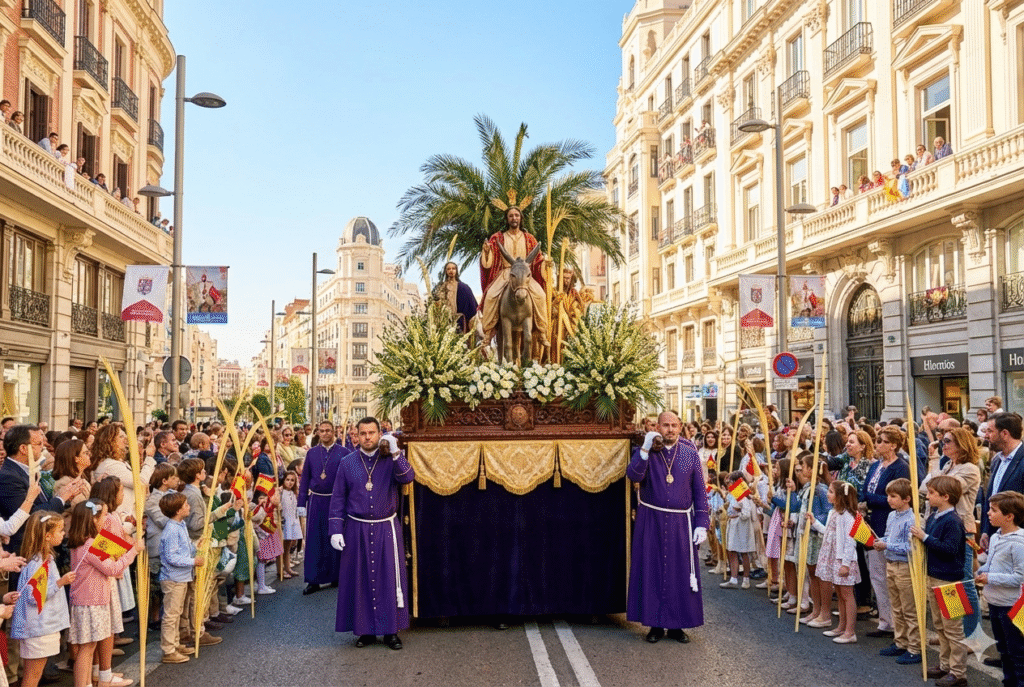
2. Nuestro Padre Jesús del Amor – “La Borriquita” (Palm Sunday, 3:15 PM)
Why it’s essential: This is Madrid’s most joyful, colorful procession. Unlike the somber tone of later in the week, this celebrates Jesus entering Jerusalem—a moment of hope and triumph.
What you’ll see: A float depicting Jesus riding a donkey, surrounded by palm fronds and children dressed as biblical characters. The float is covered in flowers and accompanied by a full band.
Route:
- Starts: Iglesia de Santiago y San Juan Bautista (3:15 PM)
- Through: Gran Vía (around 5:00 PM)
- Passes: Puerta del Sol (around 6:30 PM)
- Ends: Back at starting church (around 9:00 PM)
Best viewing spots:
- Calle Mayor (between Bailén and Sol) – great visibility, less crowded than Sol
- Corner of Gran Vía and Calle Alcalá – wider street, easy photos
- Plaza de la Villa – historic square with café seating
What to bring: Sunglasses (it’s usually sunny), comfortable shoes, maybe a small stool if you’re short
Local tradition: Children wave palm branches (you can buy them from street vendors for €3-5)
3. Cristo de Medinaceli (Good Friday, times vary)
Why it’s important: This is the most venerated Christ image in Madrid. Throughout the year, thousands of Madrileños line up on the first Friday of each month to kiss the feet of this statue. During Semana Santa, it takes to the streets.
What makes it special: The devotion is palpable. This isn’t a tourist attraction—these are genuinely faithful Madrileños following their most beloved religious image.
What you’ll see: An incredibly realistic 17th-century sculpture of Jesus carrying the cross. The craftsmanship is stunning—you can see individual strands of hair, realistic skin tones, genuine fabric clothing.
Route: From Jesús de Medinaceli Basilica (Calle Duque de Medinaceli) through city center
Crowd warning: This one gets VERY crowded. It’s one of the few Madrid processions that rivals Seville-level crowds.
Pro tip: If you want to see the statue up close without crowds, visit the basilica on any day except the first Friday of the month. It’s free, peaceful, and you can take your time.
4. Jesús el Pobre (Good Friday, evening)
Why you’ll love it: This procession takes you through Lavapiés, Madrid’s most multicultural, working-class neighborhood. The contrast between the centuries-old religious tradition and the vibrant immigrant community creates a uniquely Madrid moment.
What you’ll see: A simple, moving image of Jesus as a poor man, carried by working-class costaleros through narrow streets lined with balconies full of watching neighbors.
Route: Lavapiés neighborhood streets
Duration: 2-3 hours
Atmosphere: Intimate, neighborhood-focused, authentic
Why locals love it: This feels like what Semana Santa was before tourism—a neighborhood honoring its traditions.
Bonus: After the procession, Lavapiés has fantastic cheap restaurants. Try Indian, Moroccan, or traditional Spanish—all within two blocks.
5. Cristo de los Alabarderos (Good Friday, afternoon)
Why it’s spectacular: This is the military procession, featuring the Royal Guard in full ceremonial uniforms carrying a float used exclusively by Spanish royalty.
What you’ll see:
- Royal Guard in 19th-century dress uniforms
- Elaborate military precision
- One of the most ornate floats in Madrid
- Possible royal family attendance (they sometimes watch)
Route: From Royal Palace area through city center
Duration: 3-4 hours
Photo opportunity: Best in Madrid—the uniforms are incredible
Historical note: This cofradía was founded in 1615 to serve the Spanish royal family. You’re watching a tradition that has served kings for over 400 years.
6. La Macarena de Madrid (Good Friday)
Wait, isn’t La Macarena in Seville?: Yes, but Madrid has its own version, and locals are fiercely proud of it.
What you’ll see: A beautiful Virgin Mary statue dressed in elaborate robes, carried through the streets accompanied by heartfelt saetas (improvised flamenco-style religious songs sung from balconies).
Why it’s special: When someone spontaneously breaks into a saeta from a balcony, the entire procession stops. The singer pours their heart out in a raw, emotional performance. Then the procession continues in silence. It’s incredibly moving.
Route: Through Malasaña neighborhood
Best experience: Let yourself be surprised by a saeta—you can’t plan for these moments
7. Procesión del Encuentro (Good Friday)
Why it’s unique: This procession depicts the moment Jesus meets his mother Mary on the way to Calvary. Two separate processions—one with Christ, one with Mary—converge in a choreographed “meeting” in Plaza Mayor.
What you’ll see: Both floats bow toward each other three times in the plaza. The symbolism and execution are beautiful.
Time: Late afternoon Good Friday
Best viewing: Arrive at Plaza Mayor an hour early for a spot near the center
8. Santísimo Cristo de la Fe y del Perdón (Good Friday morning)
Why it matters: This is one of the longest processions, winding through the entire historic center for nearly 5 hours.
What you’ll see: An elaborate 18th-century float depicting the crucifixion
Route: Starts in Chamberí, passes through Gran Vía, ends in Centro
Duration: 4-5 hours
Pro tip: You don’t need to watch the entire thing. Pick one spot along the route, watch it pass (about 15-20 minutes), then go explore.
9. Virgen de la Soledad (Holy Saturday evening)
Why it’s poignant: This is the last major procession before Easter. The Virgin Mary, alone (soledad = solitude) after her son’s death, is carried through dark streets.
Atmosphere: Deeply somber, reflective, quiet
What you’ll see: A black-robed Virgin Mary, carried by women (unusual—most cofradías are men)
Route: Through Salamanca neighborhood
Duration: 2-3 hours
Symbolism: This represents the darkest moment—Christ is dead, hope seems lost. It makes Sunday’s resurrection celebration even more powerful.
10. Cristo del Gran Poder (Thursday)
Why it’s impressive: One of the most artistically significant floats, featuring a stunning baroque sculpture from the 17th century.
What you’ll see: Christ carrying the cross, surrounded by incredibly detailed biblical figures
Route: Through Centro and Austrias neighborhoods
Crowd level: Moderate
Art history note: The main sculpture is attributed to Juan Martínez Montañés, one of Spain’s greatest baroque sculptors. You’re seeing a genuine masterpiece.
Traditional Semana Santa Foods in Madrid.
Forget what you think you know about Easter food. Spanish Semana Santa cuisine is its own glorious category, and Madrid does it with particular flair. Here’s what you absolutely must try:
1. Torrijas – The Star of Semana Santa ⭐⭐⭐
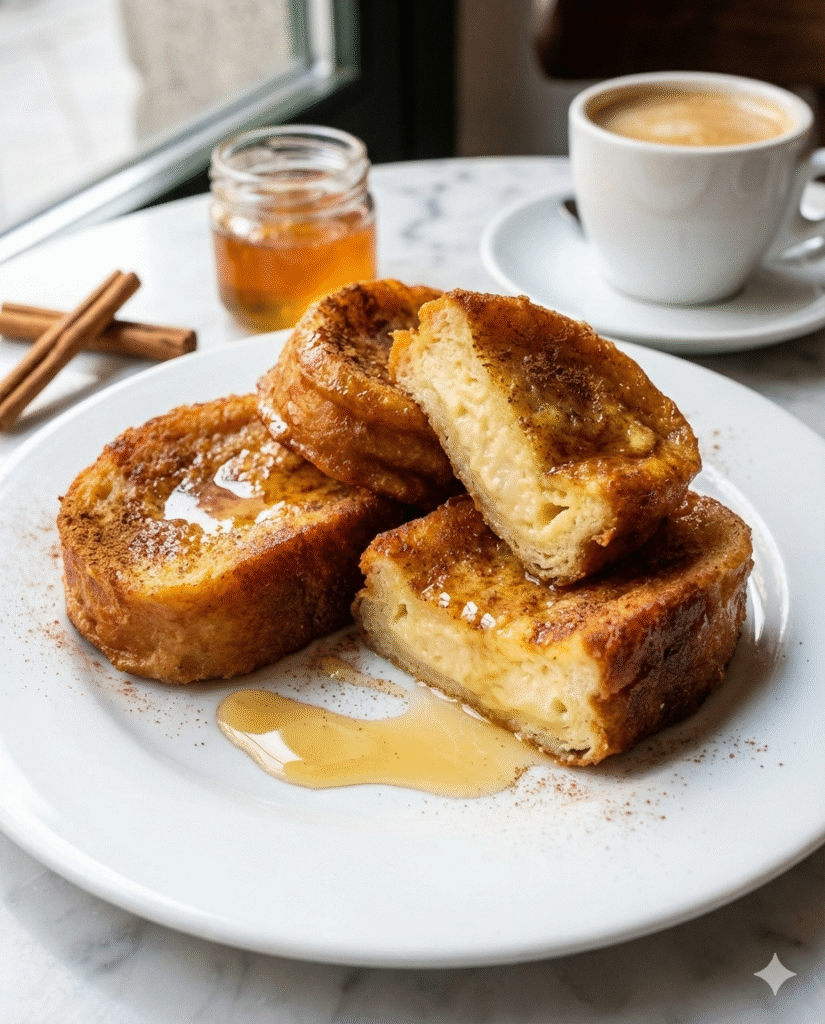
If you only try one thing, make it torrijas. Think French toast, but elevated to an art form.
What they are: Thick slices of bread (usually a day or two old) soaked in milk or wine, dipped in egg, fried until golden, then drenched in honey or dusted with cinnamon sugar.
Why they’re special: Every family has their own recipe passed down through generations. Some use wine instead of milk. Some add orange zest. Some serve them warm, others cold. All are delicious.
Where to get the best:
Casa Mira (Carrera de San Jerónimo, 30)
- In business since 1842
- Famous for turrón (nougat) but their torrijas are legendary
- Price: €2.50 each
- Style: Classic milk-soaked, heavy on honey
- Lines can be long—worth it
Viena Capellanes (Multiple locations)
- Modern take on traditional recipe
- Try: Wine-soaked torrijas with cinnamon ice cream
- Price: €3.50-4.50 each
- Locations throughout city center
La Mallorquina (Puerta del Sol)
- Tourist spot, but torrijas are genuinely good
- Convenient if you’re watching Sol processions
- Price: €2.80 each
- Often sold out by evening
Your neighborhood panadería
- Honestly? The best torrijas are often at random local bakeries
- Look for hand-written signs saying “TORRIJAS”
- Price: €1.50-2.50
- Ask which style they make
Pro tips:
- Try multiple versions—milk vs wine, warm vs cold
- Eat them fresh (within a few hours of purchase)
- Perfect afternoon snack between processions
- Pair with coffee or hot chocolate
My favorite: Milk-soaked, served warm, extra cinnamon, with a glass of sweet wine. You’re welcome.
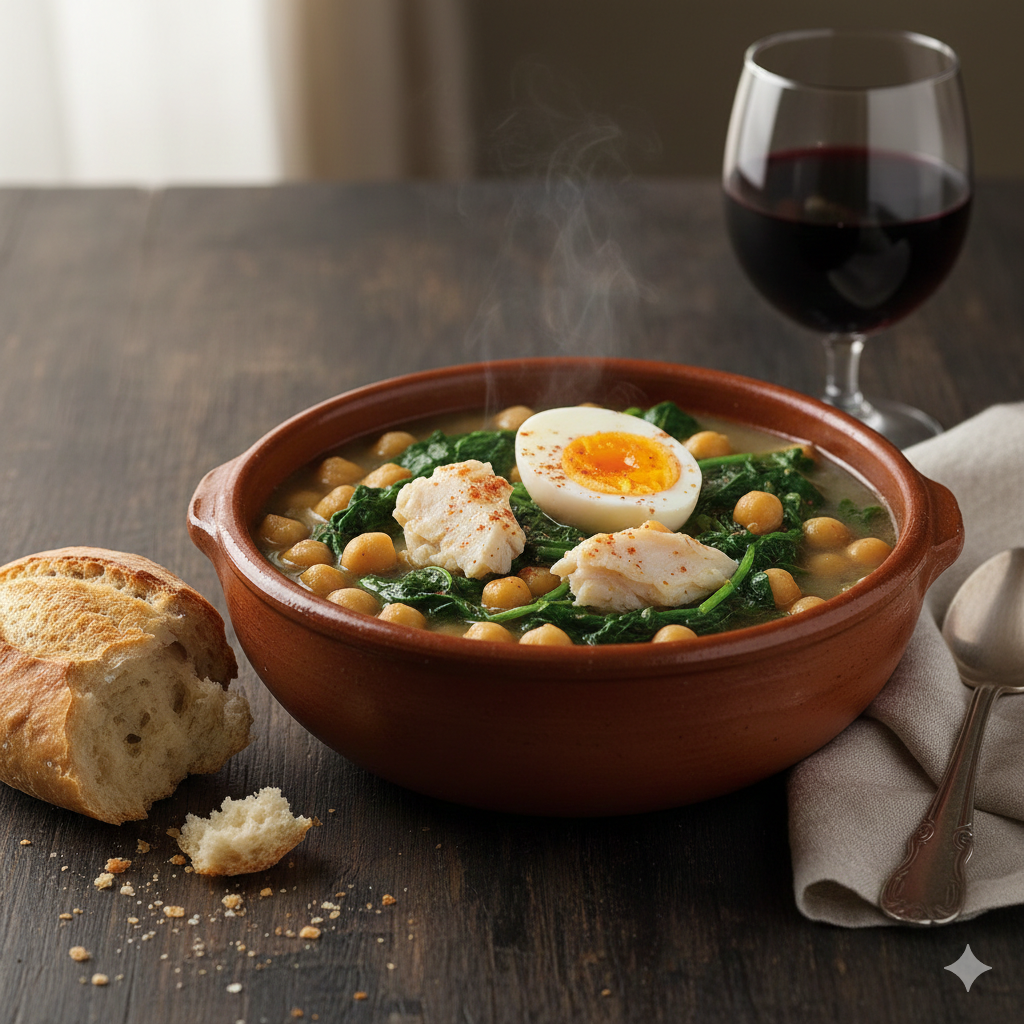
2. Potaje de Vigilia – Lent Stew
What it is: A hearty chickpea stew with spinach, salt cod, and spices. NO meat (it’s a fasting dish for Good Friday when Catholics traditionally abstain from meat).
Why it’s traditional: During Lent and especially Holy Week, Catholics historically didn’t eat meat on Fridays. This was the rich, filling meal that got them through fasting days.
Where to try it:
- Most traditional restaurants have it as a special during Semana Santa
- Casa Ciriaco (near Opera) – classic Madrid version
- Taberna La Bola (famous for cocido, makes excellent potaje)
- Price: €8-12 for a generous bowl
What it tastes like: Earthy, rich, surprisingly filling. The salt cod adds depth, the chickpeas give heft, and the spinach freshness. It’s comfort food that happens to be religious.
Pro tip: Order it with good bread for dipping. This is stick-to-your-ribs food that’ll fuel you for hours of procession-watching.
3. Bacalao (Salt Cod) Dishes
Why cod?: Historically, salt cod was one of the few “luxury” proteins available during Lent when fresh meat was forbidden.
Dishes to try:
Buñuelos de Bacalao (Cod fritters)
- Crispy, fluffy fritters made with salted cod
- Found at most bars as tapas
- Perfect with beer or wine
- Price: €6-8 for 6-8 pieces
Bacalao a la Vizcaína
- Salt cod in a red pepper and tomato sauce
- Basque-style preparation popular in Madrid
- Available at most traditional restaurants
- Price: €14-18 main course
Soldaditos de Pavía
- Cod strips battered and fried
- Literally translates to “Little soldiers from Pavia”
- Bar snack perfection
- Price: €8-10
Best places:
- Casa Labra (since 1860) – Their cod croquettes are legendary
- La Trainera (upscale seafood)
- Any traditional tasca in La Latina
4. Pestiños & Bartolillos – Sweet Fried Pastries
Pestiños: Fried dough pieces flavored with anise and sesame, soaked in honey
Bartolillos: Triangular fried pastries filled with custard cream
Where to find them:
- Old-school bakeries in Lavapiés, La Latina
- Confitería El Riojano (since 1855)
- Malacatín (bakery chain with good traditional pastries)
- Price: €1-2 each
When to eat them: Mid-afternoon with coffee, or after dinner as dessert
5. Rosquillas Tontas y Listas (“Silly” and “Smart” Donuts)
What they are: Traditional Madrid donuts that appear starting in Semana Santa but peak around San Isidro festival (May).
The difference:
- Tontas (Silly): Plain, no glaze
- Listas (Smart): Glazed with lemon icing
Local joke: The “smart” ones got dressed up with glaze.
Where to buy: Any traditional bakery. Look for them starting Easter weekend.
Price: €1.20-1.80 each
6. Monas de Pascua – Easter Cakes
What they are: Elaborately decorated cakes traditionally given by godparents to godchildren on Easter Monday.
Madrid version: Round sponge cakes decorated with hard-boiled eggs, chocolate figures, or elaborate designs.
Where to see them: Bakery windows throughout Semana Santa—they’re as much art as food.
To buy: Order ahead at pastelerías if you want a traditional one. Available Easter weekend only.
7. Chickpeas & Spinach (Espinacas con Garbanzos)
A simpler, everyday version of potaje that locals eat throughout Lent.
Where: Any menú del día (daily menu) at neighborhood restaurants
Price: €10-12 for full lunch menu including this dish
Why it’s good: Simple, flavorful, cheap, filling—everything Spanish home cooking should be
Budget for Semana Santa Food
Daily food budget:
- Budget: €25-30/day (bakery breakfast, menú del día lunch, tapas dinner)
- Mid-range: €40-50/day (café breakfast, restaurant lunch, nice dinner)
- Splurge: €80+/day (good restaurants, wine pairings, fine dining)
Must-budget items:
- Torrijas: €2-4 each (try at least 3 different places = €12)
- Potaje: €10-12
- Cod tapas: €15-20 for variety
- Traditional bakery items: €10-15 total
My strategy: Splurge on one nice Semana Santa meal (€40-50), eat menú del día lunches (€12-15), and fill gaps with bakery items and tapas.
Where to Watch Processions: Local Insider Spots.
This is where most guides fail you. They’ll tell you to go to Puerta del Sol or Plaza Mayor—the two WORST places to watch processions. Too crowded, can’t see anything, and frankly, locals avoid them.
Here’s where Madrileños actually watch:
Best Viewing Spots (Tested by 20+ Years of Local Experience)
1. Calle Sacramento (Between Plaza Mayor and Calle Segovia)
Why it’s perfect:
- Narrow medieval street creates intimate atmosphere
- Stone buildings and old streetlamps = gorgeous backdrop
- Multiple processions pass through
- Local families bring chairs and camp out
- Small bars nearby for bathroom breaks
Which processions: Most major ones, including Silencio and several Good Friday processions
How to do it:
- Arrive 30 minutes early
- Bring something to sit on (small stool or cushion)
- Stand near corner of Calle Segovia for easy exit
Nearby facilities: Bar Las Cuevas (bathrooms, drinks, tapas)
Why locals love it: This is “old Madrid” at its best—narrow streets, historic buildings, neighborhood vibe.
2. Plaza de la Villa
Why it’s perfect:
- Historic square with beautiful architecture
- Plenty of space but still intimate
- Several cafés with terraces (reserve ahead)
- Clean bathrooms nearby (City Hall has public ones)
- Great for photos—the Baroque buildings are stunning backdrop
Which processions: Most that go through Centro, including Borriquita and several Good Friday processions
Café strategy:
- Reserve terrace table at Café del Oriente or nearby spots
- Order drinks/food, keep seat for entire procession
- Split cost among friends (€15-20 each for drinks + view)
- Best for: Elderly, families with small kids, anyone who can’t stand long
Photo opportunity: The steps of Casa de la Villa (old City Hall) offer elevated view—arrive very early for these spots
3. Calle Mayor (Between Bailén and Sol)
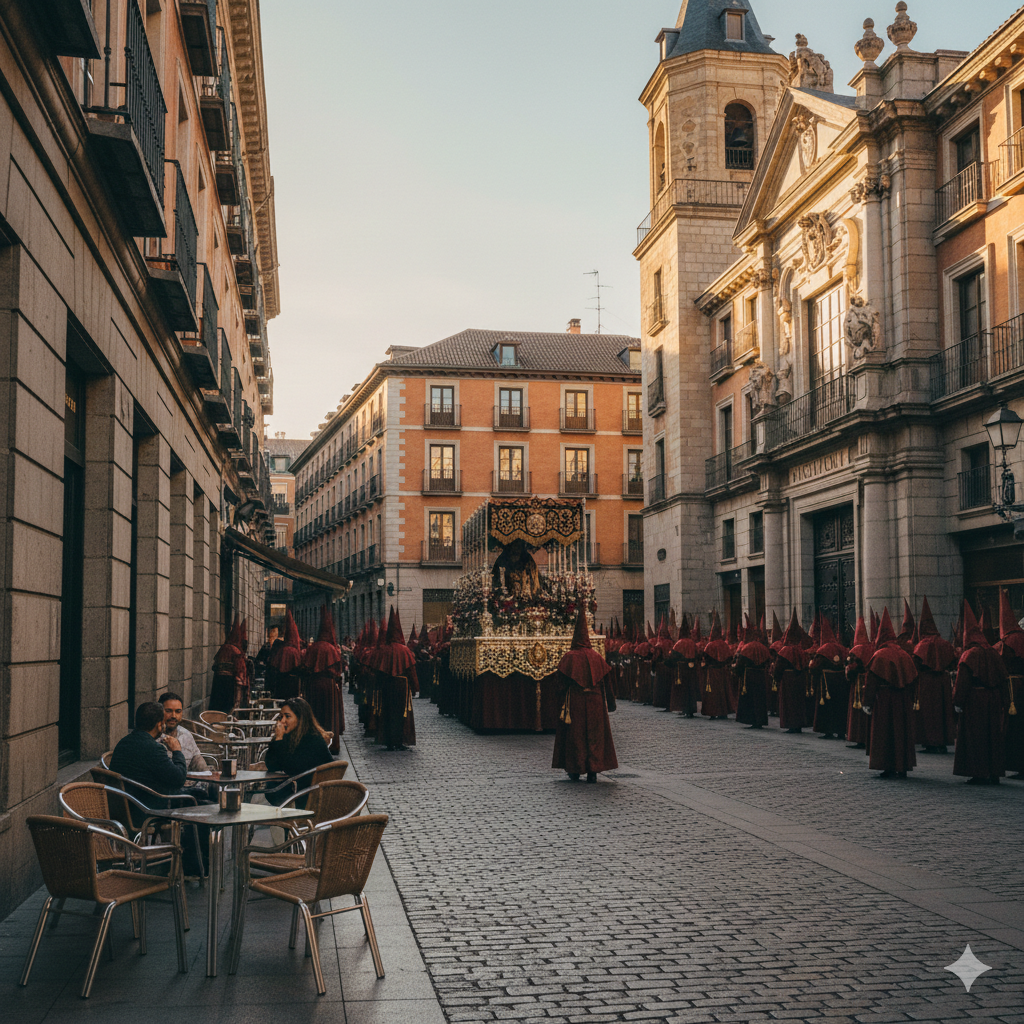
Why it’s perfect:
- Wide street = good visibility for everyone
- Historic route through UNESCO World Heritage zone
- Multiple cofradías use this path
- Easy to move around if needed
- Several viewing “layers” (front row, back row, café terraces)
Best stretch: Between Calle Bailén and Plaza Mayor (before it gets too crowded near Sol)
Which processions: Borriquita, many Good Friday processions
Strategy:
- Stand on south side (sunny in afternoon)
- Position near cross-streets for easy exit
- Cafés like Taberna del Alabardero have terrace seats
For photographers: This street offers unobstructed shots with architectural background
4. Barrio de los Austrias Side Streets
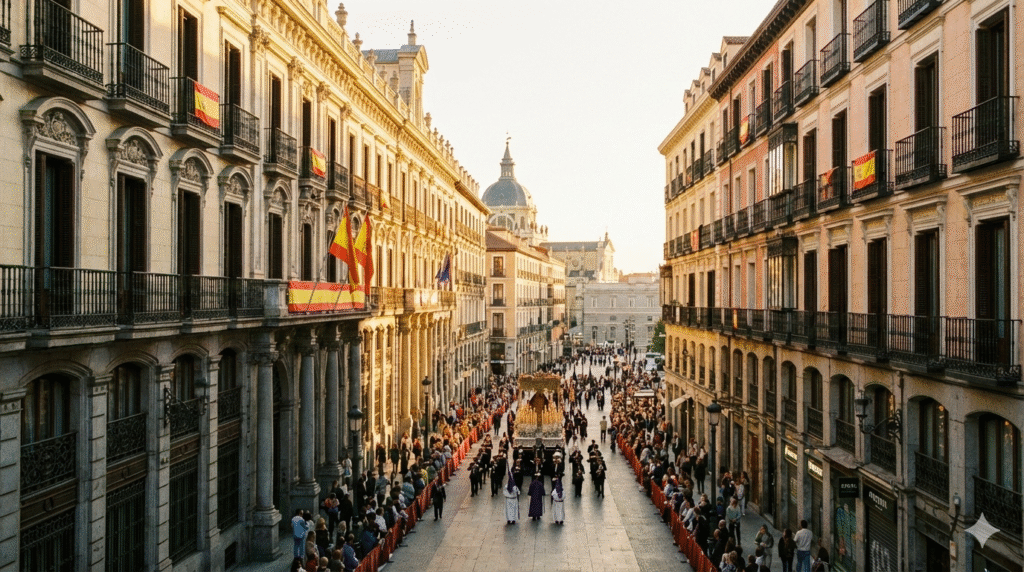
Why it’s perfect:
- Ultra-local feel—these are residential streets
- Neighbors watch from balconies (very Spanish scene)
- Narrow streets mean processions pass VERY close
- Almost no tourists
- Authentic neighborhood Semana Santa
Specific streets to try:
- Calle del Factor
- Calle del Biombo
- Calle de la Morería
- Small plazas like Plaza de la Paja
Which processions: Smaller, neighborhood cofradías
Experience: This is where you’ll see Madrileño grandmothers bringing out chairs, families setting up, kids playing in streets before processions arrive. It’s the real thing.
Pro tip: Walk around the neighborhood 1-2 hours before a procession. Watch locals preparing. Chat with them. They’re usually happy to explain routes, timing, traditions.
5. Calle de Atocha (For Procesión del Silencio)
Why it’s perfect for Silencio:
- Traditional route for this specific procession
- Lighting is perfect (dim streetlights, candles)
- Acoustics enhance the drum sounds
- Local tradition to watch here
Where exactly: Between Plaza de Antón Martín and Calle León
When to arrive: At least 45 minutes early—this one fills up
What to expect: Absolute silence. The drums create an almost hypnotic rhythm. The candles flicker. It’s profound.
Where NOT to Watch (Avoid These Tourist Traps)
❌ Puerta del Sol:
- Jammed with confused tourists
- Can’t see anything (heads everywhere)
- Pickpockets work the crowds
- Locals joke about watching the tourists watching the procession
- Only go if you enjoy crowds (some people do)
❌ Gran Vía directly in front of buildings:
- Too wide—processions look small and far away
- Traffic noise ruins atmosphere
- Generic modern buildings = boring photos
- Better spots available nearby
❌ Anywhere blocking doorways or traffic:
- Police will move you
- Locals will be annoyed
- You’ll have to move anyway during procession
Pro Viewing Tips From a Local
General strategy:
- Research which processions you want to see
- Check routes on cofradía websites
- Pick a specific corner or plaza
- Arrive 30-45 minutes early
- Bring: water, small snack, something to sit on, phone charger
- Make friends with locals around you—they’ll explain everything
For photographers:
- Golden hour (6-7 PM) is magical for Palm Sunday procession
- Use fast lens for evening/night processions
- No flash during Procesión del Silencio (you’ll be shamed)
- Get low-angle shots by sitting on curb
- Ask costaleros’ permission before close-ups
For families with kids:
- Choose afternoon processions (better light, warmer, shorter)
- Bring snacks and activities for waiting
- Let kids sit on curb (they’ll actually see)
- Have exit strategy (kids get bored after 30 min)
- Consider café terrace (bathrooms + escape route)
For the disabled/elderly:
- Reserve café terrace seats in advance
- Some cofradías have accessible viewing areas (call ahead)
- Avoid narrow medieval streets (cobblestones, no benches)
- Plaza de la Villa has plenty of space and nearby bathrooms
Practical Information for Visiting Madrid During Semana Santa.
Let’s get into the nitty-gritty details you actually need to know.
Is Everything Closed During Semana Santa?
The short answer: No, but Good Friday is the exception.
Here’s the detailed breakdown:
Monday-Wednesday (March 30-April 1): Business as usual
- All shops, restaurants, museums open normal hours
- Some businesses close early for major processions
- Full public transport
Thursday, April 2 (Jueves Santo): Public holiday but partial closures
- Banks: Closed
- Government offices: Closed
- Shops: Many close after 2 PM
- Restaurants/bars: Open (this is Spain—food never stops)
- Museums: Open but check hours
- Public transport: Normal service
Friday, April 3 (Viernes Santo/Good Friday): The big closure day
- Banks: Closed
- Government offices: Closed
- Most shops: Closed (except tourist areas)
- Chain stores: Mostly closed
- Small family businesses: Closed
- Restaurants: About 60% open (tourist areas stay open, neighborhood places close)
- Museums: Open! (But may close early)
- Cafés: Open
- Public transport: Normal service
Saturday, April 4 (Sábado Santo): Gradual reopening
- Many businesses reopen after morning
- Restaurants: Mostly open
- Shops: Major retailers open
Sunday, April 5 (Easter Sunday): Sunday closures + family time
- Most shops closed (normal Sunday)
- Restaurants: Open but PACKED for family lunches
- Museums: Normal Sunday hours
- Book Sunday lunch ahead or eat late (after 3 PM when locals finish)
Pro tip: Stock up on snacks, water, any essentials before Thursday. Good Friday is the one day things genuinely close.
Getting Around Madrid During Semana Santa
Madrid Metro:
- Normal service throughout Semana Santa
- Slightly reduced Sunday schedule on Easter Sunday
- Some stations closer to procession routes may be crowded
- Download the Madrid Metro app (free, offline maps)
- Tourist ticket: €8.40 for unlimited 1-day, €14.20 for 2-day
Buses:
- Routes may be diverted during major processions
- Check EMT Madrid app for real-time updates
- Generally reliable but allow extra time
Walking:
- BEST option for Semana Santa
- Historic center is compact (most processions within 2km radius)
- Google Maps works perfectly
- Wear comfortable shoes (cobblestones!)
Taxi/Uber:
- Expensive during peak times
- Streets closed during processions = long detours
- May refuse short rides during busy periods
- Use only if necessary (elderly, luggage, etc.)
Bike rentals:
- BiciMAD (city bikes) available
- Good for getting TO procession areas
- Can’t ride through crowds or during processions
My recommendation: Walk everywhere. You’ll see more, find hidden plazas, discover better viewing spots, and save money.
Weather in Late March/Early April Madrid
Average temperatures:
- Daytime: 15-18°C (59-64°F)
- Nighttime: 8-10°C (46-50°F)
- Procesión del Silencio (8 PM Thursday): Around 10°C (50°F)
Typical conditions:
- Mostly sunny (Madrid gets 300+ days of sun yearly)
- Occasional rain (bring umbrella)
- Can be windy, especially in open plazas
- Nights are genuinely cold
What to pack:
- Light jacket or cardigan for daytime
- Warm jacket for evening processions
- Layers (mornings cool, afternoons warm)
- Comfortable walking shoes (you’ll walk 15,000-25,000 steps daily)
- Sunglasses (that Spanish sun is strong)
- Small umbrella (just in case)
- Scarf (looks good in photos, keeps you warm)
Dressing for processions:
- Respectful but casual (no shorts/tank tops during processions)
- Dark colors common but not required
- Locals dress normal—jeans and nice shirt/blouse is fine
- Comfortable shoes essential (standing for hours)
- Something warm for evening (you’re standing still)
Packing mistakes tourists make:
- ❌ Not bringing jacket (nights ARE cold)
- ❌ Wearing heels (cobblestones + hours of standing = pain)
- ❌ Overdressing (daytime is warm)
- ❌ Forgetting sunscreen (spring sun burns too)
Accommodation: Where to Stay & How to Book
Pricing during Semana Santa:
- Expect 20-30% increase over normal rates
- Still much cheaper than Seville (which sees 300-400% increases)
- Best deals: Book 4-6 weeks ahead
Booking timeline:
- 2-3 months ahead: Widest selection, reasonable prices
- 1 month ahead: Good options still available, prices rising
- 2 weeks ahead: Limited availability, peak pricing
- Last minute: Expensive, possibly nothing in Centro
Best Neighborhoods to Stay
Centro/Sol (Most Convenient)
- Pros: Walking distance to everything, center of procession routes
- Cons: Touristy, can be noisy, slightly pricier
- Best for: First-time visitors, those who want convenience
- Budget: €40-60/night hostels, €90-130 hotels
- Recommendations:
- Budget: Way Hostel, Cat’s Hostel
- Mid-range: Hotel Liabeny, Hotel Moderno
- Splurge: Hotel Palacio de los Duques
La Latina (My Top Pick for Authentic Stay)
- Pros: Authentic neighborhood, great tapas, still central, locals live here
- Cons: Slightly farther walk to some processions (10-15 min)
- Best for: Those wanting local experience, foodies
- Budget: €35-50/night hostels, €80-110 hotels
- Recommendations:
- Budget: Safestay Madrid
- Mid-range: Posada del León de Oro
- Splurge: Petit Palace Plaza Mayor
Malasaña (Hip & Local)
- Pros: Trendy neighborhood, vintage shopping, younger vibe, authentic
- Cons: 15-20 min walk to main processions
- Best for: Young travelers, those who love nightlife
- Budget: €30-45/night hostels, €70-100 hotels
- Recommendations:
- Budget: The Hat Madrid
- Mid-range: Hotel Abalú
- Splurge: Dear Hotel
Salamanca (Upscale & Quiet)
- Pros: Elegant, quiet, safe, great restaurants
- Cons: More expensive, farther from processions (20 min walk)
- Best for: Those wanting luxury, peace
- Budget: Limited hostel options, €100-150 hotels
- Recommendations:
- Mid-range: Hotel Bless Collection Madrid
- Splurge: Hotel Wellington
Lavapiés (Budget & Multicultural)
- Pros: Cheapest, multicultural vibe, authentic, great food diversity
- Cons: Grittier (but safe), some areas loud at night
- Best for: Budget travelers, those who love diversity
- Budget: €25-40/night hostels, €60-85 hotels
- Recommendations:
- Budget: Hostal Atocha Almudena
- Mid-range: Hotel Meninas
Areas to avoid: None are dangerous, but Atocha train station area is purely functional with no charm.
Booking strategy:
What I’d do with different budgets:
€50/night: Book Malasaña hostel private room or Lavapiés budget hotel
€100/night: Book La Latina mid-range hotel or Sol 3-star
€150+/night: Book Salamanca boutique or Sol premium hotel
Crowds & Safety
How crowded is Madrid during Semana Santa?
Let me be honest: It gets crowded, but it’s not overwhelming like Seville or Barcelona during peak season.
Crowd levels by day:
- Monday-Wednesday: Normal Madrid crowds
- Thursday: Moderate increase
- Good Friday: Peak crowds (but still manageable)
- Saturday-Sunday: Crowds drop off
Comparison:
- Barcelona in August: 10/10 crowded
- Seville during Semana Santa: 10/10
- Madrid during Semana Santa: 6/10
- Madrid normal weekend: 4/10
Where it gets crowded:
- Puerta del Sol during major processions (avoid)
- Plaza Mayor on Palm Sunday and Good Friday (manageable if early)
- Tourist restaurants (book ahead)
Where it stays manageable:
- Side streets
- Neighborhood viewing spots
- Museums
- Local restaurants
Safety:
Madrid is very safe, but during Semana Santa take normal precautions:
Watch out for:
- Pickpockets during crowded processions (keep valuables secure)
- Scam artists around Sol (three-card monte, petition scams)
- Overpriced tourist menus (eat where locals eat)
Safety tips:
- Keep backpack in front during processions
- Don’t carry all cash/cards at once
- Stay aware in crowded areas
- Women: Madrid is very safe for solo female travelers, but normal nighttime awareness applies
- Phone theft: Hold phone securely, especially taking photos in crowds
Emergency numbers:
- Police: 091
- Ambulance: 112
- Tourist police: Located at Calle Leganitos, 19 (English spoken)
Reality check: Madrid is one of Europe’s safest capitals. I’ve never felt unsafe during 20+ Semana Santas. Use common sense and you’ll be fine.
Money & Budget
Currency: Euro (€)
Credit cards: Widely accepted, but many small bars/bakeries prefer cash
ATMs: Everywhere, but use bank ATMs (avoid Euronet – high fees)
Daily budget estimates (per person):
Budget traveler (€50-75/day):
- Accommodation: €30-40
- Food: €25-30 (breakfast café €5, menú del día €12, tapas dinner €15)
- Transport: €5 (mostly walking)
- Activities: Free (processions) to €15 (museum)
Mid-range (€100-150/day):
- Accommodation: €70-100
- Food: €40-50
- Transport: €10
- Activities: €20-30
Comfortable (€200+/day):
- Accommodation: €120-180
- Food: €70-90
- Transport: €15
- Activities: €30-40
Money-saving tips:
- Many museums free certain hours
- Menú del día lunches (€10-15) best value
- Buy torrijas at neighborhood bakeries, not tourist spots
- Walk everywhere (free + see more)
- Bring refillable water bottle (tap water safe)
- Happy hour vermouth (5-7 PM, €3-4 drinks)
Phone & Internet
WiFi: Available at most hotels, cafés, restaurants
SIM cards: Available at airport and phone shops (Vodafone, Orange, Movistar)
- Tourist SIM: €20-30 for 2 weeks with data
- Worth it if staying 4+ days
Apps to download before arrival:
- Google Maps (download Madrid offline)
- Madrid Metro (offline metro map)
- Google Translate (download Spanish offline)
- WhatsApp (what Spaniards use to communicate)
Complete 5-Day Semana Santa Madrid Itinerary.
Here’s a realistic, tested itinerary that balances processions, sightseeing, food, and rest. Because trust me, you can’t watch processions for 12 hours straight without burning out.
Day 1: Saturday, March 28 (Pre-Semana Santa Arrival)
Morning:
- Arrive in Madrid, check into hotel
- Walk to Plaza Mayor, Puerta del Sol, orient yourself
- Coffee and pastry at a café (€3-5)
Afternoon:
- Visit Almudena Cathedral (free entry, where Borriquita procession starts tomorrow)
- Walk to Royal Palace (tickets €12-14, or admire from outside)
- Explore Barrio de Austrias narrow streets
Evening:
- Early dinner at Casa Lucio or similar (cocido madrileño €25-30)
- Rest up—tomorrow’s a big day
Budget: €60-80 (accommodation separate)
Day 2: Sunday, March 29 – Palm Sunday (Domingo de Ramos)
Morning:
- Sleep in, relaxed breakfast at hotel or café
- Visit Mercado de San Miguel (food browsing, light snacks €10-15)
- Buy torrijas at nearby bakery to try (€2-3)
Afternoon – MAIN EVENT:
- 2:00 PM: Walk to Calle Mayor (between Bailén and Plaza Mayor)
- Find viewing spot (arrive early for good position)
- 3:15 PM: La Borriquita procession begins at Almudena
- 6:00-6:30 PM: Procession passes your viewing spot
- Watch the 40+ costaleros carry the 2-ton float
- Admire the craftsmanship, music, pageantry
- 7:30 PM: Procession continues; you’re free to leave
Evening:
- Walk to La Latina
- Dinner: Traditional tavern (try callos, €15-20)
- Vermut at Casa Camacho (€3-4)
- Early night (you’ve been standing for hours)
Steps: ~18,000
Budget: €40-50 (plus food €40-50)
Day 3: Monday, March 30 – Cultural Day (Quiet Semana Santa Day)
Use this quiet day for sightseeing while crowds are low.
Morning:
- 9:00 AM: Prado Museum opens
- Spend 2-3 hours (don’t rush)
- Focus: Velázquez, Goya, religious paintings take on new meaning during Semana Santa
- Entry: €15 (free after 6 PM but crowded)
Lunch:
- Menú del día at restaurant near Prado (€12-15)
- Try: potaje de vigilia (Lent stew)
Afternoon:
- Walk through Retiro Park (free)
- Row a boat on the lake (€6 for 45 min)
- Visit Crystal Palace (free)
- Buy more torrijas for afternoon snack (€2-3)
Evening:
- Walk to Malasaña
- Dinner at Mercado de San Ildefonso (variety of options €15-20)
- Explore vintage shops
- Drinks at Plaza San Ildefonso (€4-6 per drink)
- Optional: Small evening procession in neighborhood (check schedule)
Steps: ~22,000
Budget: €50-70
Day 4: Tuesday, March 31 – Day Trip to Toledo
Early morning:
- 8:30 AM: Train from Atocha to Toledo (€13 return, 33 minutes)
- Book return train for 6:00 PM
In Toledo (9:30 AM – 5:30 PM):
- Cathedral (€10, stunning Gothic masterpiece)
- Synagogue del Tránsito (€3)
- Alcázar viewpoints (free from outside)
- Lunch: Carcamusas (Toledo specialty, €12-15)
- Wander medieval streets
- Marzipan tasting (Toledo famous for it)
- Watch local Semana Santa preparations (Toledo has processions too)
Evening:
- Return to Madrid around 7:00 PM
- Light tapas dinner in La Latina (€12-18)
- Early night (tomorrow is Good Friday—peak day)
Steps: ~20,000 (lots of Toledo hills!)
Budget: €50-65
Day 5: Wednesday, April 2 – Jueves Santo (Maundy Thursday)
The tone shifts. Today gets serious.
Morning:
- Sleep in, slow breakfast
- Visit Museo del Romanticismo (€3, gives context to Spanish religious traditions)
- Wander Chueca neighborhood
Lunch:
- Traditional restaurant, try bacalao (salt cod, €15-18)
- More torrijas taste-testing (you’re a connoisseur now)
Afternoon:
- Rest at hotel (seriously, tonight is late)
- Light snack around 6 PM
- Dress warm—it’ll be cold standing for hours
Evening – MAIN EVENT: Procesión del Silencio:
- 6:45 PM: Walk to Calle Atocha (near Calle León)
- 7:00-7:15 PM: Arrive at viewing spot
- Find place along route (earlier = better spot)
- Settle in, turn off phone ringer
- ~8:00 PM: Procesión del Silencio begins
- Experience: Absolute silence except drums
- Dim lighting, candles, profound atmosphere
- Stay silent as it passes (locals will glare if you talk)
- ~8:30-9:00 PM: Procession passes your location
- 9:15 PM: Walk to nearby bar for reflective drink
Late evening:
- Light dinner or just churros at San Ginés (open 24 hours)
- Process what you just experienced (it’s intense)
Steps: ~12,000 (lots of standing still)
Budget: €40-55
Day 6: Thursday, April 3 – Viernes Santo (Good Friday) – PEAK DAY
This is THE day. Multiple processions, full city immersion.
Morning:
- Sleep in (late night yesterday)
- Note: Many shops closed today
- Breakfast at hotel or café
- Visit a church (they’re all open, services happening)
- Observe locals preparing for processions
Midday:
- 12:00 PM: Position for Cristo de los Alabarderos (military procession)
- Watch Royal Guard in full ceremonial uniforms
- About 1 hour to watch it pass
- Lunch: Traditional potaje de vigilia (€10-12) + torrijas (€2-3)
Afternoon:
- Brief rest at hotel (you’ll need energy for evening)
- 4:00 PM: Position for Cristo de la Fe (one of longest processions)
- Watch multiple cofradías pass
- Observe craftsmanship of different floats
- Listen to music, saetas (impromptu flamenco songs from balconies)
Evening:
- 7:00 PM: Quick tapas break
- 8:00 PM: Position for one more evening procession
- Alternatively: Find a bar with terrace to watch
- Soak in the atmosphere
Night:
- Late dinner (10 PM or later)
- Churros at San Ginés if still hungry
- Collapse into bed
Steps: ~15,000 (more standing than walking)
Budget: €45-60
Day 7: Friday, April 4 – Sábado Santo (Holy Saturday) – Transition Day
Morning:
- Sleep late (you’ve earned it)
- Slow breakfast, lots of coffee
- Optional: Visit Reina Sofía Museum (€10, see Guernica)
- Or just relax, recover from yesterday
Afternoon:
- Explore a neighborhood you haven’t seen yet
- Light lunch at local restaurant
- Shopping for souvenirs, gifts
Evening:
- 7:00 PM: Procesión de la Soledad (Virgin of Solitude)
- Less crowded than yesterday, beautiful in its own way
- Dinner at nice restaurant (celebrate your week)
- Drinks in Malasaña or Chueca
Budget: €50-70
Day 8: Saturday, April 5 – Domingo de Resurrección (Easter Sunday) – Celebration Day
Morning:
- Attend mass at Almudena Cathedral if interested (9:30 AM, 11 AM, 12:30 PM)
- Or sleep in and have leisurely breakfast
- Plaza Mayor: Watch Tamborrada (drum celebration) around 11 AM
Afternoon:
- Traditional Easter Sunday lunch (book ahead!)
- This is FAMILY time in Spain—restaurants packed
- Multi-course meal, 2-3 hours, wine, celebration
- Budget: €40-60 per person for quality Easter lunch
Evening:
- Walk off lunch in Retiro Park
- Maybe one last vermouth
- Pack for departure tomorrow (or stay longer!)
Budget: €60-90
Total 7-Day Budget Summary:
Accommodation (not included above): €200-700 depending on choice
Daily expenses: €340-450
Total trip: €540-1,150 + accommodation + flights
Budget Breakdown: What Does Semana Santa in Madrid Really Cost?.
Let’s get specific about money. I hate guides that are vague about costs, so here’s the real deal based on current 2026 prices.
Flights to Madrid
From Europe:
- Budget airlines (Ryanair, Vueling, easyJet): €50-120 return
- Full-service airlines: €150-300 return
- Book 2-3 months ahead for best prices
From US:
- East Coast (NYC, Boston): €400-700 return
- West Coast (LA, SF): €600-900 return
- Book 3-4 months ahead
From Latin America:
- Mexico City: €500-800 return
- Buenos Aires: €600-1,000 return
- Book 2-3 months ahead
Pro tip: Madrid has two airports (Barajas is main one). Sometimes budget airlines use “Madrid” for airports 2 hours away—verify.
Accommodation (per night)
Budget (Hostels/Budget hotels):
- Dorm bed: €25-40
- Private room in hostel: €50-70
- Budget hotel: €60-85
Mid-range (3-star hotels):
- Standard room: €80-120
- Better location: €100-150
Upper mid-range (4-star hotels):
- Standard room: €120-180
- Superior room: €150-220
Luxury (5-star/boutique):
- Standard room: €200-350
- Suite: €300-600
Total for 6 nights:
- Budget: €300-420
- Mid-range: €480-720
- Upper mid-range: €720-1,080
- Luxury: €1,200-2,100
Food & Drink (daily)
Budget eating (€25-35/day):
- Breakfast: Café con leche + pastry (€3-5)
- Lunch: Menú del día (€10-15)
- Snack: Torrijas (€2-3)
- Dinner: Tapas (€12-18)
- Drinks: House wine/beer (€3-4 each)
Mid-range eating (€45-65/day):
- Breakfast: Nice café (€8-12)
- Lunch: Restaurant (€20-30)
- Snack: Bakery (€5-8)
- Dinner: Traditional restaurant (€25-35)
- Drinks: Better wine (€5-8 each)
Comfortable eating (€80-120/day):
- Breakfast: Hotel or upscale café (€15-20)
- Lunch: Quality restaurant (€35-50)
- Snack: High-end pastelería (€10-15)
- Dinner: Fine dining (€45-70)
- Drinks: Cocktails/good wine (€8-12 each)
Total for 6 days:
- Budget: €150-210
- Mid-range: €270-390
- Comfortable: €480-720
Transport (total trip)
Madrid Metro tourist ticket: €8.40-14.20 (1-2 days unlimited)
Or: Pay-per-ride €1.50-2 per trip
Total: €15-30 for whole trip (you’ll mostly walk)
Day trip to Toledo: €13 return train
Total transport: €30-50
Attractions & Activities
Free:
- All processions (FREE!)
- Many churches (free)
- Retiro Park (free)
- Walking historic center (free)
- Some museums certain hours (free)
Paid:
- Prado Museum: €15 (free after 6 PM Mon-Sat, after 5 PM Sun)
- Reina Sofía: €10 (free Mon, Wed-Sat after 7 PM, Sun after 1:30 PM)
- Royal Palace: €12-14
- Almudena Cathedral crypt: €6
- Guided tours: €15-30
- Toledo entrance fees: €15-20 total
Total for 6 days: €30-80 (depends how many museums)
Total Trip Cost (6 nights, 7 days)
BUDGET TRAVELER:
- Flights: €100 (Europe) / €500 (US)
- Accommodation: €300-420
- Food: €150-210
- Transport: €30-40
- Activities: €30-50
- TOTAL: €610-820 (Europe) / €1,010-1,220 (US)
MID-RANGE TRAVELER:
- Flights: €200 (Europe) / €650 (US)
- Accommodation: €480-720
- Food: €270-390
- Transport: €40-50
- Activities: €50-80
- TOTAL: €1,040-1,440 (Europe) / €1,490-1,890 (US)
COMFORTABLE TRAVELER:
- Flights: €300 (Europe) / €700 (US)
- Accommodation: €720-1,080
- Food: €480-720
- Transport: €50-60
- Activities: €60-100
- TOTAL: €1,610-2,260 (Europe) / €2,010-2,660 (US)
Money-Saving Hacks
Accommodation:
- Book 4-6 weeks ahead (prices rise closer to dates)
- Stay in Lavapiés or Malasaña (cheaper, still central)
- Consider hostel private room (€50-70 vs €100+ hotel)
Food:
- Menú del día lunches (best value in Spain)
- Buy torrijas at neighborhood bakeries (€1.50 vs €4 tourist spots)
- Happy hour vermouth (5-7 PM, €3-4 vs €6-8 evening)
- Picnic lunch one day (market shopping €10-15 vs €25 restaurant)
- Water bottles refill (tap water safe)
Transport:
- Walk everywhere possible (saves €20-30)
- Don’t take taxis (expensive, slow during processions)
- Skip tourist buses (everything walkable)
Attractions:
- Museum free hours (Prado after 6 PM, Reina Sofía free times)
- Processions are FREE (main event costs nothing!)
- Free walking tours (tip-based, €10-15 if you enjoyed)
- Many churches free entry
My budget strategy:
- Splurge on accommodation (worth it to be central)
- Save on food (menú del día lunches, occasional nice dinner)
- Walk everywhere (free + see more)
- Use museum free hours
- Result: Comfortable experience without breaking bank
Frequently Asked Questions About Semana Santa in Madrid.
Let me answer every question I’ve been asked over 20 years of bringing friends to Semana Santa.
Do I need to be religious to enjoy Semana Santa?
Absolutely not. I’d estimate 40% of spectators at any given procession are non-religious people appreciating the cultural, artistic, and historical significance. Many locals who watch aren’t particularly religious either—they’re honoring tradition, admiring craftsmanship, and participating in community culture.
That said, respect is essential. You don’t need to believe, but you should be reverent during solemn moments.
Is Semana Santa in Madrid better than Seville?
They’re different experiences. Seville is grander, more famous, more spectacular—but also more crowded, more expensive, and more performative. Madrid is more intimate, authentic, and manageable.
Choose Seville if: You want the most famous, don’t mind massive crowds, and are comfortable with advance planning (6+ months).
Choose Madrid if: You want authentic Spanish culture, manageable crowds, flexibility, and a real city experience beyond just Semana Santa.
My honest answer: For first-timers, Madrid is better. You’ll actually see the processions, meet locals, and not feel overwhelmed.
What should I wear to processions?
Daytime: Casual but respectful. Jeans and a nice shirt/blouse are perfect. Avoid shorts, tank tops, revealing clothing.
Evening: Add a jacket or cardigan (it gets cold). Dark colors are common but not required.
Shoes: Comfortable walking shoes essential. You’ll stand for hours on cobblestones. Leave heels at home.
Accessories: Scarf (warmth + looks nice), comfortable bag for essentials.
What locals wear: Normal everyday clothes, maybe slightly nicer. We’re not dressing up for church—we’re watching a procession.
Can I take photos during processions?
Yes, with important exceptions:
NO flash photography during Procesión del Silencio – You will be publicly shamed. Locals take this seriously.
Otherwise: Photos are fine, but be respectful. Don’t block people’s views, don’t use iPad (seriously, no one wants to see behind an iPad), don’t spend the entire procession looking through your phone.
Pro tip: Take some photos, then put phone away and just experience it. You’ll remember the feeling more than the photos.
Are processions crowded?
It depends where you watch:
Puerta del Sol: Very crowded (avoid)
Plaza Mayor: Moderately crowded
Side streets: Manageable
Neighborhood spots: Often just locals
Good Friday afternoon is peak crowding, but it’s nothing like Seville or Barcelona in peak season.
Will restaurants be open on Good Friday?
About 60% of restaurants stay open, especially in tourist areas. Family-owned neighborhood places often close. Museums stay open. Cafés stay open. You won’t starve, but make reservations for dinner if you want specific places.
Can I join a procession as a participant?
Only if you’re a member of a cofradía. These are religious brotherhoods that often require year-round participation. You can’t just show up and join.
However, anyone can watch, and you’re part of the collective experience.
How long do processions last?
It varies:
- Shortest: 2 hours start to finish
- Longest: 5+ hours for major Good Friday processions
But you don’t watch the entire procession. You pick a spot, wait for it to pass (10-30 minutes), then move on.
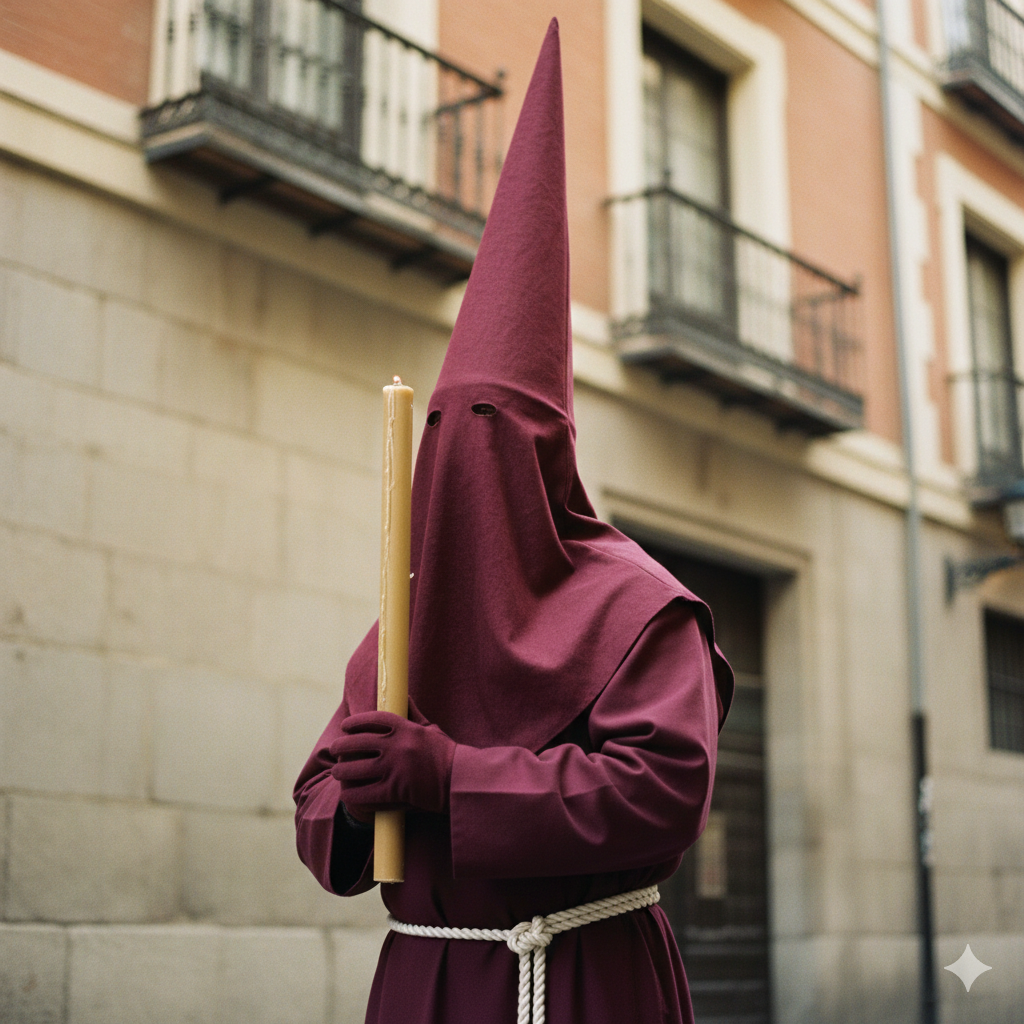
What’s the deal with the pointed hoods (capirotes)?
Those tall pointed hoods look surprising to non-Spanish people, but they have nothing to do with what you might be thinking. They’ve been part of Spanish Catholic tradition for 500+ years, long before any other organization adopted similar imagery.
The capirote represents penitence and anonymity—the penitent’s identity is hidden before God. Different colors represent different cofradías.
Is Madrid safe during Semana Santa?
Yes, very safe. Madrid is one of Europe’s safest capitals. Normal precautions:
- Watch valuables in crowded areas
- Don’t leave bags unattended
- Be aware of pickpockets during major processions
I’ve never felt unsafe during 20+ years of Semana Santa, even late at night.
What if it rains?
Processions generally continue in light rain. Heavy rain can cause delays or cancellations—it’s rare but happens.
If it rains:
- Bring umbrella (won’t save the experience)
- Cofradías have plastic covers for floats
- Crowd thins out (better viewing!)
- Alternative: Watch from café terrace with roof
Can kids attend processions?
Absolutely! Spanish families bring children of all ages. Tips:
- Choose afternoon processions (warmer, better light)
- Bring snacks and activities for waiting
- Let them sit on curb (they’ll actually see)
- Have exit strategy (kids get bored)
- Avoid Procesión del Silencio with young kids (late, long, requires silence)
Do I need advance tickets?
No! All processions are completely free and public. Just show up at viewing spots.
Some churches sell premium seated viewing for specific processions, but it’s not necessary—standing spots are free and often better.
What’s the best day to visit if I can only choose one?
Good Friday (April 3) without question. Most processions, peak atmosphere, full Madrid immersion. If you can only experience one day, this is it.
Second choice: Thursday evening for Procesión del Silencio.
Should I book a guided tour?
Not necessary, but could enhance experience if:
- You want historical/religious context explained
- You’re uncomfortable navigating alone
- You want guaranteed good viewing spots
DIY is totally fine though. Processions are self-explanatory, and locals are happy to answer questions.
Can I eat meat on Good Friday?
You’re a tourist—you can do whatever you want. The meat restriction is for Catholics observing Lent. No one will judge you.
That said, trying traditional Lent foods (potaje, bacalao) is part of the cultural experience.
What language do people speak?
Spanish, obviously. But in tourist areas (Centro, near museums), many people speak English. Restaurants have English menus. You’ll be fine.
Learn basics: “Hola” (hello), “Gracias” (thanks), “Por favor” (please), “La cuenta” (the bill).
Is there an Easter Bunny or egg hunts?
This is slowly creeping into Spain due to American influence, but traditionally no. Spanish Easter is religious processions and family meals, not bunnies.
You might see chocolate eggs in some shops (modern addition), but egg hunts aren’t a thing.
What happens after Easter Sunday?
Life returns to normal. Shops reopen, processions end, tourists leave. Madrid goes back to being regular Madrid.
Actually, post-Easter (April 6 onwards) is a great time to visit—nice weather, no crowds, normal prices.
Semana Santa Etiquette: How to Respectfully Experience Holy Week
This is important. Semana Santa is a living religious tradition for millions of Spaniards. Even if you’re not religious, respect is non-negotiable.
DO:
✅ Dress respectfully during processions
No shorts, tank tops, or revealing clothing during the actual processions. Casual is fine; sloppy is not.
✅ Stay silent during solemn moments
Especially during Procesión del Silencio. Talking during this procession is considered deeply disrespectful.
✅ Applaud the costaleros after they set down the float
This is traditional! When the men carrying the float rest, spectators applaud their effort. Join in.
✅ Step aside when processions pass
Don’t block the route. Stand back, let them pass.
✅ Ask locals questions politely
Most Madrileños love explaining traditions to respectful visitors.
✅ Try traditional foods
Torrijas, potaje, bacalao—this is cultural participation.
✅ Stay for the entire procession as it passes your spot
Don’t leave mid-procession. Wait until it fully passes.
✅ Turn phone to silent
Or off during Procesión del Silencio.
DON’T:
❌ Talk loudly during solemn processions
Inside voice, or better yet, silence.
❌ Use flash during Procesión del Silencio
This will earn you angry stares and possibly verbal reprimands. Locals are serious about this.
❌ Drink alcohol visibly on the street during processions
Spain is chill about public drinking, but not during religious events.
❌ Block doorways, streets, or routes
Police will move you anyway.
❌ Mock religious elements
You don’t have to believe, but don’t be disrespectful.
❌ Leave trash on streets
Use bins. Respect the neighborhoods.
❌ Touch the floats or pasos
They’re sacred religious objects. Look, don’t touch.
❌ Walk in front of the procession
Stay on the sides. Don’t cross their path.
❌ Wear politically charged clothing
This isn’t the place for statements.
❌ Expect English everywhere
Learn basic Spanish phrases. Effort is appreciated.
Gray areas locals debate:
Eating during processions: Probably fine on side streets, but not directly in front of passing processions. Use judgment.
Taking selfies: Not ideal during solemn moments, but acceptable if discrete and not blocking anyone.
Leaving early: If you must leave, do it between processions or during breaks, not while one is actively passing.
Cultural context:
For many Spaniards, Semana Santa is:
- Family tradition (their grandparents participated)
- Community identity (neighborhood cofradías)
- Artistic heritage (500-year-old sculptures)
- Living history (unbroken tradition since 1500s)
You’re not attending a performance. You’re witnessing a living tradition. Act accordingly.
Beyond Processions: What Else to Do During Semana Santa
Semana Santa isn’t 24/7 processions. Here’s how to fill the hours between:
Museums with Easter Context
Prado Museum
All those religious paintings suddenly make sense when you’re experiencing Semana Santa. The Passion scenes, crucifixion paintings, Virgin Mary depictions—they come alive with context.
Must-sees:
- Velázquez’s Christ Crucified
- El Greco’s religious works
- Goya’s religious paintings
- Rubens’ Passion scenes
Reina Sofía Museum
More modern, but Picasso’s Guernica and Spanish Civil War art provide context for Spain’s complex relationship with religion and tradition.
Museo del Romanticicism
Shows how 19th-century Spaniards lived, including religious traditions. Small, beautiful, underrated.
Churches Worth Visiting
- Free entry to main cathedral
- €6 for crypt and museum
- Where Palm Sunday procession begins
- Impressive neo-Gothic interior
San Francisco el Grande
- Stunning dome (third-largest in Christianity)
- Beautiful frescoes
- Often empty (tourists skip it)
- €3 entry
San Ginés Church
- Historic 17th-century church
- Right next to Chocolatería San Ginés
- Free entry
- Often has processions starting here
Iglesia de Jesús de Medinaceli
- Home of Madrid’s most venerated Christ
- Long lines first Friday of each month
- Visit any other day for peaceful experience
- Free
Special Concerts & Events
Many churches host:
- Sacred music concerts
- Organ recitals
- Classical music performances
- Special masses with choirs
Check event listings or ask at tourist information.
Day Trips from Madrid
Toledo (33 minutes by train):
- UNESCO World Heritage medieval city
- Has its own Semana Santa processions
- Cathedral is stunning
- €13 return train from Atocha
Segovia (27 minutes by train):
- Roman aqueduct
- Fairytale castle (Alcázar)
- Quieter than Toledo
- €20-25 return train
El Escorial (1 hour by bus):
- Massive royal monastery
- Philip II’s palace
- Library, art collection
- €5-8 bus from Moncloa
Aranjuez (45 minutes by train):
- Royal Palace with beautiful gardens
- Strawberries famous here
- Less touristy
- €8-10 return train
Pro tip: Toledo and Segovia also have Semana Santa processions. You could experience both cities’ traditions in one trip.
Foodie Experiences
Cooking classes:
- Learn to make tortilla española
- Paella workshops
- Traditional Spanish cooking
- €50-80 per person
- Book ahead
Market tours:
- Mercado de San Miguel (touristy but fun)
- Mercado de San Antón (local favorite)
- Mercado de la Paz (upscale Salamanca)
- Go morning for best selection
Wine tastings:
- Many wine bars offer tastings
- Spanish wine introduction (€20-40)
- Pair with cheese/jamón
- Self-guided (follow my La Latina recommendations)
- Organized tours (€60-90, include drinks)
- Best neighborhoods: La Latina, Lavapiés, Malasaña
Outdoor Activities
- Free entry
- Row a boat (€6/45 min)
- Crystal Palace exhibitions (free)
- Street performers
- Locals relaxing
- Massive park (5x bigger than Central Park)
- Cable car with views (€6)
- Zoo (if you’re into that)
- Walking trails
- Park along the river
- Bike paths
- Playgrounds
- Locals jogging, relaxing
- Egyptian temple (seriously, in Madrid)
- Free entry
- Best at sunset
- Gets crowded
Shopping
Traditional crafts:
- Fans, shawls, religious items
- Calle Toledo: souvenir shops (touristy)
- Artisan markets around Easter
Designer shopping:
- Salamanca neighborhood: luxury brands
- Gran Vía: mainstream retail
- Las Rozas Village outlet (45 min outside city)
Nightlife (Because It’s Still Madrid)
Semana Santa doesn’t stop Madrid’s famous nightlife:
- Círculo de Bellas Artes (best views)
- Hotel Riu Skybar (Gran Vía)
- The Hat terrace (Malasaña)
Cocktail bars:
- Salmon Guru (craft cocktails)
- Viva Madrid (historic tiles, great drinks)
- 1862 Dry Bar (classic cocktails)
Live music:
Flamenco:
- Casa Patas (authentic, not touristy)
- Corral de la Morería (more show-oriented)
- Candela (intimate, local)
Note: Nightlife is slightly calmer during Semana Santa (especially Thursday-Friday), but Madrid never fully stops.
After Semana Santa: Easter Sunday and Beyond
Easter Sunday Traditions
Tamborrada in Plaza Mayor (drum celebration):
- Around 11:00 AM
- Drums celebrating resurrection
- Free to watch
- Joyful, loud, celebratory
Church services:
- Almudena Cathedral: 9:30 AM, 11 AM, 12:30 PM
- Packed with families
- Formal dress
- Beautiful music
Easter lunch:
- THE biggest meal of Semana Santa
- Multi-course family affairs
- Restaurants packed 2-5 PM
- Book days ahead
- Traditional dishes: roast lamb, seafood, special desserts
What locals do:
- Morning church (for religious families)
- Multi-hour lunch with extended family
- Afternoon walk
- Quiet evening at home
Tourist strategy: Book Easter lunch at good restaurant (experience family meal tradition) or visit museums (they’re empty while everyone’s eating).
Monday After Easter (Lunes de Pascua)
In some regions of Spain, this is a holiday (Valencia, Balearic Islands, Catalonia). In Madrid, it’s a regular workday.
What happens:
- Businesses reopen
- Normal work day
- Some families extend the weekend
- Things return to normal
Post-Easter Madrid (April 6 onwards)
This is actually a fantastic time to be in Madrid:
Advantages:
- Hotel prices drop back to normal
- Crowds thin out
- Weather is beautiful (spring in full swing)
- All attractions open normal hours
- Locals are relaxed, post-holiday mood
Weather:
- April: 10-20°C (50-68°F)
- Mostly sunny
- Occasional rain
- Perfect sightseeing weather
What to do:
- All the Madrid classics without Easter crowds
- Day trips (easier to get trains)
- Restaurant reservations easier
- Enjoy spring in Retiro Park
Pro tip: If your schedule is flexible, stay a few extra days after Easter. You’ll see the “real” Madrid without event crowds, and weather is at its best.
Final Thoughts: Why You Should Experience Semana Santa in Madrid
I’ve been asked hundreds of times: “Is Semana Santa in Madrid worth it?”
My answer is always yes, but with context.
If you want:
- Instagram-perfect elaborate processions
- To say you’ve been to THE most famous Semana Santa
- Maximum spectacle
Go to Seville.
If you want:
- Authentic Spanish cultural immersion
- Meaningful traditions lived by locals
- A real city experience beyond just Easter
- Manageable crowds
- Flexibility and spontaneity
Come to Madrid.
After 20+ years of experiencing Semana Santa here, I still get emotional during the Procesión del Silencio. There’s something about standing in the cold Madrid night, surrounded by silent neighbors, watching candlelight flicker across a 400-year-old sculpture carried by 40 men, accompanied only by rhythmic drums echoing off stone buildings… it transcends religion, transcends tourism, transcends everything.
You feel connected to something bigger. To centuries of tradition. To community. To the Spanish soul that values heritage, artistry, collective experience.
You don’t need to be Catholic. You don’t need to speak Spanish fluently. You don’t need to understand every symbol.
You just need to show up with respect, openness, and willingness to experience something profound.
Madrid during Semana Santa shows you its truest self. Not the party capital, not the museum city, not the foodie destination—though it’s all those things. It shows you a city that honors its past, lives its traditions, and welcomes strangers to witness something sacred.
Come for the processions. Stay for the torrijas. Leave with memories that’ll last a lifetime.
¡Feliz Semana Santa!
Plan Your Madrid Semana Santa Trip
Need help planning your trip?
I offer custom Madrid itinerary planning services. Whether you’re here for Semana Santa or anytime, I can create a personalized day-by-day plan based on your interests, budget, and travel style.
Contact me for custom itineraries →
Want my free Madrid planning guide?
Download my comprehensive PDF guide with:
- Printable itineraries
- Restaurant recommendations by neighborhood
- Money-saving tips
- Metro maps and walking routes
- Spanish phrases for travelers
Save this guide!
📌 Pin it to Pinterest for your Madrid trip
📧 Share it with your travel companions
💾 Bookmark it for when you book your flights
About the Author: I’m a Madrid native who’s lived in this city for over 20 years and experienced more than 20 Semana Santas. I started this blog to share the real Madrid—not the tourist version—with travelers who want authentic experiences. Follow my Instagram @madridallincluded for daily Madrid tips and behind-the-scenes stories.
Last updated: February 2026. All prices, times, and information accurate as of publication. Semana Santa 2026 dates: March 29 – April 5.
Procession times and routes can change. Verify specific procession details closer to your travel dates.

 12°C
12°C - Temperature
- Precipitation
- Rain Chance
- Wind
- Humidity
- Pressure





. Complete guide to processions, traditional food, where to watch, and insider tips from a local.)