Step through the door at Calle Cervantes 11 in Madrid, and you step back 400 years. This isn’t a museum that recreates the past – this IS the past. These are the actual rooms where Lope de Vega, Spain’s most prolific playwright, lived his last 25 years. The garden he tended. The study where he wrote hundreds of plays. The chapel where he prayed after becoming a priest late in life.
Most tourists rush past this unassuming door on their way to the Prado or chasing tapas in La Latina. But those who stop, who book the 45-minute guided tour, who step into Lope de Vega’s preserved 17th-century world, discover one of Madrid’s most intimate and moving cultural experiences.
I’ll never forget my first visit. The guide (tours are mandatory, maximum 15 people) led us through rooms arranged exactly as they would have been in the 1630s. Period furniture. Original wooden beams. Windows looking onto the garden Lope himself planted. And suddenly, Lope de Vega wasn’t just a name in Spanish literature textbooks – he was real. A man who lived in this house, sat in this study, walked in this garden, and created an astonishing body of work that shaped Spanish theater.
But here’s what makes this guide different: the Casa-Museo Lope de Vega sits in the heart of Barrio de las Letras (Literary Quarter), surrounded by literary sites, museums, theaters, and some of Madrid’s best cultural attractions. You don’t just visit Lope de Vega’s house – you explore an entire neighborhood steeped in Golden Age history.
So let me show you not just the museum, but how to experience this corner of Madrid like someone who understands its layers.
Understanding Lope de Vega
Before visiting his house, you should know who lived there.
Félix Lope de Vega y Carpio (1562-1635) was extraordinary even by Spanish Golden Age standards:
- Wrote approximately 1,500 plays (about 500 survive) – making Shakespeare’s 37 look modest
- Also wrote poetry, novels, and religious works
- Created or popularized many theatrical conventions still used today
- Lived a dramatic personal life: duels, secret affairs, multiple wives and mistresses, finally became a priest at age 52 (though his romantic adventures continued)
- Represented everything passionate, creative, and excessive about Spain’s Golden Age
His rivalry with Cervantes: They lived on streets later named for each other (Lope on Calle Cervantes, Cervantes probably lived near what’s now Calle Lope de Vega). They were literary contemporaries and not exactly friends. Cervantes made veiled criticisms of Lope in Don Quixote. Lope responded in kind. Their rivalry defined Spanish Golden Age literature.
Why he matters: Lope essentially invented the Spanish comedia (three-act play). He made theater accessible to everyone – nobles and commoners alike. He wrote for the corrales de comedias (open-air theaters) that dotted this neighborhood. Without Lope, Spanish theater would look completely different.
Casa-Museo Lope de Vega: Inside the House
Address: Calle Cervantes 11, Madrid
Metro: Antón Martín (Line 1), 5-minute walk
Hours: Tuesday-Sunday 10 AM – 6 PM, closed Mondays and holidays
Entry: €3 (free on Sundays after 2 PM, but book ahead regardless)
Tour format: Mandatory guided tours in Spanish, maximum 15 people, approximately 45 minutes
Booking: ESSENTIAL – book online at casaMuseolopedevega.org or call +34 914 29 92 16. Tours fill up days in advance, especially weekends.
What You’ll See
The Entrance & Courtyard: Small entrance leads to a traditional Madrid courtyard. Already you’re in the 17th century – the architecture, the scale, the atmosphere is period-authentic.
The Estrado (Women’s Room): Ground floor room where women of the household received guests and did needlework. Low platforms covered with carpets and cushions (women sat on cushions, men on chairs – social convention of the era). Beautiful painted ceiling beams. This room shows how upper-middle-class madrileños lived in the 1600s.
The Chapel: Lope had a private chapel built in his house after becoming a priest. Small, intimate, beautifully preserved. The guide explains how Lope’s life transformed from passionate playwright to devoted priest (though his passion never fully disappeared – he continued writing and had at least one more romantic relationship after ordination).
The Study: This is the heart of the house. Lope’s study where he wrote hundreds of plays. The desk (not his original but period-appropriate), the simple furnishings, the window overlooking the garden. Stand here and imagine Lope writing late into the night, creating the plays that would be performed in nearby theaters the next week.
The guide usually mentions that Lope was incredibly prolific – he could write a play in a day. Whether this is literally true or Golden Age exaggeration, his output was undeniably staggering.
The Bedrooms: Upstairs bedrooms furnished with period beds, furniture, personal items. You see how compact the house is – remember, this was a successful, famous writer’s home. Even prosperous people lived in relatively small spaces in 17th-century Madrid.
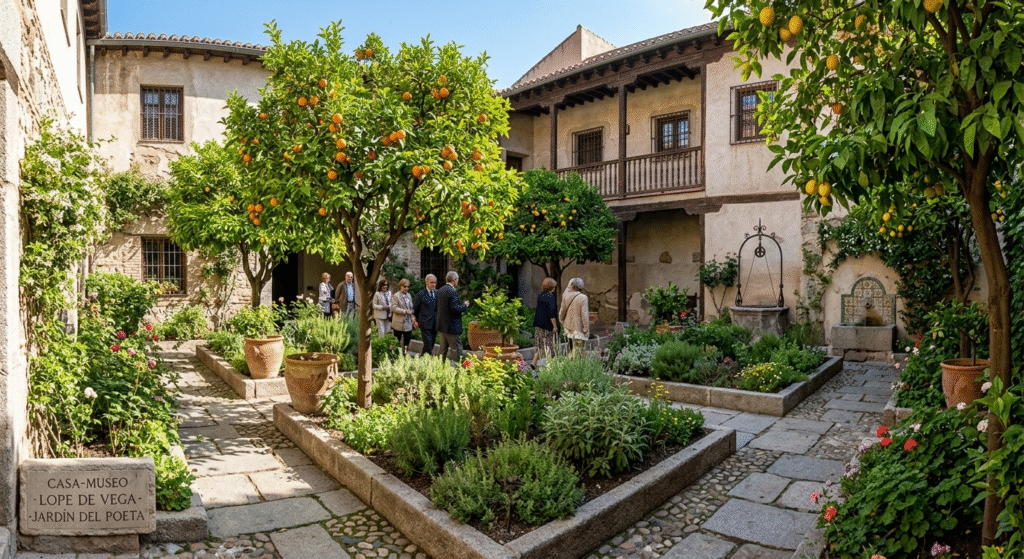
The Garden: Accessed from the house, this small garden is beautifully maintained with plants that would have grown in Lope’s time. He loved gardening and wrote about his garden in letters and poems. It’s peaceful, green, a surprising oasis in the middle of Madrid.
The garden includes:
- Orange and lemon trees
- Aromatic herbs
- A small well
- Period plantings based on historical records
In spring and summer, the garden is lovely. Even in winter, it’s atmospheric.
Tour Experience
Language barrier: Tours are in Spanish only. If your Spanish is limited, you’ll still enjoy seeing the house and garden, but you’ll miss the detailed stories. Some visitors use translation apps to follow along, though this is awkward during a moving tour.
Photography: Generally not allowed inside the house (rules can vary – ask your guide). You can photograph the garden.
Accessibility: The house has stairs and narrow passages. Not wheelchair accessible. Might be challenging for those with mobility issues.
Group size: Maximum 15 people keeps it intimate. You’re not fighting crowds – you can actually see everything and hear the guide clearly.
Duration: 45 minutes is perfect – enough to see everything without feeling rushed, not so long that you get tired.
Practical Tips
Book ahead: This cannot be stressed enough. The house can only accommodate 15 people per tour, and tours run every 30-60 minutes. Popular times (weekends, free Sunday afternoons) book out days in advance.
Free Sundays: After 2 PM on Sundays, entry is free. But you still need to book ahead – free doesn’t mean walk-in. These slots fill up fastest.
Best times:
- Weekday mornings (fewer tourists, easier booking)
- First tour of the day (10 AM) for a quieter experience
- Spring/early summer when the garden is most beautiful
Combine with: You’ll spend 45 minutes at the house. Plan at least 2-3 hours total for this neighborhood, combining the museum with nearby attractions (detailed below).
Nearby Attractions Within Walking Distance
The Casa-Museo sits in the heart of Barrio de las Letras, surrounded by literary and cultural sites.
Literary Sites (5-10 minute walk)
Convento de las Trinitarias Descalzas (Cervantes’ Tomb)
Address: Calle Lope de Vega 18 (literally around the corner from Lope’s house)
Distance: 2-minute walk
Miguel de Cervantes is buried here. You can’t enter the convent (it’s a functioning monastery), but there’s a commemorative plaque outside marking where the author of Don Quixote rests.
The location’s irony isn’t lost on anyone: Cervantes buried on Calle Lope de Vega, Lope’s house on Calle Cervantes. The two great rivals of Spanish literature eternally linked by street names.
Time needed: 5 minutes to see the plaque and pay respects
Quotes in the Cobblestones
Location: Throughout Barrio de las Letras, especially Calle de las Huertas
Distance: All around you
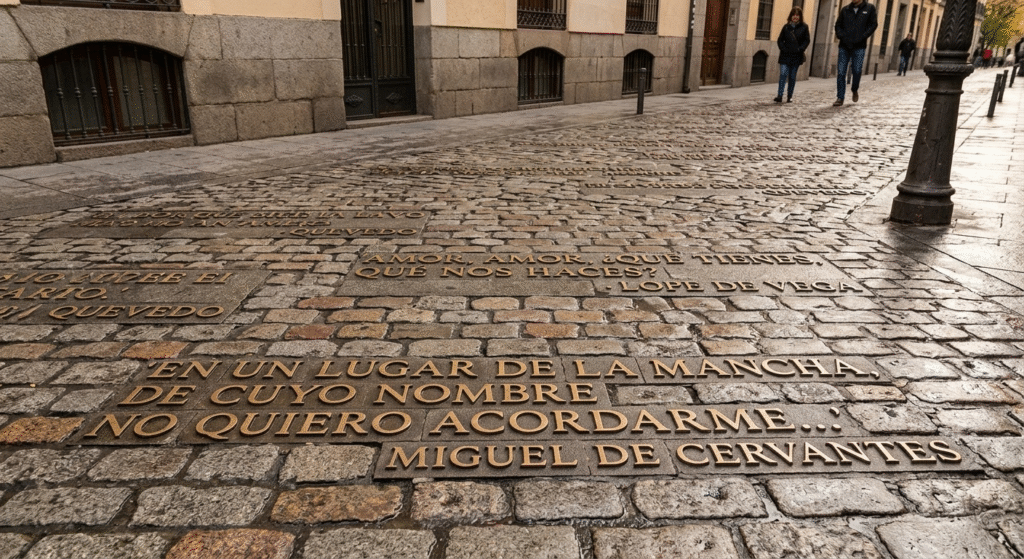
Look down as you walk. Literary quotes from Spanish writers are carved into the cobblestones with bronze letters. Cervantes, Lope, Quevedo, Góngora – the entire neighborhood is literally paved with literature.
Find the opening line of Don Quixote: “En un lugar de La Mancha, de cuyo nombre no quiero acordarme…”
Time needed: Ongoing as you walk the neighborhood
San Sebastián Church
Address: Calle Atocha 39
Distance: 5-minute walk
Both Cervantes and Lope de Vega had their funerals here. It’s still an active church, free to enter. Beautiful interior, historically significant.
Time needed: 15-20 minutes
[For complete Barrio de las Letras guide →]
Museums (5-15 minute walk)
Museo Nacional del Prado
Address: Paseo del Prado
Distance: 10-minute walk
Spain’s premier art museum with works by Velázquez, Goya, El Greco, Bosch, and more. World-class collection.
- Hours: Monday-Saturday 10 AM – 8 PM, Sunday/holidays 10 AM – 7 PM
- Entry: €15, free Monday-Saturday 6-8 PM, Sunday 5-7 PM (limited capacity, arrive early)
- Time needed: 2-4 hours minimum
Museo Nacional Centro de Arte Reina Sofía
Address: Calle Santa Isabel 52
Distance: 10-minute walk
Spain’s modern art museum, home to Picasso’s Guernica and works by Dalí, Miró.
- Hours: Monday, Wednesday-Saturday 10 AM – 9 PM, Sunday 10 AM – 7 PM, closed Tuesday
- Entry: €12, free Monday, Wednesday-Saturday 7-9 PM, Sunday 1:30-7 PM
- Time needed: 2-3 hours
Museo Thyssen-Bornemisza
Address: Paseo del Prado 8
Distance: 10-minute walk
The third museum in Madrid’s “Golden Triangle of Art.” Private collection spanning old masters to modern art.
- Hours: Tuesday-Sunday 10 AM – 7 PM, closed Monday
- Entry: €13, free Mondays 12-4 PM
- Time needed: 2-3 hours
CaixaForum Madrid
Address: Paseo del Prado 36
Distance: 12-minute walk
Contemporary art space in a stunning building with vertical garden wall.
- Hours: Daily 10 AM – 8 PM
- Entry: Usually free or very affordable (varies by exhibition)
- Time needed: 1-2 hours
Museo Nacional de Artes Decorativas
Address: Calle Montalbán 12
Distance: 8-minute walk
Decorative arts museum with furniture, ceramics, textiles from different periods.
- Hours: Tuesday-Saturday 9:30 AM – 3 PM, Sunday 10 AM – 3 PM, closed Monday
- Entry: €3, free Saturday afternoon and Sunday
- Time needed: 1-2 hours
Cultural Venues & Theaters
Teatro Español
Address: Plaza de Santa Ana
Distance: 5-minute walk
One of Europe’s oldest theaters (founded 1583). Still stages classic Spanish plays and contemporary theater.
Check their schedule – seeing a play here (even if your Spanish is limited) connects you to the theatrical tradition Lope helped create. Tickets €15-30.
Ateneo de Madrid
Address: Calle del Prado 21
Distance: 3-minute walk
Prestigious cultural institution since 1835. Beautiful library and reading rooms. Sometimes open for exhibitions and events.
Café Central
Address: Plaza del Ángel 10
Distance: 7-minute walk
One of Europe’s best jazz clubs. Intimate setting, top-tier musicians. Evening shows €8-15.
Plazas & Atmosphere
Plaza de Santa Ana
Distance: 5-minute walk
The heart of Barrio de las Letras. Teatro Español, terrace cafés, statues of García Lorca and Calderón. Perfect for coffee or vermouth while people-watching.
Plaza del Ángel
Distance: 5-minute walk
Quieter plaza with Café Central jazz club. Good for a peaceful break.
Traditional Bars & Restaurants
Casa Alberto
Address: Calle de las Huertas 18
Distance: 5-minute walk
Madrid’s oldest tavern (1827), supposedly built where Cervantes once lived. Excellent vermouth, croquetas, traditional Madrid atmosphere.
La Venencia
Address: Calle Echegaray 7
Distance: 7-minute walk
Sherry bar unchanged since 1929. Hemingway drank here. No photos allowed, cash only, sawdust floor, pure atmosphere.
Cervecería Alemana
Address: Plaza de Santa Ana 6
Distance: 5-minute walk
Another Hemingway haunt. Good for beer and tapas on the plaza.
[For complete Barrio de las Letras food guide →]
Suggested Itineraries
Half-Day Literary & Cultural Walk (3-4 hours)
10:00 AM – Casa-Museo Lope de Vega (book 10 AM tour)
11:00 AM – Walk to Convento de las Trinitarias (Cervantes’ tomb)
11:15 AM – Explore cobblestone quotes around Calle de las Huertas
11:30 AM – Coffee in Plaza de Santa Ana
12:00 PM – Browse bookshops or galleries
12:30 PM – Vermouth and tapas at Casa Alberto
1:30 PM – Walk through neighborhood, San Sebastián Church if desired
Full-Day Cultural Immersion (6-7 hours)
10:00 AM – Casa-Museo Lope de Vega
11:00 AM – Literary walk through Barrio de las Letras
12:00 PM – Museo del Prado (2-3 hours)
2:30 PM – Lunch in Barrio de las Letras
4:00 PM – Retiro Park walk (20 minutes away)
6:00 PM – Return to neighborhood for evening vermouth
8:00 PM – Dinner or tapas crawl
Museum Triangle + Literary Sites (Full Day)
9:00 AM – Early arrival at Prado (less crowded)
12:00 PM – Lunch break
1:00 PM – Casa-Museo Lope de Vega (1 PM tour)
2:00 PM – Literary walk, Plaza de Santa Ana
3:00 PM – Reina Sofía Museum (free entry 3 PM Sunday)
6:00 PM – Dinner in Barrio de las Letras
Evening Cultural Experience
6:00 PM – Late afternoon at Casa-Museo Lope de Vega
7:00 PM – Vermouth at La Venencia or Casa Alberto
8:00 PM – Tapas crawl through Barrio de las Letras
10:00 PM – Jazz at Café Central (show usually starts 9-10 PM)
Getting There & Around
Metro to Casa-Museo Lope de Vega:
- Antón Martín (Line 1) – 5-minute walk
- Sol (Lines 1, 2, 3) – 10-minute walk through the neighborhood
Walking from major landmarks:
- Prado Museum: 8 minutes
- Puerta del Sol: 10 minutes
- Retiro Park (Felipe IV entrance): 15 minutes
- Atocha Station: 12 minutes
Everything in this guide is walkable: The beauty of Barrio de las Letras is that everything is within 5-15 minutes on foot. You don’t need metro once you’re here.
Who Will Love This Experience
Literature enthusiasts: Obviously – this is literary pilgrimage territory
History lovers: The preserved 17th-century house brings Spanish Golden Age to life
Museum-goers: Combining Lope de Vega with Prado/Reina Sofía creates perfect cultural day
Those seeking authentic Madrid: This neighborhood feels real, not theme-park touristy
Theater lovers: Lope created the Spanish theatrical tradition; Teatro Español continues it
Anyone tired of crowds: Casa-Museo is intimate (max 15 people), offering respite from packed museums
Who Might Skip This
Those with very limited time: If you only have 1-2 days in Madrid, prioritize Prado, Retiro, La Latina tapas
Non-Spanish speakers uncomfortable with language barrier: Tours are Spanish-only, which some find frustrating
Those uninterested in literary history: If the Golden Age doesn’t fascinate you, the house might feel like just an old building
Families with very young children: The 45-minute guided tour requires sitting still and listening – challenging for small kids
Practical Tips
Photography inside: Generally not allowed in the house, but you can photograph the garden. Rules may vary – always ask your guide.
Dress code: None, but comfortable walking shoes recommended for neighborhood exploration.
Accessibility: Not wheelchair accessible. Has stairs and narrow passages typical of 17th-century construction.
Bathrooms: Small museum, limited facilities. Use bathroom before the tour starts.
Gift shop: Tiny shop sells books about Lope, postcards, small souvenirs. Nothing extensive.
Language: Guides speak Spanish. Some basic knowledge helpful but not essential to appreciate the house.
Final Thoughts
Casa-Museo Lope de Vega won’t overwhelm you with size or grandeur. It’s a small house. The tour is short. You could rush through it in 45 minutes and tick it off a list.
But that would miss the point entirely.
This house is intimate time travel. When you stand in Lope’s study looking at the desk where he created hundreds of plays, when you walk in the garden he planted, when you see the small chapel where he prayed, you’re connecting directly with someone who lived 400 years ago and shaped Spanish culture profoundly.
And then you step outside onto Calle Cervantes, and you’re in a neighborhood that hasn’t forgotten its literary past. The quotes are in the cobblestones. Cervantes is buried around the corner. The theaters where Lope’s plays premiered still stage performances. The taverns where Golden Age writers drank still serve vermouth.
This isn’t a museum experience – it’s a neighborhood that still lives its literary heritage.
So visit Lope’s house. Read the quotes in the stones. Have vermouth at Casa Alberto. Walk the streets where Spain’s greatest writers lived and created. Stand in Plaza de Santa Ana and imagine the corrales de comedias that once dotted this area, filled with madrileños watching Lope’s latest play.
Because this corner of Madrid doesn’t just remember the Golden Age. It never quite left.
FAQ Section (10 Questions)
Q1: What is Casa-Museo Lope de Vega?
A: Casa-Museo Lope de Vega is the preserved 17th-century house where Spain’s most prolific playwright, Lope de Vega (1562-1635), lived his last 25 years. Located at Calle Cervantes 11 in Barrio de las Letras, it features his study, chapel, garden, and period-furnished rooms. Entry €3, mandatory 45-minute guided tours in Spanish.
Q2: How much does Casa-Museo Lope de Vega cost?
A: Entry costs €3 for mandatory guided tours. Free on Sundays after 2 PM, but reservations still required. Maximum 15 people per tour. Book ahead at casaMuseolopedevega.org or call +34 914 29 92 16 as tours fill up days in advance, especially weekends and free Sundays.
Q3: What are Casa-Museo Lope de Vega hours?
A: Tuesday-Sunday 10 AM – 6 PM, closed Mondays and holidays. Guided tours run approximately every 30-60 minutes. Tours last 45 minutes and are mandatory (not self-guided). Advance booking essential as groups limited to 15 people maximum.
Q4: Can you visit Lope de Vega’s house?
A: Yes! Casa-Museo Lope de Vega is open to visitors Tuesday-Sunday. You must book a guided tour in advance (not self-guided). Tours are in Spanish only, last 45 minutes, maximum 15 people. See his study, garden, chapel, and period-furnished rooms exactly as they were in the 1630s.
Q5: Who was Lope de Vega?
A: Félix Lope de Vega y Carpio (1562-1635) was Spain’s most prolific playwright, writing approximately 1,500 plays (about 500 survive) – far exceeding Shakespeare’s 37. He invented the Spanish comedia (three-act play), lived dramatically (duels, affairs, eventually became priest), and defined Spain’s Golden Age theater. Contemporary and rival of Cervantes.
Q6: Where is Cervantes buried in Madrid?
A: Miguel de Cervantes (author of Don Quixote) is buried at Convento de las Trinitarias Descalzas, Calle Lope de Vega 18, just 2 minutes walk from Casa-Museo Lope de Vega. You cannot enter the functioning monastery, but a commemorative plaque marks where he rests. Both Cervantes and Lope had funerals at San Sebastián Church (Calle Atocha 39).
Q7: What’s near Casa-Museo Lope de Vega?
A: Nearby attractions within 5-15 minutes walk: Cervantes’ tomb (2 min), Plaza de Santa Ana (5 min), Prado Museum (10 min), Reina Sofía Museum (10 min), Casa Alberto tavern (5 min), literary cobblestone quotes throughout neighborhood, Teatro Español, Café Central jazz club. Everything in Barrio de las Letras is walkable.
Q8: Is Casa-Museo Lope de Vega worth visiting?
A: Yes, especially for literature lovers, history enthusiasts, and anyone interested in Spanish Golden Age. The preserved 17th-century house offers intimate time travel experience. At €3 for 45 minutes, it’s excellent value. Combine with nearby Prado museums and Barrio de las Letras literary sites for perfect cultural half-day or full day.
Q9: Are tours in English at Lope de Vega museum?
A: No, guided tours are in Spanish only. If your Spanish is limited, you’ll still enjoy seeing the beautifully preserved house and garden, but will miss detailed stories and context. Some visitors use translation apps, though this is awkward during moving tours. Photography generally not allowed inside (but garden okay).
Q10: How do I get to Casa-Museo Lope de Vega?
A: Metro: Antón Martín (Line 1) 5-minute walk, or Sol (Lines 1,2,3) 10-minute walk. Address: Calle Cervantes 11. Walking from Prado Museum: 8 minutes, from Retiro Park: 15 minutes, from Puerta del Sol: 10 minutes. Everything in Barrio de las Letras is walkable.

 12°C
12°C - Temperature
- Precipitation
- Rain Chance
- Wind
- Humidity
- Pressure