Last Updated on June 3, 2026 by Jaime
By Jaime · May 22, 2026 · 14 min read

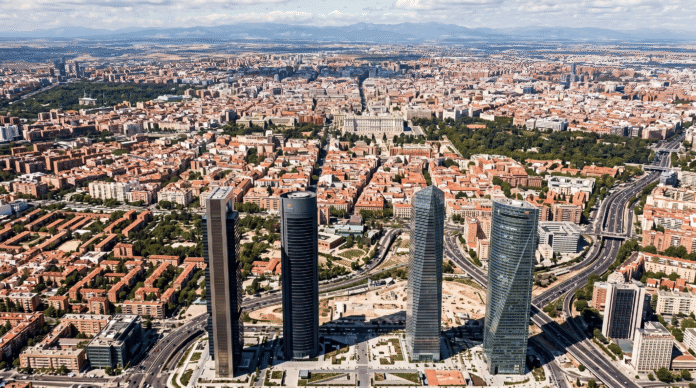
Madrid from above — 3.3 million people, 650 metres above sea level, and a city that takes about three days to fall in love with and a lifetime to fully understand
📍 Location: Centre of Spain · 650m above sea level · Population: 3.3 million (6.7M metro area)
✈️ Airport: Adolfo Suárez Madrid-Barajas (MAD) · Metro Line 8 to centre ~20 min · Taxi flat rate €33
🗓️ Best months: April–May · September–October · June also excellent
⏱️ Minimum visit: 3 days · Recommended: 4–5 days · Week if you love museums
💶 Daily budget: €60–80 (budget) · €120–180 (mid-range) · €300+ (luxury)
🗣️ Language: Spanish · English widely spoken in tourist areas
🔒 Safety: Very safe · Watch for pickpockets in tourist areas
🚇 Transport: Excellent metro · Tarjeta Multi €2.50 + 10-trip €12.20 · Tourist Pass €10–42/day
💡 The one thing to know: Madrid runs 2 hours later than the rest of Europe. Dinner starts at 21:30.
I was born and raised in Madrid. I have spent most of my adult life here, and for the past several years I have been writing about this city for people who are visiting for the first time. In that time, I have noticed that the same questions come up again and again — in emails, in comments, in conversations with travellers I meet.
This post is my attempt to answer all of them at once. Not with the vague reassurances you get from generic travel guides (“Madrid is a wonderful city with so much to offer!”) but with the specific, honest answers that actually help you plan a trip and navigate the city when you are here. Twenty-five questions. Real answers. Nothing to sell you except a better trip.
🗓️ Planning Your Trip
1. How many days do you need in Madrid?
3 days minimum · 4–5 days ideal · 7 days if you love museums.
Three days is enough to see the highlights — Prado, Royal Palace, Retiro Park and a neighbourhood or two. But Madrid is not a city that reveals itself quickly. The rhythm is slow and the pleasures are cumulative: a morning market, an afternoon in a park, a late dinner that turns into three hours of conversation.
Four to five days is the sweet spot for a first visit: time for two or three major museums without rushing, two or three different neighbourhoods, one day trip (Toledo or Segovia), and enough evenings to eat and drink the way locals do. A week lets you go deeper — and feel, by the end, that you actually lived here briefly rather than just passing through.
If you only have a weekend (2 days): one museum, the Royal Palace area, La Latina tapas and Retiro Park. Accept you are scratching the surface and plan to return.
→ Day trips from Madrid guide · Prado Museum guide
2. When is the best time to visit Madrid?
Spring (April–May) and autumn (September–October) are the best months. June is excellent. Summer is hot but culturally rich. Winter is cold but cheap.
April and May give you warm afternoons (18–24°C), manageable crowds, the Retiro Park rose garden in bloom, and the full museum programme running. October keeps the warmth into early autumn with noticeably thinner crowds. June is increasingly my favourite month — warm evenings, Veranos de la Villa beginning, and the city at its most alive before the summer crush.
July and August are genuinely hot (35–42°C at peak) and the city is crowded with tourists. But Madrid’s summer cultural calendar — outdoor cinemas, free concerts, neighbourhood fiestas — makes it a real option if you follow local rhythms (do nothing 14:00–18:00, live your life after 19:00).
November through February is the cheapest time to visit. Cold (4–12°C) and dark by 18:00, but hotel prices drop 30–40%, queues at museums are minimal, and the city has an authentic, unhurried character that disappears in summer.
→ Summer in Madrid guide · Veranos de la Villa guide
3. Is Madrid expensive?
No — Madrid is one of the most affordable capitals in Western Europe.
Comparable to Lisbon and significantly cheaper than London, Paris, Amsterdam or Copenhagen. A coffee costs €1.20–1.80. A beer at a bar costs €2–3.50. A three-course menú del día (the weekday lunch that is a Spanish institution) with bread, wine and dessert runs €11–16 in a good neighbourhood restaurant. A single metro ride is €1.50–2.00.
For planning purposes:
- Budget traveller (hostel, menú del día, cheap bars, free museum hours): €60–80/day
- Mid-range (3-star hotel, sit-down dinners, museums, occasional taxi): €120–180/day
- Comfortable (4-star hotel, good restaurants, all paid activities): €200–280/day
- Luxury (5-star, fine dining, premium experiences): €350+/day
Where tourists overspend: airport transfers (use the metro or the flat-rate €33 taxi, never a private transfer tout), restaurants on the Puerta del Sol tourist strip (genuinely terrible value), and buying the tourist card when you would not use enough attractions to break even.
→ Madrid tourist card — is it worth it? · Transport guide
4. What neighbourhood should I stay in?
For a first visit: Sol/Centro, La Latina, Malasaña or Chueca. All are walkable to the main attractions.
- Sol/Centro: The most central option — everything is walkable, excellent metro connections. The area around Sol itself is touristy, but side streets immediately adjacent are perfectly fine. Best for people who want pure convenience.
- La Latina: The most characterful of the central options. Narrow medieval streets, the best tapas scene in the city, close to the Royal Palace and Plaza Mayor. My top recommendation for first-timers who want atmosphere.
- Malasaña: Young, creative, bohemian. Excellent independent restaurants and bars. Very central. The best choice if you care more about food and nightlife than proximity to the Royal Palace.
- Chueca: Similar to Malasaña but slightly more polished. LGBTQ+ friendly and welcoming to everyone. Great for solo travellers.
- Salamanca: Upmarket and quiet. Good for luxury hotels. Further from the historic centre but excellent metro. Best for a second visit when you know the city.
Avoid: Any accommodation that appears suspiciously cheap and is in Carabanchel, Vallecas or Vicálvaro — these are distant peripheral districts with limited tourist interest and slow transport connections.
5. Do I need to book anything in advance?
Yes — three things specifically: the Prado, the Royal Palace and your hotel.
The Prado Museum frequently sells out timed entry for peak hours. Book at least 3–5 days ahead at museodelprado.es. The free-entry hours (Mon–Sat 18:00–20:00, Sun 17:00–19:00) are genuinely free but have queues of 30–90 minutes in high season.
The Royal Palace (Palacio Real) also sells out in spring and summer. Book at patrimonionacional.es 2–3 days ahead minimum. Entry is €14 adults, €7 children.
The Reina Sofia (Guernica), Thyssen-Bornemisza and most other attractions are easier to visit without pre-booking, though tickets can also be purchased in advance online.
For hotels: book as far ahead as possible for June–September and Christmas week. Outside peak season, booking 2–3 weeks ahead is usually fine. The city fills up completely during the papal visit (June 6–9, 2026), Mad Cool Festival (July 8–11), and Semana Santa.
→ Prado guide · Best tours in Madrid
🚇 Getting Around

The Madrid metro — 13 lines, clean, air-conditioned and cheap. The Tarjeta Multi card (€2.50, reusable) is all you need.
6. How do I get from the airport to the city centre?
Metro Line 8 is the cheapest. Official taxi is the easiest. Avoid private transfer touts.
Metro Line 8 (pink line): From Aeropuerto T1-T2-T3 or Aeropuerto T4 to Nuevos Ministerios (~15–20 min). Change there for Lines 6 or 10 to anywhere in the city. Cost: your Tarjeta Multi ticket + €3 airport supplement. Total with card: approximately €5–6. Trains run 06:00–01:30.
Official taxi (white, red stripe): Flat rate of €33 from anywhere in the airport to anywhere within the M-30 ring road. This covers all central hotels. Metered for destinations outside the M-30. No negotiation, no extras — it is a fixed legal tariff. Find the official taxi rank outside arrivals. Do not accept offers from people approaching you inside the terminal.
Avoid: Anyone offering you a “private transfer” inside the terminal building. These are unlicensed and charge 3–5x the taxi rate.
→ Complete airport transfer guide · Madrid transport guide
7. What transport card should I buy?
The Tarjeta Multi (€2.50) loaded with a 10-trip Metrobús ticket (€12.20) is the best option for most visitors.
Buy the red Tarjeta Multi card at any metro station machine (including the airport). It is reusable for 10 years and costs €2.50 one-time. Load it with the 10-trip Metrobús ticket (€12.20 — works on metro and city buses, shareable between multiple people travelling together). Each trip costs €1.22, significantly cheaper than single tickets.
The Tourist Travel Pass (€10/day to €42/week) is only worth it if you are taking 8+ metro trips per day AND need the airport connection included. For most 4–5 day visitors using the metro moderately, two 10-trip cards are better value than the daily pass.
→ Tourist pass vs 10-trip — full comparison
8. Is Madrid walkable?
The historic centre is very walkable. Between districts, the metro is easier.
The core tourist triangle — Royal Palace, Plaza Mayor, Puerta del Sol, La Latina, Lavapiés, the Prado, Retiro — can be walked entirely. Sol to the Royal Palace is 10 minutes. Sol to the Prado is 15 minutes. Sol to La Latina is 8 minutes. Retiro Park to the Prado is 5 minutes.
The city starts spreading out when you go beyond this core. Malasaña is 20 minutes walk from Sol; Chueca is 15 minutes. The Bernabéu, Chamberí and Salamanca are all metro-friendly rather than walk-friendly from the historic centre.
Madrid is a hilly city in parts — the area around La Latina and the Royal Palace involves significant elevation changes. Comfortable shoes are essential. Flip-flops on cobblestone is the fastest way to end a Madrid day early.
9. Should I rent a car in Madrid?
No — for the city itself. Yes — for day trips into the Sierra or rural Castilla.
Driving in central Madrid is genuinely stressful. The ZBE (Zona de Bajas Emisiones) low-emission zone covers most of the historic centre and requires a registered environmental badge — most rental cars have this, but fines for entering without it are significant. Parking is expensive, scarce and complicated. The metro covers everything you need.
If you want to explore the Sierra de Guadarrama, the wine country around Ribera del Duero, the villages of Castilla or off-the-beaten-path day trips — a rental car from one of the Chamartín station agencies is the right tool. Pick it up after you have done the city by metro and use it only for excursions.
🗣️ Culture & Language
10. Do people speak English in Madrid?
In tourist areas: yes, reliably. In neighbourhood bars and with older locals: often not.
Major museums, large hotels, most central restaurants, metro information staff, airport staff — all handle English without difficulty. Most people under 40 in service jobs in the centre have basic-to-good English.
Walk into a neighbourhood bar in Chamberí at 08:00 for breakfast and the bartender may have zero English. Same with taxi drivers, small shop owners in residential areas, and older Madrileños generally. This is not rudeness — Madrid simply has less anglophone saturation than London, Amsterdam or Dublin.
The solution is simple: learn 10 phrases. Hola (hello), gracias (thank you), por favor (please), la cuenta (the bill), una cerveza (a beer), perdona (excuse me), dónde está…? (where is…?), hablas inglés? (do you speak English?), no entiendo (I don’t understand), me pones un…? (can I have a…?). These ten phrases will carry you through 90% of interactions. Madrileños are genuinely warmer to visitors who try.
11. What time do people eat in Madrid?
Later than you think. Much later than you think.
Breakfast: 08:00–10:00 (coffee and toast, or a napolitana pastry, standing at a bar).
Lunch: 14:00–16:00. This is the main meal of the day. Restaurants that do the menú del día (the weekday three-course set menu) serve it from 13:30 to 16:00. Arriving at 12:30 “for lunch” at a Madrid restaurant will get you an empty room and a confused look.
Dinner: 21:00–23:30. Locals do not eat dinner before 21:00. Restaurants fill up from 21:30. A dinner reservation for “20:00” in a neighbourhood restaurant will mean you eat in an empty room next to other tourists while locals are still on their evening walk.
The aperitivo: 13:00–14:30. Cold vermouth or beer, olives and a pincho. This is the Sunday ritual and the cultural institution that makes Madrid Sundays so specifically Madrid.
12. Is tipping expected in Madrid?
No — tipping is appreciated but never obligatory, and nothing like American tipping culture.
Service charges are included in Spanish restaurant prices by law. Tipping is genuinely optional. In a café, rounding up to the nearest euro is fine. In a sit-down restaurant, leaving €1–2 per person for good service is generous. In tapas bars, nothing is expected. For taxis, rounding up is the norm.
Leaving a 15–20% tip as you would in the US will confuse a Spanish server more than delight them — it is simply not the cultural expectation. Cash tips are preferred over card additions, which are not standard at Spanish payment terminals.
13. Is there a siesta in Madrid?
Not really — not the way the myth suggests. But some things close in the afternoon.
Large shops, supermarkets, museums, pharmacies and all tourist-facing businesses operate continuously. The “siesta” closure affects primarily: small independent shops (some close 14:00–17:00), some neighbourhood banks, and a few old-school businesses in residential areas.
What is absolutely real: Madrid slows down significantly between 14:00 and 18:00 in summer. Not because businesses are closed, but because sensible people are not walking around in 38°C heat for no reason. Follow that logic — have lunch, rest, come out again at 18:00 when the city re-energises.
🔒 Safety
14. Is Madrid safe?
Yes — Madrid is one of the safest capital cities in Europe. The risk is pickpocketing, not violence.
Violent crime against tourists is extremely rare. You can walk around at 02:00 in Chueca, Malasaña or La Latina without any realistic concern. Solo female travellers consistently report feeling safer in Madrid than in most equivalent European capitals.
The actual risk is pickpocketing, which is common in specific areas and specific situations:
- Puerta del Sol and Gran Vía — dense tourist crowds are ideal for pickpockets
- Metro Line 1 and airport connections — crowded carriages at peak hours
- El Rastro flea market on Sunday mornings — the most pickpocket-heavy environment in Madrid
- Around the Prado and Reina Sofia — tourist concentration
The solutions: crossbody bag with the clasp facing forward. Phone in front pocket or zipped inner pocket. Never put your wallet in your back pocket. Never leave your phone on a restaurant table when sitting outside. These precautions reduce your risk to near-zero.
Emergency number in Spain: 112 (police, ambulance, fire — all in one).
15. What scams should I watch out for in Madrid?
Four main ones that target tourists specifically.
- The flower/rosemary seller: A woman hands you a sprig of rosemary “for luck,” holds your hand to “read your palm,” then demands money. When you try to leave, an accomplice grabs your bag. Solution: do not accept anything from anyone on the street, especially around Opera and La Latina. Say “no gracias” firmly and keep walking.
- The airport/station transfer tout: Someone approaching you inside Barajas offering a private transfer for “only €50.” Official taxi is €33 flat. Just walk to the official taxi rank.
- The shell game (three-card monte): Still exists around Puerta del Sol and the Rastro area. It is rigged. The winner in the crowd is an accomplice. Never play.
- Fake police officers: Two men approach, claim to be plain-clothes police, ask to see your wallet “to check for counterfeit bills.” Real police in Spain do not do this. Offer only to accompany them to the nearest police station. This causes them to leave immediately.
🍽️ Food & Drink

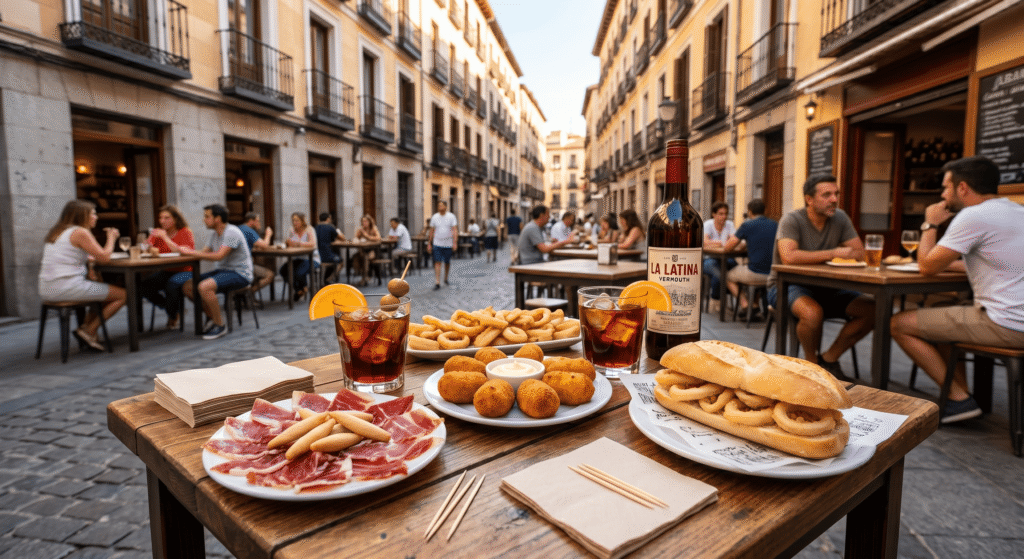
The essential Madrid eating experience — jamón ibérico, croquetas, bocadillo de calamares and a cold caña. La Latina neighbourhood is the best place to start.
16. What should I eat in Madrid?
These are the non-negotiables for a first visit.
- Bocadillo de calamares — a bread roll filled with fried squid rings. The quintessential Madrid street food. Best from the bars around Plaza Mayor. €3–4. Do not leave without having one.
- Tortilla española — potato and onion omelette, slightly runny in the centre when done correctly. Every bar serves it, quality varies enormously. The best versions are made to order, not sitting in a display case.
- Jamón ibérico de bellota — acorn-fed Iberian cured ham. The finest food product Spain produces. Order a ración in a good bar with a glass of red wine. One of those experiences that explains why people love this country.
- Croquetas — bechamel croquettes, most commonly jamón or bacalao (salt cod). A great croqueta is one of the most quietly magnificent things you will eat here.
- Cocido madrileño — Madrid’s signature chickpea, vegetable and meat stew, served in two courses. A winter dish that represents this city better than almost anything. Book a table at La Bola or Malacatín if you are visiting between October and March.
- Churros con chocolate — for breakfast or late at night. The chocolate is thick — more like a dipping sauce than a drink. Chocolatería San Ginés near Sol, open 24 hours, is the classic destination.
→ Wine bars guide · La Latina neighbourhood guide
17. What is a menú del día and should I use it?
Yes — it is the best value meal in Spain and one of the great institutions of Madrid daily life.
The menú del día (menu of the day) is a three-course set lunch served Monday–Friday in most Spanish restaurants, typically from 13:30 to 16:00. By Spanish law it must include: a first course (soup, salad, vegetables), a main course (meat or fish), a dessert or coffee, bread, and a glass of wine, beer or water. Price: €11–16 in a good local restaurant. This is how Madrid’s workers eat lunch every day.
The quality varies by restaurant — the tell is whether the menu is handwritten or printed daily (fresh, good) versus laminated (avoid). In neighbourhoods like Argüelles, Chamberí and Alonso Martínez, the competition between restaurants keeps quality high and prices honest because local workers will not return to a bad one.
This is also how you find the best local restaurants: look for a lunch queue at 14:15 with no tourists in it.
18. Is tap water safe to drink in Madrid?
Yes — Madrid tap water is excellent and safe to drink.
Madrid’s water comes from the Sierra de Guadarrama mountain system and is consistently rated among the cleanest and best-tasting municipal tap water in Spain. You can ask for agua del grifo (tap water) in any bar or restaurant — they are legally required to provide it for free if you ask. Bring a reusable water bottle. Fill it at your hotel. Save money and plastic.
Restaurants will often bring bottled water automatically without asking — this is charged on the bill (€1.50–3). Ask for tap water specifically if you want it free.
🏛️ Culture & Sightseeing
19. Prado, Reina Sofia or Thyssen — which one if I only have time for one?
Prado if you love classical art. Reina Sofia if you want Picasso’s Guernica. Thyssen if you want variety across all periods.
The Prado is one of the greatest art museums in the world — Velázquez, Goya, Titian, Rubens, Bosch, El Greco. The Las Meninas alone is worth the trip. It is a serious, extraordinary museum that rewards slow looking. If you care about painting as a discipline, the Prado.
The Reina Sofia contains Picasso’s Guernica — the most important 20th-century Spanish painting and one of the most powerful anti-war statements in the history of art. The museum also covers Dalí and Miró and 20th-century Spanish art broadly. If you want the 20th century, the Reina Sofia.
The Thyssen-Bornemisza covers everything from the 13th century to Pop Art — the most varied of the three. Less overwhelming than the Prado, more accessible as a single visit. Good if your companion has different tastes or you have limited time.
The Paseo del Arte card (€32.80) covers all three and saves €7.20 versus individual entry — valid for one year, so you do not have to visit all three in one trip.
→ Prado Museum guide · Paseo del Arte card
20. What are the most overrated things in Madrid?
An honest local’s list.
- Mercado de San Miguel: Beautiful space, mostly mediocre food at double the normal price. A tourist food hall. Go to the Mercado de Antón Martín or the Mercado de Maravillas instead for how Madrid actually shops and eats.
- The restaurants immediately on and around Puerta del Sol: Without exception, overpriced and underdelivering. Walk two streets in any direction for the same food at half the price and double the quality.
- The City Tour hop-on hop-off bus: Useful for orientation if you have never visited before, but it gives you a tourist’s-eye view of a city that rewards being walked and metroed. The routes avoid the neighbourhoods where Madrid is actually interesting.
- Buying a flamenco show in the street: Touts around Sol sell tickets to “authentic flamenco shows.” Most are low-quality productions for tourists. For real flamenco, go to Cardamomo, Corral de la Morería or — best of all — the free flamenco at Veranos de la Villa in the IES San Isidro cloister in summer.
21. What are the most underrated things in Madrid?
The things locals love that most tourists never find.
- Museo del Romanticismo (Calle San Mateo, Justicia) — A perfectly preserved 19th-century palace with 17,000 objects and a secret garden café. Free on Saturday afternoons. Almost nobody goes. Justicia neighbourhood guide →
- Ermita de San Antonio de la Florida — A tiny chapel with Goya’s extraordinary 1798 frescos on the ceiling. Goya is buried underneath them. Free. Almost always empty. One of the greatest small museums in Europe.
- Parque del Oeste rose garden — 600 varieties of roses at peak bloom in May–June. Less crowded than Retiro, equally beautiful. Free. Argüelles guide →
- La Venencia (Calle Echegaray, Huertas) — A sherry bar from 1922, unchanged, orders chalked on the bar, photos forbidden, sherry from the barrel from €1.90. Wine bars guide →
- Sunday morning vermouth in La Latina — The ritual that makes Madrid Sundays feel like nowhere else in the world. Cold vermouth, olives, sunshine, nobody in a hurry. Start around 12:30 on Calle Cava Baja or Calle Almendro.
⚙️ Practical Essentials
22. What should I pack for Madrid?
The essentials that people forget.
- European Type C plug adaptor — Spain uses 220V/50Hz with Type C/E/F sockets. US and UK plugs do not fit. Buy before you leave.
- Comfortable walking shoes — broken in before arrival. Madrid’s historic centre is cobblestone. 12–15km walking days are normal for first-time visitors. This is the single most important packing decision.
- A light layer for evenings — even in summer. Air conditioning in Spanish restaurants and museums is aggressive. And Madrid evenings can be cooler than the daytime suggests, especially in spring and autumn.
- Sun cream SPF50 for summer — Madrid sits at 650 metres altitude, UV is stronger than at sea level.
- A crossbody bag — front-facing clasp, for pickpocket prevention.
- Cash (€50–100) — neighbourhood tapas bars, markets and some restaurants are cash-only.
→ Full logistics guide for US visitors
23. Do I need a SIM card or eSIM for Madrid?
If you are EU-based: your home plan works in Spain. Non-EU visitors: get an eSIM before you leave.
EU visitors: EU roaming regulations mean your French, German, Italian or other EU mobile plan works in Spain at your home rates. No action needed.
UK visitors: Check your carrier — most UK plans include Spain at no extra charge, but some charge daily roaming fees. Verify before travelling.
US/non-EU visitors: Buy an eSIM before departure. Airalo (10GB Spain for ~$15) or Holafly (unlimited data from ~$51/15 days) are the best options. Install before boarding — activation is instant on arrival. Requires iPhone XS (2018) or newer, or a recent Android flagship.
Alternatively, buy a physical Spanish SIM card (Movistar, Orange, Vodafone) at carrier stores in Madrid. You will need your physical passport for registration — Spanish law requires it. Prepaid tourist SIMs with 10–15GB cost €15–25.
→ Full US visitor logistics guide
24. Should I go to Madrid with or without a guided tour?
Both have their place. The honest answer is: one guided tour at the start of your trip, then independent for the rest.
A free walking tour on your first morning (SANDEMANs or similar — tip-based, usually around €10–15) is one of the best investments of time in a first visit. Two hours with a knowledgeable guide contextualises the city’s history, locates you geographically, and surfaces things you would miss on your own. It also tells you immediately which museums, restaurants and experiences that guide personally recommends — which is better than any generic top-ten list.
For the Prado specifically, a guided tour (small group, 2 hours, €35–42) covers the 50 most important works and saves you from the overwhelming experience of wandering 8,000+ paintings without context. Worth it for a first visit.
After that: explore independently. Madrid rewards getting lost in neighbourhoods, stumbling into bars, following streets without a plan.
→ Best tours in Madrid — honest guide
25. What is the one thing you would tell a first-time visitor to Madrid?
Slow down and stay later.
The single biggest mistake first-time visitors make in Madrid is trying to run it like a northern European city — maximising sights per day, eating on schedule, going to bed at a sensible hour. Madrid does not reward that approach.
What Madrid rewards is the opposite: a long lunch that drifts past 16:00. A tapas bar discovered by accident at 22:30 that becomes the highlight of the trip. Sitting in the Retiro with a book on a Tuesday morning when the whole park is quiet. Walking into a neighbourhood you had not planned to visit because the street looked interesting.
The city’s genius is in its daily rhythms — the morning market, the midday vermouth, the long afternoon, the late dinner. Tourists who schedule every hour see the city. Those who slow down and let it find them get to know it. Come with time to spare. Stay later than you planned. You will understand why people who visit Madrid once tend to come back.
Madrid First-Timer Cheat Sheet — Everything at a Glance
| Topic | The answer | More detail |
|---|---|---|
| How many days | 3 minimum · 4–5 ideal · 7 for museum lovers | Q1 above |
| Best time | April–May or Sept–Oct · June also great | Q2 above |
| Daily budget | €60–80 budget · €120–180 mid-range | Q3 above |
| Best neighbourhood | La Latina · Malasaña · Chueca · Sol | Q4 above |
| Book in advance | Prado ✅ · Royal Palace ✅ · Hotel ✅ | Q5 above |
| Airport to city | Metro L8 + €3 supplement OR taxi €33 flat | Full guide |
| Transport card | Tarjeta Multi €2.50 + 10-trip €12.20 | Q7 above |
| English spoken? | Yes in tourist areas · Limited in neighbourhood bars | Q10 above |
| Dinner time | 21:00–23:30 (NOT before 20:30) | Q11 above |
| Tipping | Optional · €1–2/person at most · Not American style | Q12 above |
| Safety | Very safe · Watch for pickpockets at Sol, metro, Rastro | Q14 above |
| Tap water | Safe and delicious · Ask for agua del grifo | Q18 above |
| Museum pick | Prado (classical) · Reina Sofia (Guernica) · Thyssen (variety) | Q19 above |
| Emergency number | 112 (police, ambulance, fire) | Q14 above |
| Plug adaptor | Type C · 220V · Buy before departure | Q22 above |
The best starting point for planning your Madrid trip: Use this FAQ to answer the big questions, then dive into the specific guides below for each topic. All linked throughout this post — every internal link goes to a full guide written by the same local, with current 2026 prices and verified information.

 17°C
17°C - Temperature
- Precipitation
- Rain Chance
- Wind
- Humidity
- Pressure