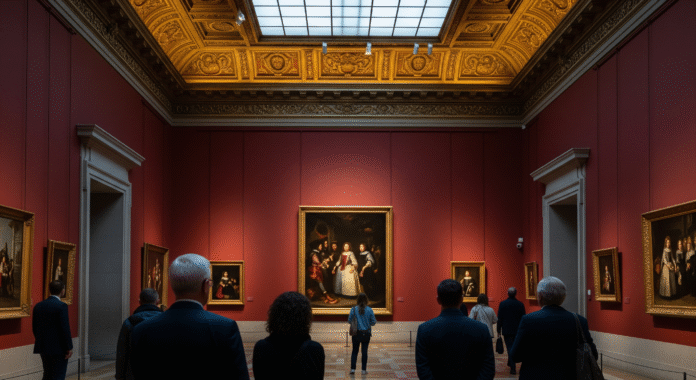
Stand in front of Velázquez’s Las Meninas in the Prado Museum and you’ll understand why people travel across the world to visit this place. The painting is enormous – over 10 feet tall – and impossibly complex. Velázquez painted himself painting. The king and queen appear only as reflections. The perspective makes you, the viewer, seem to be standing where the royal couple stood. It’s been called “the theology of painting,” and standing before it is genuinely transformative.
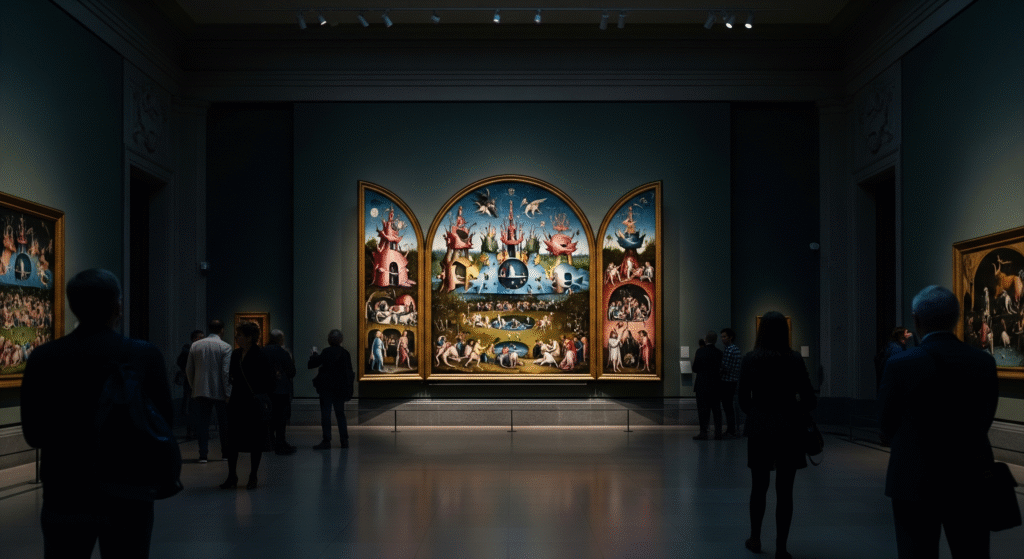
But here’s the thing about the Prado: Las Meninas is just one masterpiece among thousands. Goya’s Black Paintings – dark, disturbing, profound – cover an entire room. Bosch’s Garden of Earthly Delights presents a triptych so detailed you could study it for hours and keep discovering new elements. El Greco’s elongated figures reach toward heaven. Rubens’ canvases explode with baroque energy.
The Museo del Prado holds the world’s finest collection of Spanish art, plus exceptional Flemish, Italian, and Dutch masters. It’s one of Europe’s greatest museums, drawing nearly 3 million visitors annually. And unlike some museums where you shuffle through seeing distant artworks behind barriers, here you’re close to everything – close enough to see brushstrokes, to understand technique, to feel the power of art that has endured for centuries.
I’ve visited the Prado dozens of times – during free hours when crowds pack the galleries, early morning when you can stand alone with masterpieces, guided tours where experts reveal hidden details. I’ve rushed through in an hour and lingered for entire afternoons. And I’ve learned that most visitors make the same mistakes: they arrive without a plan, they skip the audio guide, they spend too much time wandering and not enough with the essential works, and they never discover that the Prado contains far more than the famous pieces everyone knows.
So let me show you how to visit Spain’s greatest museum properly. What you absolutely must see, how to avoid the crowds, whether free hours are worth it, and why this palace of art deserves a central place in your Madrid visit.
Understanding the Prado Museum
Full name: Museo Nacional del Prado (Prado National Museum)
Founded: 1819 (building completed 1785)
Architect: Juan de Villanueva (neoclassical design)
Collection: 8,600+ paintings, 700+ sculptures, plus drawings, prints, decorative arts
On display: About 1,300 works (collection too large to show simultaneously)
Specialty: Spanish painting (world’s finest), plus Flemish, Italian, Dutch masters
Why it exists: Originally designed as a Natural History Cabinet, King Ferdinand VII repurposed the building to house the Spanish Royal Collection’s art. What you see represents centuries of Spanish monarchs’ collecting preferences – they didn’t collect representatively, they collected their favorite artists in depth. That’s why the Prado has 60+ Rubens, 50+ Titian, dozens of Velázquez and Goya. It’s a museum of painters, not painting styles.
UNESCO Status: Part of the “Paseo del Prado and Buen Retiro, Landscape of Light” World Heritage designation (2021)
Tickets, Prices & Free Hours
Regular Tickets
General admission: €15
Reduced: €7.50 (students under 25, seniors 65+, large families)
FREE: Under 18, students 18-25 (art/humanities), disabled visitors + companion
Where to buy:
- Online: museodelprado.es (official, €1 booking fee, choose time slot)
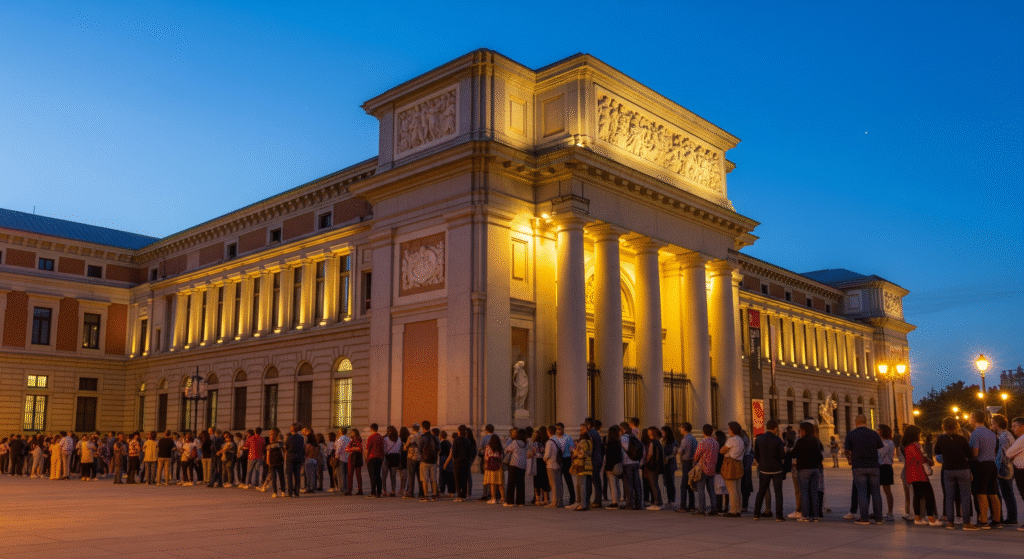
- On-site: Ticket offices (can have 30-60 minute waits, especially midday)
- Skip-the-line tours: €25-45 (includes guide, priority entry)
Pro tip: Book online with specific time slot – guarantees entry, avoids lines.
FREE Entry Hours
When:
- Monday-Saturday: 6-8 PM (last entry 7:30 PM)
- Sunday & holidays: 5-7 PM (last entry 6:30 PM)
Strategy:
- Arrive 30-45 minutes before free hours begin (lines form early)
- You get 2 hours maximum in museum
- Temporary exhibitions NOT included during free hours
- Choose what you want to see beforehand – 2 hours isn’t enough for everything
Is it worth it? If you’re on a budget: absolutely. If you want a comprehensive visit: pay for full admission and come earlier when less crowded. Free hours can be PACKED.
Hours & Timing
Open:
- Monday-Saturday: 10 AM – 8 PM
- Sunday & holidays: 10 AM – 7 PM
Last entry: 30 minutes before closing
Gallery evacuation: 10 minutes before closing
Closed: January 1, May 1, December 25
Best times to visit:
- Quietest: Weekday mornings right at 10 AM opening
- Good: Late afternoon 4-6 PM (before free hours)
- Busiest: Midday 12-2 PM, weekends, free hours, July-August
- Seasons: Spring (April-May) and fall (Sept-Oct) busiest but best weather
The Absolute Must-See Masterpieces
The Prado has thousands of paintings. You can’t see everything. Here are the works you absolutely cannot miss:
Las Meninas – Diego Velázquez (Room 012)
Why it’s essential: Often called the greatest painting ever created. Velázquez painted the Infanta Margarita and her maids (meninas), but included himself painting, the king and queen reflected in a mirror, and created a complex meditation on art, reality, and perspective.
What to notice: The light, the space, the way Velázquez looks directly at you, the mirror reflection, the open door in back. This painting has inspired artists and philosophers for 350+ years.
Location: Ground floor, central galleries. Always crowded – be patient for a good viewing spot.
The Garden of Earthly Delights – Hieronymus Bosch (Room 056A)
Why it’s essential: A surreal triptych depicting paradise, earthly pleasures, and hell. Painted around 1500, it’s so detailed and bizarre it still confounds interpretation. Bosch’s imagination created fantastical creatures, impossible scenes, and imagery that influenced surrealists 400+ years later.
What to notice: The triptych format (left panel = Garden of Eden, center = earthly delights, right = hell). Look closely at individual figures – there’s always something stranger to discover.
The Third of May 1808 – Francisco Goya (Room 064)
Why it’s essential: One of history’s most powerful war paintings. Depicts Spanish civilians being executed by Napoleon’s forces during the Peninsular War. The composition, the light, the expressions – this influenced political art for centuries.
Pair with: The Second of May 1808 (companion piece showing the uprising)
What to notice: The central figure in white with arms raised like crucifixion, the faceless firing squad, the brutal honesty of war.
Goya’s Black Paintings (Room 067)
Why they’re essential: Fourteen nightmarish paintings Goya created on the walls of his house when he was old, deaf, and disillusioned. “Saturn Devouring His Son” is the most famous – disturbing, powerful, unforgettable.
What to notice: These weren’t meant for public viewing. Goya painted them for himself. They represent art at its most personal and darkest.
The Nobleman with His Hand on His Chest – El Greco (Room 008B)
Why it’s essential: Exemplifies El Greco’s spiritual, elongated style. The dignity, the hand gesture, the penetrating gaze – this is Spanish nobility captured perfectly.
The Three Graces – Peter Paul Rubens (Room 029)
Why it’s essential: Rubens at his most baroque – three nude graces in classical pose, painted with his characteristic fleshy realism and dynamic composition.
Additional Must-Sees:
Titian: Emperor Charles V on Horseback
Raphael: The Cardinal
Caravaggio: David with the Head of Goliath
Dürer: Self-Portrait
Fra Angelico: The Annunciation
Mantegna: The Death of the Virgin
How to Visit: Suggested Routes
The Prado offers official routes of different lengths. Here’s my practical advice:
If You Have 1 Hour (Highlights Only)
Focus: Spanish masters Ground Floor
Route: Las Meninas → Goya’s Black Paintings → The Third of May → Garden of Earthly Delights
Strategy: Skip everything else, see these essentials well rather than rushing through more
If You Have 2-3 Hours (Recommended Minimum)
Add: El Greco, Rubens, Italian masters
Strategy: Follow the museum’s recommended 2-hour route (downloadable from website), but allow extra time for crowded rooms
If You Have Half Day (Ideal)
Do: Comprehensive Spanish art + selected Italian/Flemish
Strategy: Start with must-sees, then explore rooms with artists you’re interested in. Take breaks – museum fatigue is real.
Practical Visiting Tips
Audio Guide or Guided Tour?
Audio guide (€4): Covers 50+ major works with detailed commentary. Lets you go at own pace. Essential if self-guiding.
Official guided tours (€10-15 over admission): 90 minutes, Prado-approved guides, deeper insights. Good for first visit.
Private tours (€35-45): Small groups, skip-the-line, expert art historians. Best experience but pricey.
My recommendation: First-time visitors benefit enormously from a guide (official or audio). Return visits can be self-guided.
What to Bring / Not Bring
Bring:
- Comfortable shoes (marble floors, lots of standing)
- Water bottle (can refill inside)
- Light jacket (air-conditioned, can be cool)
NOT allowed:
- Large bags/backpacks (free lockers available, bags over 40x40cm must be stored)
- Food/drinks (café inside for purchases)
- Tripods, selfie sticks
- Flash photography (NO photography currently allowed in most areas – check current rules)
Accessibility
Fully wheelchair accessible with elevators between floors. Wheelchairs available free on request. Most rooms accessible.
Museum Fatigue
Reality: The Prado is exhausting. You can’t see everything in one visit.
Strategy:
- Take breaks in the Hall of the Muses Garden (peaceful outdoor courtyard)
- Don’t try to see everything – choose quality over quantity
- Sit when you can – benches throughout museum
- Consider splitting visit across two shorter sessions rather than one marathon
The Building Itself
Don’t overlook the architecture – Juan de Villanueva’s neoclassical design (1785) is beautiful:
Villanueva Façade: Grand Doric columns, perfect symmetry, representing Enlightenment ideals
Jerónimos Wing: Modern 2007 addition by Rafael Moneo, elegantly incorporating a restored 17th-century cloister
Statues: Bronze monuments to Goya and Velázquez stand as guardians outside
Combining with Other Attractions
The Golden Triangle of Art: The Prado is one of three world-class museums within walking distance:
- Prado (Spanish, Flemish masters)
- Reina Sofía (modern/contemporary, 10-min walk south)
- Thyssen-Bornemisza (private collection spanning centuries, 5-min walk)
Paseo del Arte Pass: €40-60, valid one year, includes all three museums plus skip-the-line. Worth it if visiting all three.
Nearby:
- Retiro Park (5-min walk)
- Palacio de Cibeles (10-min walk)
- Barrio de las Letras (Literary Quarter, adjacent)
- Royal Botanical Garden (next door, €6)
Suggested Day Itineraries
Art-Focused Day:
- 10 AM: Prado (2-3 hours)
- 1 PM: Lunch in Barrio de las Letras
- 3 PM: Retiro Park walk
- 5 PM: Reina Sofía (free hours) or Thyssen
Balanced Cultural Day:
- Morning: Retiro Park
- Noon: Early lunch
- 2 PM: Prado (avoid midday crowds)
- 5 PM: Walk Barrio de las Letras
- 6 PM: Tapas in La Latina
What Makes the Prado Special
Depth over breadth: Rather than one work from many artists, the Prado has comprehensive collections from key masters. You see Velázquez’s evolution, Goya’s range, the full scope of Spanish painting.
Royal taste: This collection reflects what Spanish kings loved, giving you insight into royal patronage and European power dynamics.
Spanish focus: Nowhere else can you see Spanish painting like this – it’s the most comprehensive collection in existence.
Quality: The masterpiece density is extraordinary. Room after room contains works that would be highlights in other museums.
Tips for Maximizing Your Visit
1. Plan ahead: Know what you want to see. Download floor plans from museodelprado.es
2. Start early: 10 AM opening = smaller crowds, fresh eyes
3. Prioritize: See must-sees first when you’re energetic, explore lesser galleries after
4. Read labels: The Prado’s English labels provide excellent context
5. Take breaks: Garden courtyard, café, or just sitting in galleries
6. Return: If you love it, come back. €15 is reasonable for a second focused visit
7. Skip gift shop rush: It’s there when you leave, but crowded post-visit
Final Thoughts
Here’s what I want you to understand about the Prado: this isn’t just a museum. It’s the soul of Spanish art, the greatest collection of Spanish painting ever assembled, and one of Europe’s absolute art treasures.
When you stand before Las Meninas, you’re seeing the same painting Spanish royalty commissioned and viewed. When you confront Goya’s Black Paintings, you’re experiencing art at its most raw and personal. When you study Bosch’s Garden of Earthly Delights, you’re encountering imagination that still defies full explanation 500+ years later.
The Prado rewards preparation and time. Don’t rush. Don’t try to see everything. Choose your must-sees, get the audio guide or join a tour, and give yourself permission to skip rooms that don’t interest you so you can spend quality time with works that do.
Art museums can feel overwhelming. The Prado IS overwhelming – there’s too much great art to process in one visit. But that’s okay. See the essentials beautifully rather than everything poorly.
And remember: €15 (or free during designated hours) gives you access to some of humanity’s greatest artistic achievements. That’s not expensive. That’s a gift.
Book your ticket. Plan your route. Start early or use free hours strategically. See Las Meninas, Goya’s darkness, Bosch’s surrealism, and whatever else calls to you.
The Prado has waited 200+ years. The art has endured centuries. Take your time with it.
FAQs
Q1: Is Prado Museum free?
A: Prado Museum offers FREE entry Mon-Sat 6-8 PM, Sunday/holidays 5-7 PM (last entry 30 min before). Otherwise €15 general, €7.50 reduced. Free for under-18, students 18-25 in arts/humanities, disabled + companion. Temporary exhibitions not included during free hours. Arrive 30-45 min early for free entry – lines form quickly.
Q2: Is Prado Museum worth visiting?
A: Absolutely! Prado holds world’s finest Spanish art collection plus exceptional Flemish/Italian/Dutch masters. Must-see masterpieces: Velázquez’s Las Meninas, Goya’s Black Paintings, Bosch’s Garden of Earthly Delights. Nearly 3 million annual visitors. €15 entry reasonable for 2-3 hours with some of humanity’s greatest art. Essential Madrid experience.
Q3: How much are Prado Museum tickets?
A: Prado tickets €15 general admission, €7.50 reduced (students under-25, seniors 65+). FREE for under-18, art/humanities students 18-25, disabled + companion. FREE hours Mon-Sat 6-8 PM, Sun 5-7 PM. Audio guide +€4. Guided tours €25-45 include skip-the-line. Book online (€1 fee) for guaranteed time slot.
Q4: What time is Prado Museum free?
A: Prado free hours: Monday-Saturday 6-8 PM (last entry 7:30 PM), Sunday/holidays 5-7 PM (last entry 6:30 PM). Free entry excludes temporary exhibitions. Arrive 30-45 minutes before free hours begin – queues can be 30-60 minutes. Maximum 2 hours in museum during free entry.
Q5: What to see at Prado Museum?
A: Must-see Prado masterpieces: Las Meninas (Velázquez, Room 012), Garden of Earthly Delights (Bosch, Room 056A), The Third of May 1808 (Goya, Room 064), Goya’s Black Paintings (Room 067), The Nobleman with Hand on Chest (El Greco), The Three Graces (Rubens). Allow minimum 2-3 hours.
Q6: How long does Prado Museum take?
A: Minimum 2-3 hours for essential masterpieces. Highlights only: 1 hour. Comprehensive visit: half-day (4-5 hours). Museum fatigue real – don’t try seeing everything. Focus on must-sees (Las Meninas, Goya, Bosch) plus personal interests. Take breaks in Hall of Muses Garden.
Q7: Should I get audio guide at Prado?
A: Yes, audio guide (€4) highly recommended for first-time visitors. Covers 50+ major works with detailed commentary, historical context, helps understand what you’re seeing. Alternatively, guided tours (€25-45) include skip-the-line and expert insights. Return visitors can explore self-guided.
Q8: What’s better Prado or Reina Sofia?
A: Different focus: Prado = Spanish Golden Age, Flemish, Italian masters (12th-early 20th century). Reina Sofía = modern/contemporary (20th-21st century), Picasso’s Guernica. Both excellent. Art history lovers: Prado. Modern art fans: Reina Sofía. Ideal: visit both (Golden Triangle Pass covers both + Thyssen).
Q9: When is best time to visit Prado?
A: Best times: Weekday mornings right at 10 AM opening (quietest), late afternoon 4-6 PM before free hours. Avoid: midday 12-2 PM (busiest), weekends, free hours (very crowded), July-August peak summer. Spring (April-May) and fall (Sept-Oct) busiest seasons but best weather.
Q10: Where is Prado Museum located?
A: Prado Museum: Paseo del Prado, central Madrid. Metro: Banco de España (Line 2) or Atocha (Line 1). Walking: 10 min from Sol, 5 min from Retiro Park, adjacent to Barrio de las Letras. Part of UNESCO World Heritage “Paseo del Prado and Buen Retiro” designation (2021).

 18°C
18°C - Temperature
- Precipitation
- Rain Chance
- Wind
- Humidity
- Pressure





, must-see Las Meninas, Goya's Black Paintings, Bosch. Hours, tips, masterpieces. 2026 guide!)