Last Updated on May 6, 2026 by Jaime
By Jaime · Mars 16, 2026 · 9 min read
Stand in the Plaza de la Armería courtyard and look up at the Royal Palace of Madrid – this honey-colored stone behemoth rising four stories above you with over 3,000 rooms inside. It’s twice the size of Buckingham Palace. Three times larger than Versailles. One of Europe’s most spectacular royal residences, and somehow, most tourists spend barely an hour here before rushing off.
That’s a mistake.
The Royal Palace (Palacio Real) deserves time. Not because it’s big – though with 135,000 square meters it certainly is – but because the rooms you can visit represent Spanish royal history at its most lavish. Throne Room with red velvet and crystal chandeliers. Porcelain Room covered floor-to-ceiling in porcelain panels from the Royal Factory. Royal Armory with centuries of weapons and armor. Stradivarius violins in the music room. Tiepolo frescoes on ceilings. Goya tapestries on walls.
This isn’t a functioning palace – Spain’s royal family lives in the more modest Palacio de la Zarzuela outside Madrid. But the Royal Palace remains their official residence for state ceremonies, and when you visit, you’re walking through rooms where Spanish kings lived, governed, held court, and shaped European history for over two centuries.
I’ve visited the Royal Palace more times than I can count – bringing visiting friends, returning for special exhibitions, discovering rooms I’d somehow missed before. And I’ve learned that most people make the same mistakes: they arrive mid-afternoon when crowds peak, they skip the audio guide, they rush through without understanding what they’re seeing, and they never make it to the gardens.
So let me show you how to visit properly. What to see, what to skip, how to avoid the crowds, and why this palace – often overshadowed by Madrid’s art museums – deserves a prominent place on your Madrid itinerary.
Understanding the Royal Palace
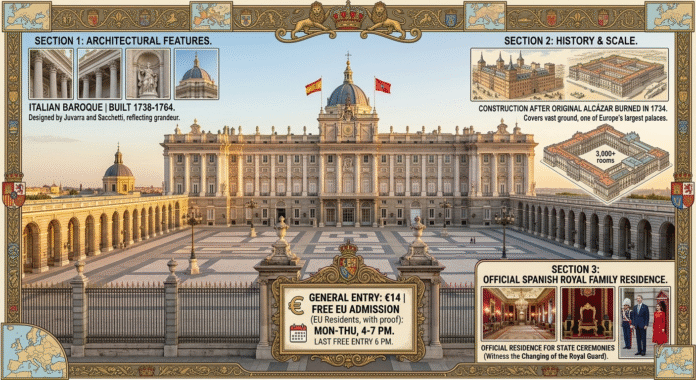
Full name: Palacio Real de Madrid (Royal Palace of Madrid)
Built: 1738-1755 (construction began), officially inaugurated 1764
Architect: Filippo Juvarra and Giovanni Battista Sacchetti (Italian baroque/neoclassical)
Commissioned by: King Philip V after the previous Alcázar burned down (1734)
Size: 135,000 square meters, over 3,000 rooms (50 open to public)
Current use: Official residence of Spanish Royal Family, state ceremonies (family lives elsewhere)
Style: Italian baroque with neoclassical elements
Why it exists: The original Alcázar (Moorish fortress, then royal palace used by Habsburg kings) burned in 1734. Philip V, Spain’s first Bourbon king, wanted something grander – a palace to rival Versailles. What he got was this enormous Italian-inspired baroque masterpiece.
Who lived here: Kings from Charles III (first to live in it, 1764) through Alfonso XIII (left in 1931 when republic declared). No monarch has lived here since, though it remains the official residence for ceremonies.
Visiting Practicalities
Tickets & Prices
Entry: €14 general, €7 reduced (students 5-16, seniors 65+), FREE under 5
Audio guide: +€4 (highly recommended – explains what you’re seeing)
Guided tour: +€10-15 (expert commentary, skip-the-line)
FREE entry times:
- Monday-Thursday 5-7 PM (April-September) or 4-6 PM (October-March)
- EU citizens and residents only (bring ID/residence proof)
- Subject to availability – arrive early, spaces limited
- Online booking recommended even for free entry
Where to buy:
- Online: patrimonionacional.es (official site, €1 booking fee but guarantees entry)
- On-site: Ticket office at entrance (can have long lines)
- Skip-the-line tours: GetYourGuide, Viator (include guide, €25-35)
Pro tip: Book online for specific time slot to skip ticket lines. If visiting during free hours, book those time slots online too – they fill up!
Hours
April-September:
- Monday-Saturday 10 AM – 7 PM
- Sunday 10 AM – 4 PM
October-March:
- Monday-Saturday 10 AM – 6 PM
- Sunday 10 AM – 4 PM
Last entry: 1 hour before closing
Time needed: 2-3 hours minimum (more with gardens)
Closed:
- Official ceremonies (check calendar – happens occasionally)
- Some holidays
- January 1, January 6, May 1, December 24, December 25
Getting There
Address: Calle de Bailén s/n, 28071 Madrid
Metro: Ópera (Lines 2, 5, R) – 2-minute walk
Bus: Multiple lines to Palacio Real stop
Walking: From Sol (10 min), from Plaza Mayor (8 min)
Entrance: Currently via archway on Calle Bailén (corner Calle Requena) due to renovation work
The Must-See Rooms & Areas
The palace has over 3,000 rooms. You’ll visit about 50. Here are the unmissable highlights:
The Grand Staircase (Escalera Principal)
Your visit begins with WOW. This monumental staircase – single-flight marble with ornate balustrade – sets the tone immediately. Look up at the ceiling fresco by Corrado Giaquinto depicting “The Triumph of Religion and the Church.”
The marble, the proportions, the way light falls through windows – this isn’t just a staircase, it’s a statement: Spain is powerful, wealthy, cultured.
Throne Room (Salón del Trono)
The palace’s most spectacular room. Enormous red velvet and gold throne beneath a ceiling fresco by Tiepolo (“The Glorification of the Spanish Monarchy”). Crystal chandeliers. Venetian mirrors. Lions guarding the thrones.
This is where Spanish kings received foreign ambassadors, where official ceremonies still happen. The current king uses this room for state functions.
Stand in the center, turn slowly 360°, and let the opulence sink in. This room alone justifies the visit.
Hall of Columns (Salón de Columnas)
Where Spanish kings held banquets and balls. Red marble Ionic columns. Tapestries. Frescoes. This room has hosted everyone from Napoleon to modern heads of state.
Now used for official dinners when Spain hosts foreign leaders. Imagine hundreds of people in formal dress, orchestras playing, candlelight reflecting off marble.
Porcelain Room (Sala de Porcelana)
Prepare for sensory overload. This small room is entirely covered – walls, ceiling, everything except the floor – in porcelain panels from the Buen Retiro Royal Factory (1760s).
Chinese-inspired designs, incredibly detailed, absolutely unique. Similar rooms exist in Naples and Madrid’s Aranjuez Palace, but this is the most impressive.
Photography here captures it, but standing inside surrounded by this porcelain explosion is something else entirely.
Gasparini Room (Salón de Gasparini)
Charles III’s dressing room, designed by Mattia Gasparini. Rococo excess at its finest – silk walls embroidered in silver and gold, intricate stucco ceiling, mirrors, the whole room dripping with decoration.
This is where the king dressed each morning in an elaborate public ceremony. Imagine the ritual, the courtiers watching, the protocol.
Royal Chapel (Capilla Real)
Active chapel where masses are still celebrated. Dome painted by Corrado Giaquinto. Black and red marble. Dramatic, intimate, beautiful.
Not the palace’s largest room, but spiritually significant. This is where royal baptisms, weddings, and funerals happened.
Royal Armory (Armería Real)
One of the world’s finest armor collections, in a separate building but included in your ticket.
See armor worn by Charles V (Holy Roman Emperor), Philip II, child-sized armor for royal princes, tournament armor, weapons from across centuries. The craftsmanship is extraordinary – these aren’t just functional, they’re art.
If you like history, military history, or craftsmanship, spend serious time here.
Royal Pharmacy (Real Farmacia)
Often overlooked but fascinating. Hundreds of ceramic jars, distillation equipment, prescriptions for royal family members. Shows how Spanish royalty treated illness in the 18th-19th centuries.
Small, quick (15 minutes), but interesting historical perspective.
State Dining Room (Comedor de Gala)
Enormous table that can seat 140 guests, set with royal porcelain, crystal, and silver. This room is still used when Spain hosts state dinners.
The table setting shows exactly how formal dinners were arranged, every detail prescribed by royal protocol.
The Gardens
Most visitors skip these. Don’t.
Sabatini Gardens (Jardines de Sabatini)
Location: North side of palace
Style: Neoclassical, geometric design
Access: Free, accessible from street or palace
Best for: Photos of palace facade, peaceful walking
Formal gardens with geometric hedges, fountains, and excellent palace views. Less impressive than other Madrid parks but pleasant and quiet.
Campo del Moro Gardens
Location: West side of palace (behind/below)
Style: English romantic garden
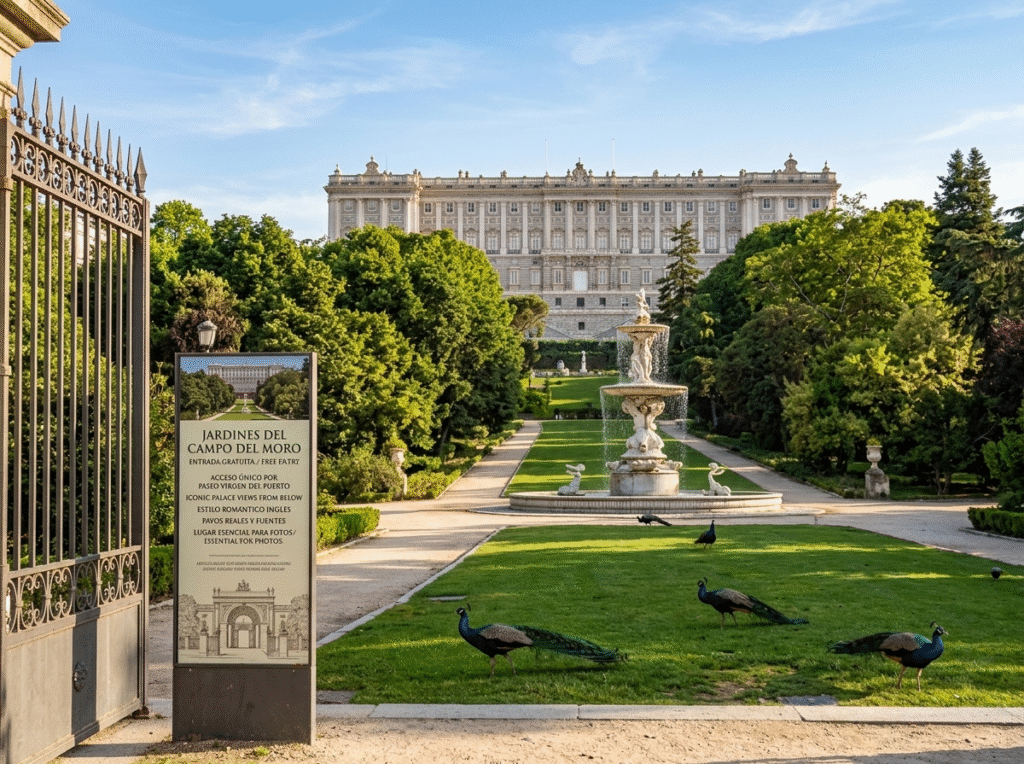
Access: Free, separate entrance (Paseo de la Virgen del Puerto)
Best for: THE BEST palace views, romantic atmosphere, peacocks
This is the secret. Descend to Campo del Moro and walk the paths for the iconic palace view – the full facade rising above you with gardens in foreground. Peacocks wander. Fountains and statues dot the landscape.
Come here for photos, for quiet, for the perspective of seeing the palace from below rather than inside it.
Hours: Daily 10 AM – 6/8 PM (seasonal)
What to Skip (If You’re Short on Time)
Not everything in the palace is equally interesting. If you have limited time:
Skip or rush through:
- Some of the smaller antechambers (beautiful but repetitive after a while)
- Crown Prince’s rooms (nice but less spectacular than main rooms)
- Some hallway galleries (unless you love tapestries)
Prioritize:
- Grand Staircase
- Throne Room
- Porcelain Room
- Gasparini Room
- Royal Armory
- Campo del Moro gardens
Practical Visiting Tips
Best Times to Visit
Quietest:
- Weekday mornings right at opening (10 AM)
- Late afternoon 1-2 hours before closing
Busiest:
- Midday (12-2 PM)
- Weekends
- July-August peak summer
- Free entry hours (arrive 45+ min early)
Best seasons:
- Spring (April-May): Perfect weather, gardens blooming
- Fall (September-October): Fewer crowds than summer
- Winter: Quietest but shorter hours
Should You Get Audio Guide or Guided Tour?
Audio guide (€4): Essential if doing self-guided. Explains what you’re seeing, gives historical context, lets you go at your own pace.
Guided tour (€10-15 extra): Better for understanding the full story, includes skip-the-line, expert answers questions. Tours last 1-1.5 hours.
My recommendation: If it’s your first visit, take the guided tour. You’ll understand so much more. Return visits can be self-guided.
Photography
Generally allowed in most rooms (check current rules as they can change). No flash. No tripods.
Best photos:
- Throne Room (the red and gold)
- Grand Staircase (look up)
- Porcelain Room (unique)
- Palace facade from Campo del Moro
Accessibility
Fully wheelchair accessible with elevators. Wheelchairs available on request. Most rooms accessible.
Changing of the Guard
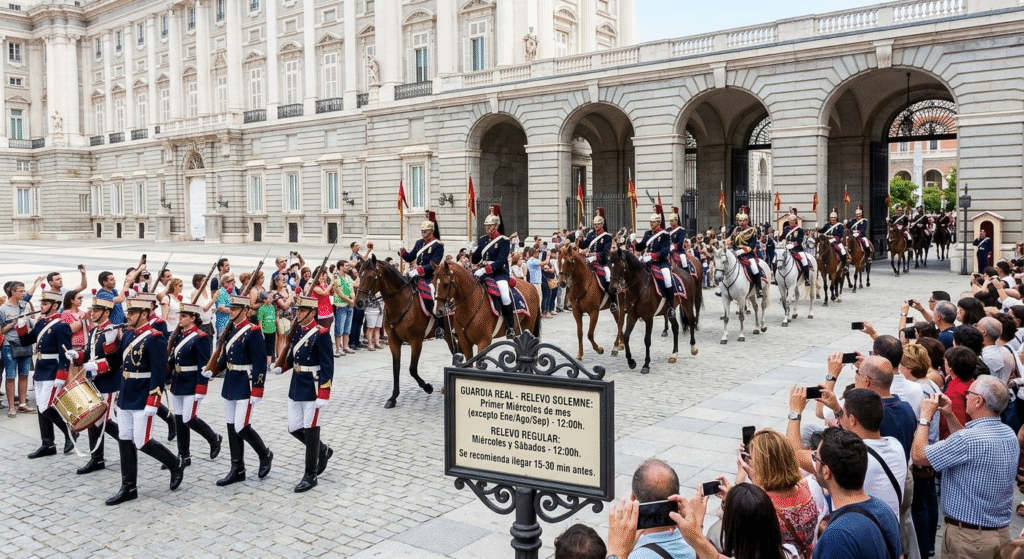
Solemn Changing: First Wednesday of month (except Jan, Aug, Sep)
Regular Changing: Wednesdays and Saturdays
Time: Usually noon
Location: Plaza de la Armería (palace courtyard)
Worth seeing if your visit coincides. Ceremonial, traditional, photo-worthy. Arrive 15-30 min early for good viewing spot.
Combining with Other Sights
The Royal Palace sits in a dense area of attractions:
Almudena Cathedral (5-min walk): Free entry, right next to palace
Plaza Mayor (8-min walk): Historic square
Sabatini Gardens (adjacent): Palace views
Campo del Moro (below palace): Best palace photos
Teatro Real (Opera House, adjacent): Beautiful building
Templo de Debod (15-min walk): Egyptian temple with sunset views
Plaza de Oriente (in front of palace): Statues, cafés with palace views
The Galeria de las colecciones Reales (Gallery of Royal Collections): is an amazing place you can not miss!!
Suggested Itineraries
Morning at the Palace (3-4 hours):
- 10 AM: Enter palace
- 10-12 PM: Palace interior tour
- 12-12:30 PM: Royal Armory
- 12:30 PM: Walk to Campo del Moro
- 1 PM: Lunch in La Latina
Royal Madrid Day:
- 10 AM: Royal Palace
- 1 PM: Lunch near Plaza Mayor
- 3 PM: Almudena Cathedral
- 4 PM: Walk to Templo de Debod for sunset
- 6 PM: Rooftop bar with views
Final Thoughts
Here’s the thing about the Royal Palace: it shouldn’t work. It’s excessive. It’s over-the-top. It’s room after room of gold and silk and crystal and marble and frescoes and tapestries and more gold.
But it absolutely works.
Because this isn’t empty decoration. Every room tells a story – of Spain’s Bourbon dynasty, of diplomatic intrigue, of royal ceremonies, of an empire’s ambitions. The Porcelain Room shows 18th-century craftsmanship at its peak. The Throne Room demonstrates how power and majesty were displayed. The Royal Armory connects you to centuries of Spanish military history.
And unlike many royal palaces where you shuffle through roped-off rooms seeing furniture from a distance, here you’re close to everything. You can see the detail in the porcelain panels, the weave of the tapestries, the expressions in the ceiling frescoes.
My advice? Give it time. Don’t rush. Get the audio guide or take the tour. Start at opening to avoid crowds. See the main palace, then visit the Armory, then walk down to Campo del Moro for the outside perspective.
And when you’re standing in the Throne Room surrounded by red velvet and gold, under Tiepolo’s ceiling celebrating Spanish monarchy, remember: this room still functions. This isn’t a museum. This is where Spain receives the world, where kings and presidents meet, where history continues to happen.
The Royal Palace isn’t just Madrid’s most spectacular building. It’s a living connection to Spanish royal history, and it deserves your attention.
FAQs
FAQs
Yes! Royal Palace Madrid is spectacular – Throne Room, Porcelain Room, Royal Armory rival any European palace. Entry €14 is reasonable for 2-3 hours exploring 50 rooms with Tiepolo frescoes, Goya tapestries, royal collections. Free EU hours Mon-Thu 4-7 PM (Apr-Sep) or 5-7 PM (Oct-Mar). Often compared favorably to Versailles.
Royal Palace tickets: €14 general, €7 reduced (students 5-16, seniors 65+), FREE under 5. Audio guide +€4. Guided tours €25-35 include skip-the-line. FREE EU citizen/resident entry Mon-Thu 5-7 PM (Apr-Sep) or 4-6 PM (Oct-Mar) – bring ID, book online, arrive early.
Minimum 2-3 hours for palace interior + Royal Armory. Add 1 hour for Campo del Moro gardens. Self-guided with audio guide: 2.5 hours. Guided tour: 1.5-2 hours. Full experience including both gardens: 4 hours. Don’t rush – the Throne Room, Porcelain Room, and Armory deserve time.
April-September: Mon-Sat 10 AM-7 PM, Sun 10 AM-4 PM. October-March: Mon-Sat 10 AM-6 PM, Sun 10 AM-4 PM. Last entry 1 hour before closing. Closed some holidays and occasional official ceremonies – check calendar. Free EU entry Mon-Thu 5-7 PM (Apr-Sep) or 4-6 PM (Oct-Mar).
Yes! Royal Palace is fully open to visitors. See Throne Room, Porcelain Room, Grand Staircase, Royal Chapel, State Dining Room, plus Royal Armory and Royal Pharmacy (separate buildings, included in ticket). About 50 of 3,000+ rooms accessible. Still official royal residence for ceremonies but family lives elsewhere.
Changing of Guard: Solemn Changing first Wednesday each month (except Jan, Aug, Sep) at noon, Regular Changing Wednesdays and Saturdays at noon, Plaza de la Armería (palace courtyard). Arrive 15-30 minutes early for good viewing spot. Traditional, ceremonial, worth seeing if visiting those days.
Yes, booking online recommended (patrimonionacional.es, €1 fee). Guarantees specific time slot, skip ticket office lines which can be long especially midday and weekends. Even FREE EU entry hours should be booked online – limited spaces fill up fast. Skip-the-line tours (€25-35) save time.
Yes, audio guide (€4) essential for first-time visitors. Explains what you’re seeing, provides historical context, tells stories behind rooms. Without it, you see beautiful rooms but miss significance. Alternatively, guided tours (€25-35) include expert commentary and skip-the-line. Self-guided return visits can skip audio guide.
Must-see: Grand Staircase (marble, Giaquinto fresco), Throne Room (Tiepolo ceiling, red velvet), Porcelain Room (entirely covered porcelain), Gasparini Room (rococo dressing room), Royal Armory (world-class armor collection), Campo del Moro gardens (best palace views). Allow 2-3 hours minimum.
Royal Palace has richer interior decoration than Versailles – more ornate rooms, better-preserved furnishings, unique Porcelain Room. Versailles has more famous gardens and Hall of Mirrors. Both baroque palaces, similar scale. Many visitors prefer Royal Palace’s opulence and fewer crowds. Royal Palace twice size of Buckingham Palace.

 22°C
22°C - Temperature
- Precipitation
- Rain Chance
- Wind
- Humidity
- Pressure





, must-see Throne Room, Porcelain Room, Royal Armory, Campo del Moro gardens. Times, tips, what to skip!)